

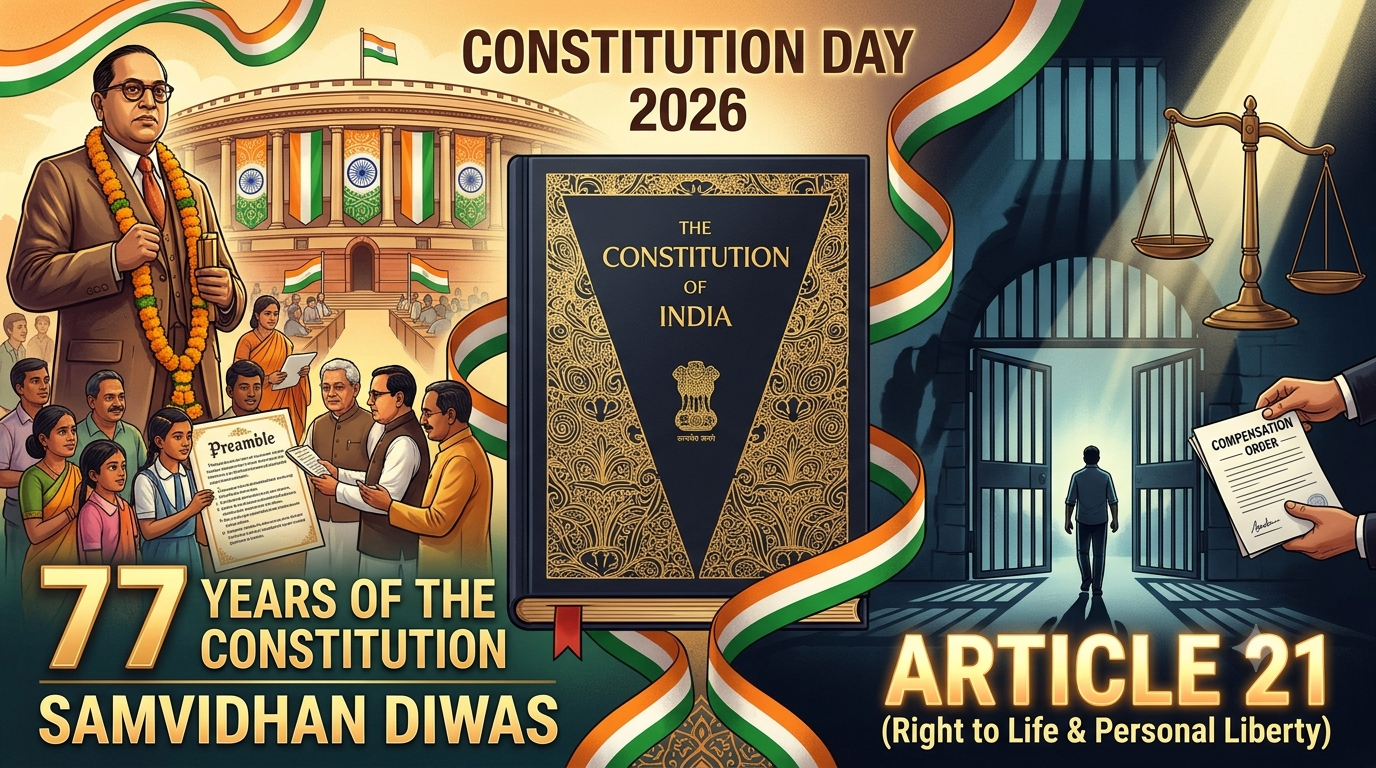
Every November, India pauses to read the Preamble aloud. As the country marks Constitution Day 2026 on November 26—exactly 77 years after the Constituent Assembly adopted the supreme law of the land—a quieter, far more uncomfortable story sits right at the heart of the conversation.
Just ten days before the anniversary, the Supreme Court of India dealt with the case of Devilal Gond, a man from Chhattisgarh who had been acquitted of murder in January 2018. Nobody told the prison. He remained locked inside a jail cell until May 2025, losing more than seven years of his life as an innocent man. On November 16, 2026, the top court ordered the state to pay him ₹30 lakh in public-law compensation for trampling on his fundamental right to personal liberty under Article 21.
That single contrast captures why Constitution day still matters in Indian politics. A constitution is not a museum piece sealed inside a helium-filled glass case. Its real test happens in courtrooms, district jails, polling booths, and parliamentary debates. Here is everything you need to know about the 77th Constitution Day India 2026—from its origins and official events to why Article 21 has once again become the fiercest battleground for citizen rights.
Table of Contents
Why November 26 Matters: Samvidhan Diwas 2026 Theme and History
If you want to understand the Constitution day; Samvidhan Diwas 2026 theme and history, start with a simple distinction: November 26 is about adoption, not commencement. On November 26, 1949, after nearly three years of heated argument, compromise, and legal craftsmanship, the Constituent Assembly formally adopted the Constitution of India. Even the closing lines of the Preamble lock that date into permanent memory.
For decades after independence, the date passed largely inside courtrooms and bar associations as National Law Day. That changed in 2015, during the 125th birth anniversary year of Dr. B.R. Ambedkar. The Union Ministry of Social Justice and Empowerment issued an official notification designating November 26 as Constitution Day—or Samvidhan Diwas—to move constitutional awareness out of lawyers’ chambers and into schools, universities, ministries, and everyday civic life.
For Constitution Day 2026, official and institutional observances centre around closely linked themes:
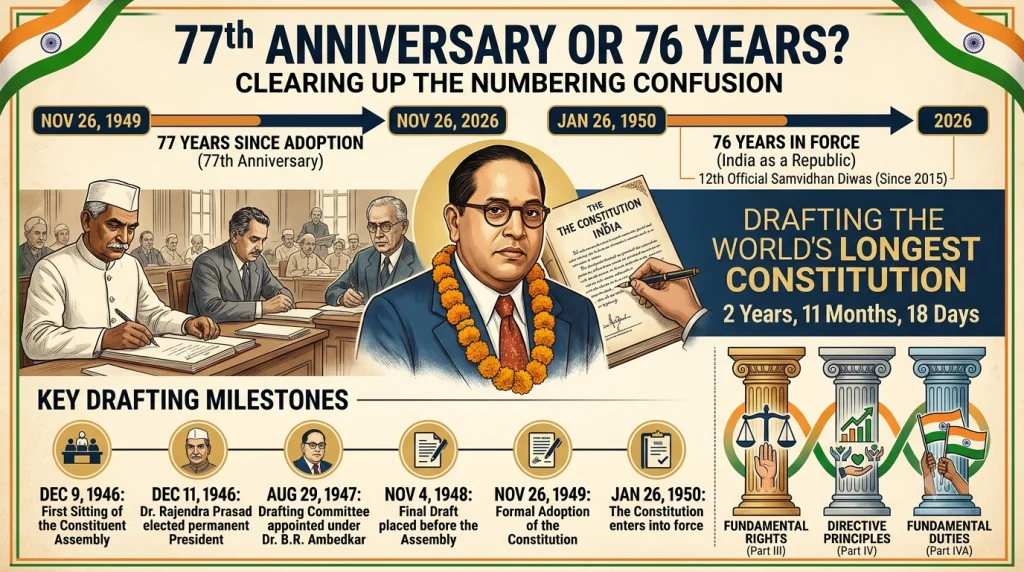
- National Civic Theme: “Hamara Samvidhan, Hamara Swabhiman” (Our Constitution, Our Pride), emphasizing citizen ownership of constitutional values.
- Dr. Ambedkar Foundation Theme: “The Constitution @76: Dr. B.R. Ambedkar’s Constitutional Vision and the Future of Indian Democracy”, examining constitutional morality and institutional accountability.
- Governance and Institutional Focus: Several central agencies and departments are holding seminars under the banner “Constitution Day, 2026: Constitutional Values, Constitutionalism & the Road Ahead”.
Taken together, the messaging signals a clear shift. Observances are no longer limited to reciting historical dates; they actively ask how democratic institutions perform under modern pressures.
77th Anniversary or 76 Years? Clearing Up the Numbering Confusion
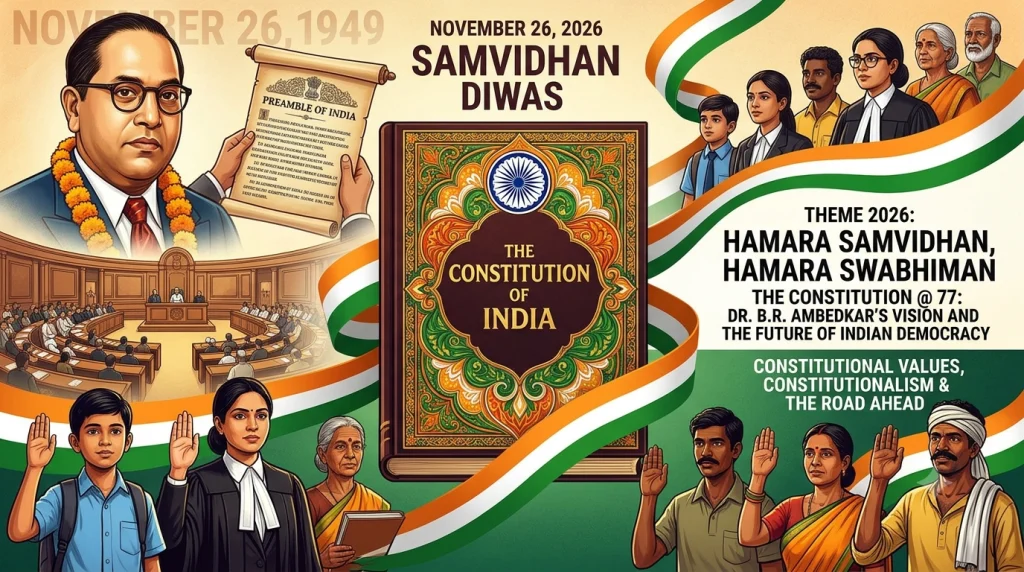
Every November, students preparing for competitive exams—and even newsrooms—trip over the exact count. You will see some headlines call November 26, 2026 the 77th anniversary, while official banners at certain events display “@76”. Both numbers come from real math, just measured from different starting points:
- 77 years since adoption: Count from November 26, 1949 to November 26, 2026, and you get 77 years completed. That makes 2026 the 77th anniversary of adopting the Constitution.
- 76 years in force: Because the Constitution took full effect on January 26, 1950, India completed 76 years as a constitutional republic earlier in 2026. Many government programmes continuing through the calendar year retain the “@76” branding for that reason.
- 12th official Samvidhan Diwas (Constitution Day) : If you count only the years since the Centre’s 2015 notification, 2026 is the twelfth annual observance under the formal title of Constitution Day.
Knowing which yardstick a question uses saves easy marks in UPSC, SSC, and state PCS papers—and keeps civic reporting accurate.
How India’s Constitution Was Built: Key Drafting Milestones and Facts
No single leader wrote India’s founding charter alone, though one jurist shaped its spine more deeply than anyone else. Dr. B.R. Ambedkar chaired the seven-member Drafting Committee, Dr. Rajendra Prasad presided over the Constituent Assembly, and constitutional adviser Sir B.N. Rau prepared the initial working draft after studying democratic charters across the globe.
Drafting the world’s longest written constitution took 2 years, 11 months, and 18 days (often counted as 17 days if the opening day is excluded), running from December 1946 to November 1949. Rather than rushing a fragile newly independent nation into a top-down framework, Assembly members debated minority safeguards, federal power-sharing, emergency clauses, and social reform line by line.
Key milestones along that road include:
- December 9, 1946: The Constituent Assembly holds its first sitting in New Delhi.
- December 11, 1946: Dr. Rajendra Prasad is elected permanent President of the Assembly.
- August 29, 1947: The Assembly appoints the Drafting Committee under Dr. B.R. Ambedkar.
- November 4, 1948: The final draft is placed before the Assembly for clause-by-clause scrutiny.
- November 26, 1949: The Constitution is formally adopted. Certain urgent provisions—covering citizenship, elections, and the provisional parliament—come into force on this very day.
- January 26, 1950: The complete Constitution enters into force, transforming India into a sovereign republic.
What makes the document durable is how it balances three interlocking pillars:
- Fundamental Rights (Part III): Legally enforceable guarantees of equality, free expression, religious freedom, and personal liberty that protect individuals from state excess.
- Directive Principles of State Policy (Part IV): Social and economic welfare guideposts that direct governments toward fairness, even though citizens cannot sue directly to enforce them.
- Fundamental Duties (Part IVA): Added later to remind citizens that democratic freedom carries parallel civic responsibilities, from promoting harmony to protecting the environment and fostering scientific temper.
Inside the 2026 Celebrations: Parliament, Dr. Ambedkar Foundation and Political Marches
On the ground, Constitution Day 2026 blends formal state ceremony with sharp contemporary politics.
At the national level, celebrations open at the Central Hall of Samvidhan Sadan—the historic Old Parliament building where the Constituent Assembly originally met—with the President of India presiding over the ceremony.
Simultaneously, the Dr. Ambedkar Foundation (DAF) under the Ministry of Social Justice and Empowerment is hosting a flagship programme at the Dr. Ambedkar International Centre (DAIC) in New Delhi on November 26. Key details of the DAF programme include:
- Chief Guest and Leadership: Union Minister for Social Justice and Empowerment Dr. Virendra Kumar serves as Chief Guest, joined by Ministers of State Ramdas Athawale and B.L. Verma, along with Ministry Secretary Sudhansh Pant.
- Preamble Reading and Keynote Lecture: Former Chief Justice of India Justice Uday Umesh Lalit leads the collective reading of the Preamble and delivers the Constitution Day Lecture on “Constitutional Governance and the Legacy of Dr. B.R. Ambedkar”.
- Academic Engagement: Chair Professors, researchers, and doctoral fellows from Dr. Ambedkar Chairs across Indian universities convene for an academic dialogue on social justice, institutional accountability, and democratic renewal.
Yet November 26 is also a live political arena this year. The Indian National Congress announced nationwide Samvidhan Raksha Marches across every Pradesh Congress Committee on November 26, 2026, with party president Mallikarjun Kharge participating in the Lucknow programme. According to AICC general secretary K.C. Venugopal, each march begins at a statue of Dr. Ambedkar or Mahatma Gandhi, includes a public Preamble reading, and links directly to the party’s Vote Rakshak campaign alleging voter-list deletions and questioning the Election Commission’s handling of electoral rolls.
Look past the partisan sparring, and one political reality jumps out: across ideological lines, every major force in India today fights to claim ownership of the Constitution. That shared appeal—even amid fierce disagreement—shows how deeply constitutional language anchors Indian public life.
Constitution Day vs Republic Day: Key Differences Explained
Because both dates revolve around the same founding document, the question of Constitution Day vs Republic Day remains one of the most frequently searched civic queries every November. Here is how the two observances differ side by side:
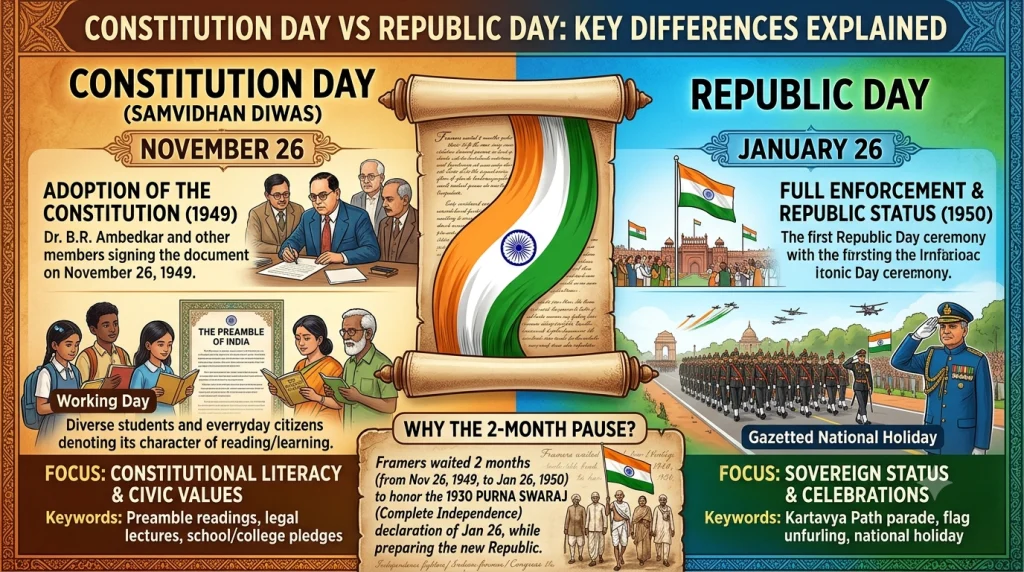
| Feature | Constitution Day (Samvidhan Diwas) | Republic Day |
| Date | November 26 | January 26 |
| Historical Event | Adoption of the Constitution by the Constituent Assembly (1949) | Full enforcement of the Constitution; India becomes a Republic (1950) |
| Official Declaration | Designated in 2015 (earlier observed as National Law Day) | Celebrated annually as a National Holiday since 1950 |
| Holiday Status | Working day; not a nationwide public holiday | Gazetted nationwide public holiday |
| Primary Focus | Constitutional literacy, Preamble values, rights, and duties | Sovereign republic status, national unity, and ceremonial defence parade |
| Typical Observances | Preamble readings, legal lectures, university seminars, and civic pledges | Kartavya Path parade, flag unfurling by the President, cultural tableaux |
Why did the framers wait two full months between adopting the Constitution on November 26, 1949, and putting it into effect on January 26, 1950? The pause was deliberate. January 26 carried deep emotional weight from 1930, when the Indian National Congress issued the Purna Swaraj (complete independence) declaration. Waiting until January 26 honoured that historic pledge while giving administrators eight weeks to prepare for the republic’s legal transition.
Article 21 Supreme Court 2026: The Devilal Gond Case and Personal Liberty
If there is one reason political observers and legal scholars are treating Constitution Day 2026 with unusual seriousness, it is the renewed spotlight on Article 21—the twenty-one-word promise stating that no person shall be deprived of life or personal liberty except according to procedure established by law.
The defining Article 21 Supreme Court 2026 ruling arrived on November 16, 2026, in Devilal Gond v. State of Chhattisgarh & Ors. (2026 INSC 1226). The facts read like a bureaucratic nightmare:
- Devilal Gond was arrested for murder in December 2012 and handed a life sentence by a trial court in August 2013.
- On January 20, 2018, the Chhattisgarh High Court acquitted him.
- Due to a clerical and judicial error, the acquittal order mistakenly assumed Gond was already out on bail. Prison authorities never received formal notice to release him.
- Gond stayed locked behind bars until May 19, 2025—enduring 7 years, 3 months, and 29 days of imprisonment without any legal basis whatsoever.
When the mistake finally surfaced, the Chhattisgarh High Court awarded Gond just ₹2 lakh in compensation, rejecting his claim for ₹50 lakh. Gond appealed to the Supreme Court.
A Bench of Justices Augustine George Masih and Sanjeev Sachdeva stepped in sharply, raising his compensation fifteen-fold to ₹30 lakh, payable by the Chhattisgarh government within four weeks. Beyond the money, the judgment nailed down three crucial constitutional points:
- Strict Liability for Liberty Violations: When the state violates a citizen’s fundamental rights under Article 21, public-law compensation does not depend on proving individual malice; the state is strictly liable for failing to safeguard liberty.
- Dignity and Rehabilitation Matter: Token payouts insult the Constitution. Courts must weigh the exact length of illegal detention alongside the lasting damage done to a person’s dignity, family life, livelihood, and ability to rebuild.
- A Glaring Legislative Gap: Citing research by NLU Delhi Vice Chancellor Prof. G.S. Bajpai, the Delhi High Court’s 2017 Babloo Chauhan proceedings, and the Law Commission of India’s Report No. 277 (2018), the Bench pointed out that nearly a decade later, India still has no statutory framework defining how victims of wrongful incarceration should be compensated.
In practical terms, Devilal Gond hands Parliament a direct constitutional challenge right as the Winter Session approaches: courts can step in case by case, but only legislation can build uniform accountability when the criminal justice machine loses track of a human being.
Beyond One Ruling: How Article 21 Continues to Expand in 2026
No clause in India’s Constitution has grown as dramatically over 77 years as Article 21. In 1950, when the Supreme Court decided A.K. Gopalan v. Union of India, judges read Article 21 narrowly—protecting only against physical restraint without checking whether the law itself was fair. Nearly three decades later, Maneka Gandhi v. Union of India (1978) shattered that narrow ceiling, holding that any procedure taking away liberty must be fair, just, and reasonable. By Francis Coralie (1981), the court confirmed that the right to life means far more than “mere animal existence”; it includes human dignity, shelter, health, and eventually a pollution-free environment under the M.C. Mehta jurisprudence.
That expansion has remained active throughout 2026:
- Right to Die with Dignity: In a notable 2026 decision authored by Justice J.B. Pardiwala (with a concurring opinion by Justice K.V. Viswanathan), the Supreme Court clarified under the passive euthanasia framework that Clinically Assisted Nutrition and Hydration (CANH) qualifies as medical treatment that can be lawfully withdrawn under Article 21. The Bench also streamlined the earlier Common Cause guidelines and urged the Union Government to pass comprehensive legislation on end-of-life care.
- Personal Autonomy in Everyday Courts: High Courts continue to lean heavily on Article 21 for ordinary citizens. In September 2026, for instance, the Allahabad High Court reiterated while allowing a habeas corpus plea that parental objections cannot override an adult’s constitutionally protected right to choose a life partner.
Together with Devilal Gond, these rulings show why Article 21 stays at the centre of Indian constitutionalism: whenever technology, bureaucracy, or social pressure threatens individual autonomy, citizens turn first to those twenty-one words.
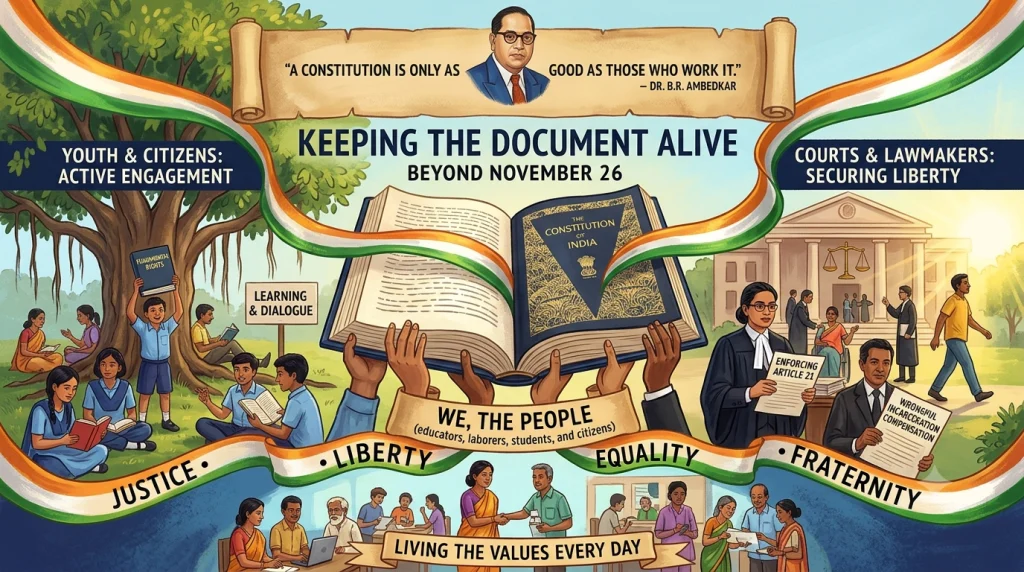
Keeping the Document Alive Beyond November 26
Dr. B.R. Ambedkar famously warned the Constituent Assembly that even the finest constitution can turn bad if those tasked with running it lack integrity, while a flawed charter can still work well in principled hands. Seventy-seven years on, that warning reads less like a speech from 1949 and more like a morning headline.
Celebrating Constitution Day 2026 properly takes more than posting a graphic of the Preamble on social media. For students and young voters, it means actually reading how Fundamental Rights interact with state power. From the Supreme Court stepping in to defend Article 21 liberty in the Devilal Gond case to regional reminders like Nepal’s 2025 Gen Z uprising against established institutions
, recent events show how quickly public trust frays when democratic accountability slips. Marking Constitution Day 2026 , properly means demanding stronger legal safeguards, staying informed, and treating justice, liberty, equality, and fraternity as everyday standards rather than once-a-year slogans.
Frequently Asked Questions (FAQs)
1. Why is Constitution Day celebrated on November 26 instead of January 26?
November 26 commemorates the exact day in 1949 when the Constituent Assembly formally adopted India’s Constitution. January 26 marks Republic Day—the date in 1950 when the Constitution came into full legal force across the country.
2. Is 2026 the 77th anniversary of India’s Constitution?
Yes. Counting from the date of adoption on November 26, 1949, to November 26, 2026, marks the 77th anniversary of adopting the Constitution. Some government events also use “@76” in reference to completing 76 years since the Constitution took effect on January 26, 1950.
3. What is the official theme of Samvidhan Diwas 2026?
Across national observances, “Hamara Samvidhan, Hamara Swabhiman” is widely highlighted as the overarching civic theme for 2026. Alongside it, the Dr. Ambedkar Foundation is hosting its New Delhi event under the theme “The Constitution @76: Dr. B.R. Ambedkar’s Constitutional Vision and the Future of Indian Democracy”.
4. What did the Supreme Court rule in Devilal Gond v. State of Chhattisgarh (2026)?
On November 16, 2026, the Supreme Court enhanced compensation from ₹2 lakh to ₹30 lakh for Devilal Gond, who stayed imprisoned for 7 years, 3 months, and 29 days after being acquitted of murder because jail officials were never notified of his acquittal. The Bench reaffirmed strict state liability for Article 21 breaches and highlighted the absence of a statutory compensation law for wrongful incarceration.
5. Is Constitution Day a public holiday in India?
No. Unlike Republic Day on January 26, Constitution Day (Samvidhan Diwas) on November 26 is a regular working day rather than a nationwide public holiday. Schools, colleges, courts, and government offices stay open and conduct Preamble readings, lectures, and awareness programmes.


