

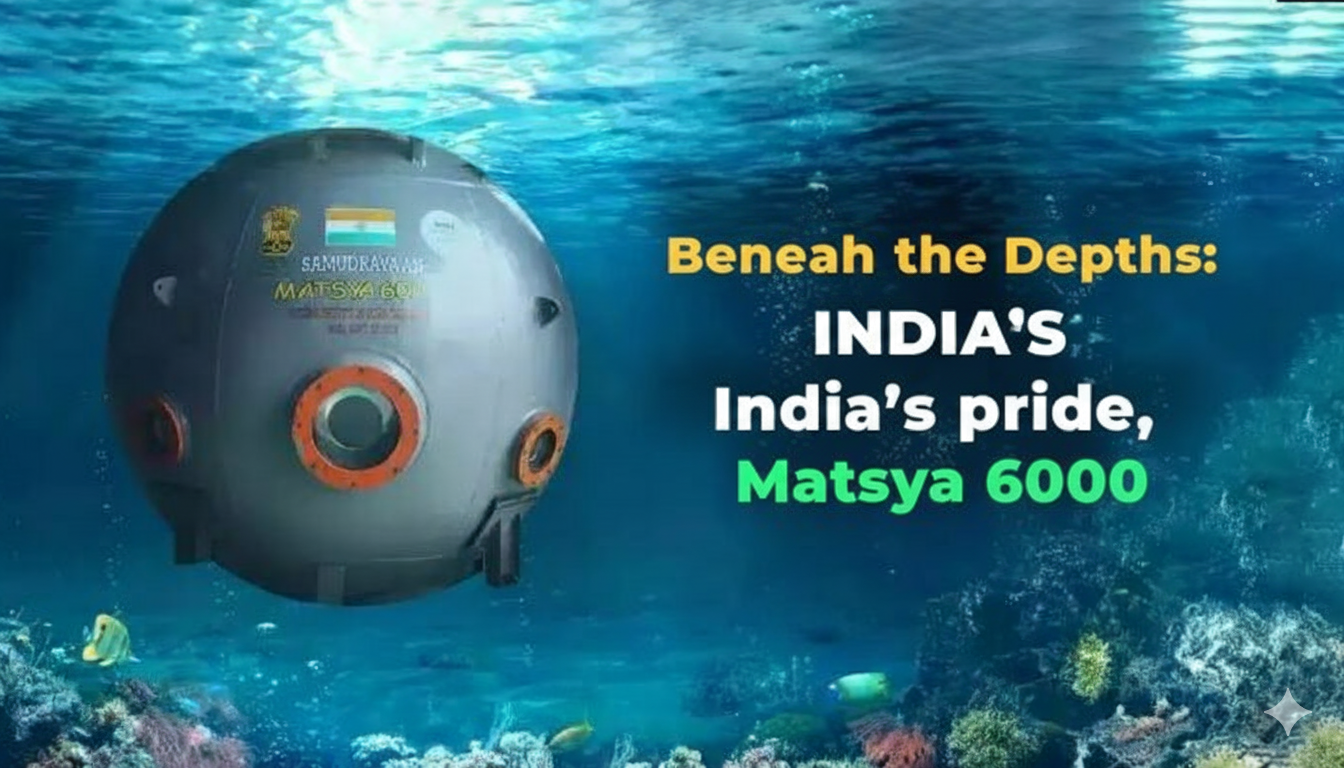
“Have you ever wondered what lies in the darkest corners of the ocean, far below where sunlight can reach ?” Matsya 6000 is named after a beautiful mythological story of Lord Vishnu, who took the form of a giant fish (Matsya) as his first avatar, to protect the people from a flood. Matsya represents Protection, exploration, and survival of the vast ocean.
Similar to the Matsya 6000, the first manned deep-sea submersible, this submersible will help India explore and survive the challenges of the deep sea.
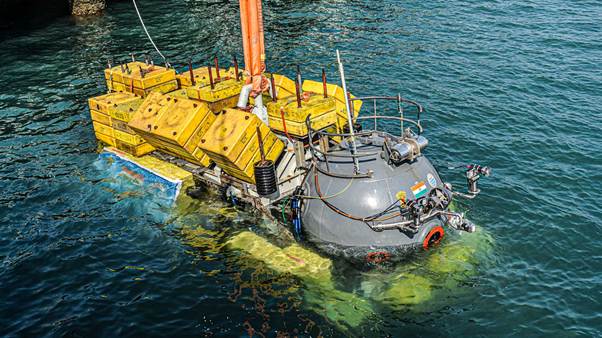
As the world evolves, its launch into space, exploration of the moon, and other frontiers are exploring the depths of the Earth’s ocean, leading us into incredible moments that are on the way. In the depths of the mission, India’s pride moment awaited in 2026.
A new adventure takes us beneath the depths of the exploring sites of the ocean’s living and non-living treasures. In this blog, let’s deep dive with them to know about the new features, designs, and other structures of the Matsya 6000.
As the generation moves ahead with new and emerging technologies, the wisdom keepers and the hard-working pioneers make future builders the fourth generation, and hard-working pioneers, an incredible moment in the Matsya 6000 submersible built under the Samudrayaan mission.
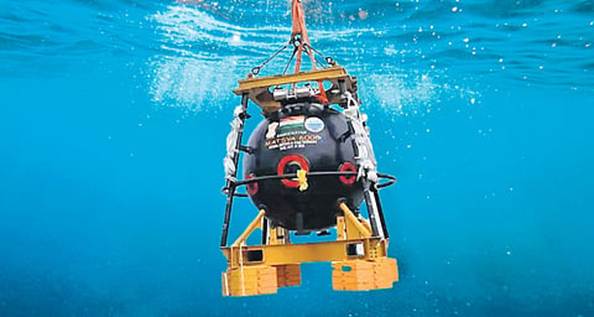
Matsya 6000 is an indigenously developed submersible, designed for a three-member crew to explore the depths of the Indian Ocean. This technology is not only designed for exploring the biodiversity, mineral resources, or mysteries of the deep ocean, but also for humans to withstand the crushing pressure of the deep sea. It stands out as a key resource for India in marine engineering and ocean.
SAMUDRAYAAN: India’s into blue, by exploring the unknown
Matsya’s 6000 stands as legendary at the core of the Samudrayaan mission, initiating the deep ocean mission. The submersible helps scientists study sea creatures, hidden resources, and mysteries that lie beneath the blue. Samudrayaan is the next stepping stone of the future, which shows India’s strength in science and technology, just like the space program made the country proud. with Matsya 6000, India collaborates with small countries like the USA, China, and Japan. this mission proves India’s open way to use ocean resources for the future.
What makes exploring Matsya’s 6000
Treasure heart of the ocean resources from rare minerals to new species explores the deep ocean floor at 6000 meters, it explores research on marine life and ecosystem with access to valuable metallic nodules that contain cobalt, nickel, copper, and manganese.
Features of Matsya 6000
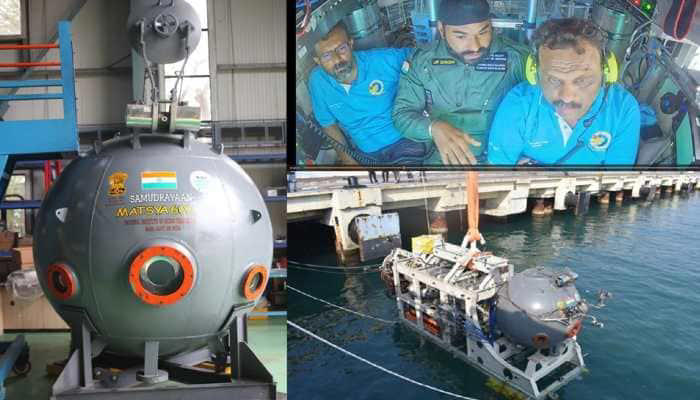
- Deep-Sea Operational Capabilities
Depth capability: it is designed to dive into the blue up to 6,000 meters, it has endurance capability to operate the mission for about 12-16 hrs under normal conditions, in case of emergencies, it supports the crew up to 96 hrs.
- Structural design
The structural diameter is 2.1 metres, spherical hull, titanium alloy 80 mm thick is used for construction. it is capable of withstanding extreme underwater crushing pressure. Titanium is used for its fracture resistance, enhancing safety for submersibles.
- Advanced mobility & sub systems
The propulsion & Buoyancy are equipped with multi-directional thrusters, it has a main ballast system, and syntactic foam. The vehicle crawls on the seabed with six degrees of freedom, connected with a battery-powered propulsion system.
- Navigation & communication systems
The position of the vehicle holds an ultra-short baseline (USBL) with acoustic navigation for tracking. communication is mainly equipped with an acoustic modem, underwater telephone, VHF radio, and a GPS for tracking from the surface for communication.
- Life support & safety systems
The crew capacity is designed to carry three members. The safety features have three backup systems for floating, power, and safety supports. It has high-pressure-resistant escape hatches and automatic buoyancy flotation for emergencies.
- Scientific Tools & Research Capabilities
For imaging and sensor purpose, it is installed with oceanographic sensors, underwater cameras, lighting, and resolution imaging systems to document the deep sea environment. Then, for sample collection, Robotic arms are used.
- Development, Testing & Timeline
The built-up process is done by NIOT, in partnership with ISRO, and is certified by ISO for a manned submersible. The testing of both manned and unmanned wet tests was completed successfully with vital system and life support conditions.
As we know about the launch is awaited, which it lead to an upcoming trial for shallow water demonstration up to 500m expected by end of 2026.
From the Mariana Trench to the Indian Ocean, exploring the depths of the ocean
With Matsya 6000, India joins a prestigious list of nations — including the USA, Japan, Russia, France, and China capable of manned deep-sea missions.
The famous deep-sea exploration vehicles from different countries. Include Trieste (USA), Alvin (USA), Nautile (France), Kaiko (Japan), Deepsea Challenger (USA), and Matsya 6000 (India).
| Country | Submersible Name | Max Depth Reached | Years of Achievement |
| 🇺🇸 USA | Trieste | 10,911m (Mariana Trench) | 1960 |
| 🇺🇸 USA | Alvin | 4,500 m | 1964 (active) |
| 🇫🇷 France | Nautile | 6,000 m | 1984 |
| 🇷🇺 Russia | MIR-1 & MIR-2 | 6,000 m | 1987 |
| 🇯🇵 Japan | Shinkai 6500 | 6,500 m | 1989 |
| 🇨🇳 China | Jiaolong | 7,062 m | 2012 |
| 🇨🇳 China | Fendouzhe (“Striver”) | 10,909 m | 2020 |
| 🇮🇳 India | Matsya 6000 (planned) | 6,000 m | 2026 (expected) |
Countries Unlocking the Secrets of the Ocean
The countries that have accomplished their achievements beneath the ocean by exploring the resources and the discovery of Earth’s evolution and tectonic processes.
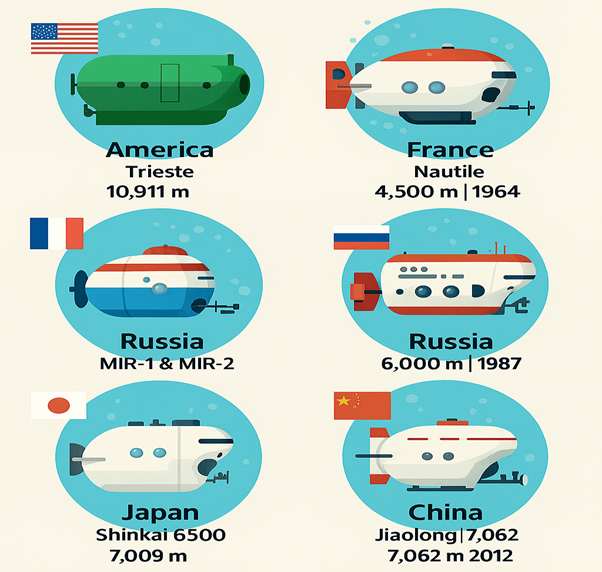
- In the USA, the manned dive to the deepest known as “Point on earth” in 1960 with the exploration submarine Alvin, in 1964, up to date, exploring the Titanic wreck and the hydrothermal vents. In September 2025, E/V Nautilus discovered the World War II Japanese destroyer Teruzuki, unseen since 1942.
- France, Nautile submarine is a deep-sea research and wreck exploration from 1984. In recent days, a discovery of the deepest shipwreck in French waters, the Camarat 4, a 16th-century merchant vessel.
- China’s first independently designed and built manned deep-sea exploration, Jiaolong, in 2010, it explores the marinana trench in 2012. Fendouzhe (“Striver”) is also a manned submersible capable of reaching the deepest parts of the ocean. In 2020, a new national record was set, diving at 10,909, in the Mariana Trench. In 2023, the Diamantina Trench in the Southeastern Indian Ocean was explored, reaching its deepest point for the first time in history.
- Russia’s pair of deep-sea Submersibles, renowned for their ability to reach the depths for scientific research.
- Japan’s Shinkai 6500 is Submersible that can dive up to a depth of 6,500 metres. The recent scientific discovery of Bathylepeta wadatsumi snail, in 2025, during an ocean census expedition, deep-sea Ecosystem.
Conclusion
“Beneath the Depths: India’s Pride, Matsya 6000” celebrates more than just a technological marvel; it’s a dream to understand the Earth from its deepest corners. As India continues its journey from space to the ocean floor, Matsya 6000 will be a milestone in the story of human exploration and scientific excellence.
Looking Ahead
When Matsya 6000 dives into the oceanic depths, it won’t just explore the sea; it will explore India’s limitless potential. Each dive will bring new insights into the planet, new technologies for humanity, and new inspiration for future explorers.
Frequently Asked Questions (FAQ)
1. What is the purpose of the Matsya 6000 mission?
It aims to explore deep-sea resources, study ocean ecosystems, and advance India’s ocean technology capabilities under the Deep Ocean Mission.
2. Who developed Matsya 6000?
It is being developed by the National Institute of Ocean Technology (NIOT), Chennai, under the Ministry of Earth Sciences, Government of India.
3. How deep can Matsya 6000 go?
It can dive up to 6,000 meters, it is approximately 20,000 feet below the sea surface, deeper than Mount Everest’s height.
4. How many people can it carry?
Matsya 6000 can carry three crew members, including scientists and pilots.
5. When will Matsya 6000’s first mission take place?
The trial runs have already begun, with the first full-scale manned mission expected soon under the Samudrayaan initiative.
6. What are the safety features of Matsya 6000?
It includes a pressure-resistant titanium sphere, redundant oxygen systems, emergency power backup, and 96-hour life support to ensure crew safety even in extreme conditions.
7. Why is it important for India?
The mission enhances India’s scientific knowledge, resource mapping, and technological self-reliance, contributing to the blue economy and future sustainability.


Can you be more specific about the content of your article? After reading it, I still have some doubts. Hope you can help me.
Thanks for sharing. I read many of your blog posts, cool, your blog is very good.