

Space is filled with extraordinary objects, including shining stars, distant galaxies, colourful nebulae, and mysterious black holes. Among all these cosmic wonders, black holes are some of the most fascinating objects scientists have ever studied. Their powerful gravity, unusual effects on time, and ability to trap light make them important subjects in modern astronomy. But what exactly is a black hole, and how does it work? Is it a giant hole in space that swallows everything around it? Can scientists observe something that does not allow light to escape?
They are objects with enormous mass and powerful gravitational effects. In this article, we will explore 10 mysterious facts about black holes, explain how they work, and discover why they continue to capture the attention of scientists and space enthusiasts.
Table of Contents
What is a Black Hole?
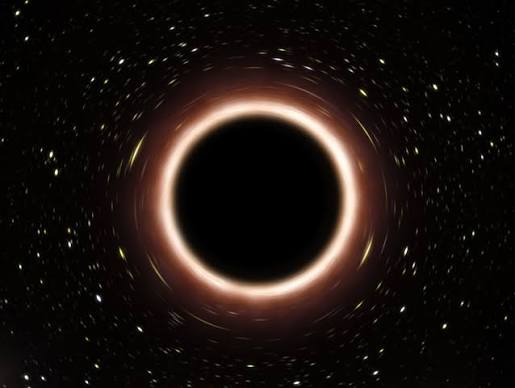
A black hole is an astronomical object whose gravity becomes so strong that nothing can escape from within its event horizon, not even light. A black hole represents an extreme example of this effect. Black holes are difficult to observe directly because they do not emit or reflect light from inside their event horizons.
However, astronomers can investigate their surroundings, observe their influence on nearby stars, and detect signals produced when black holes interact or merge. Scientists study black holes to understand gravity, the behavior of matter under extreme conditions, and the evolution of galaxies. Although researchers have learned a great deal about these objects, several questions about their interiors and origins remain unanswered.
10 Fascinating Facts About Black Holes
1. Black Holes Can Form from Dying Massive Stars
One of the most interesting facts about black holes is that some of them originate from massive stars. Stars produce energy through nuclear fusion in their cores. This energy creates outward pressure that helps balance the inward pull of gravity.
When the core collapses under its own gravity, the result depends on the star’s mass and physical conditions. In some cases, the collapse produces a black hole. The surrounding star may also eject its outer layers in a powerful explosion. However, not every dying star becomes a black hole. Smaller stars, including our Sun, are expected to end their lives as white dwarfs rather than black holes. The formation of stellar-mass black holes helps scientists understand the life cycles of stars and the processes that shape the universe.
2. The Event Horizon Is the Point of No Return
The event horizon is one of the most important features of a black hole. It marks the boundary beyond which escape is impossible for anything traveling outward, including light. At a certain point, the current becomes too strong to swim back. The event horizon is a rough analogy for a boundary beyond which returning to the outside universe is no longer possible, although the actual physics is much more complex.
The event horizon is not a solid surface. A spacecraft approaching it would not necessarily encounter a physical wall. Instead, crossing this boundary changes what paths through space and time can lead back to the outside universe. The size of an event horizon depends on a black hole’s mass and other physical properties, including its rotation. Understanding this boundary helps scientists describe black holes mathematically and interpret observations of their surroundings.
3. Black Holes Do Not Stuck in Everything Around Them
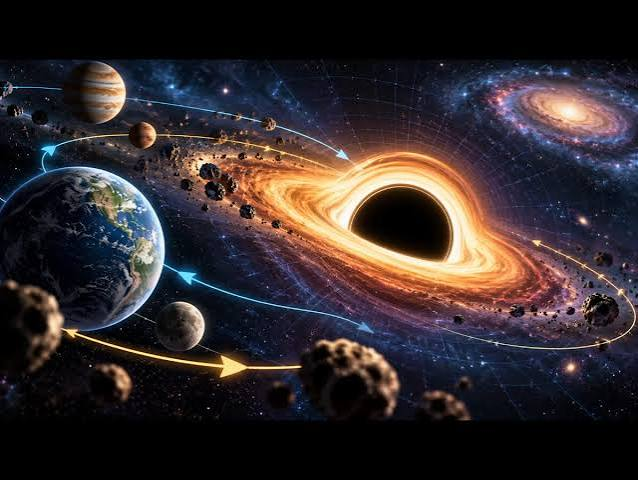
Movies often portray black holes as powerful cosmic vacuum cleaners that pull entire star systems into their centres. This is an inaccurate picture. A black hole’s gravity depends on its mass and the distance from it. At a sufficient distance, its gravitational influence is comparable to that of another object with the same mass. For example, imagine that the Sun could somehow be replaced by a black hole with exactly the same mass.
If Earth’s orbit remained unchanged, our planet would continue following approximately the same path. However, Earth would lose the sunlight needed to sustain its present climate and ecosystems. Objects must approach a black hole closely enough, or lose enough orbital energy, to fall into it. Matter that remains in a stable orbit can continue moving around it. This fact shows that black holes are not mysterious cosmic cleaners. Their effects depend on gravity, distance, and the movement of surrounding matter.
4. Black Holes Comes in Different Sizes
Black holes are not all identical. Scientists classify them according to their masses, and researchers continue investigating how different types form.
Stellar-mass black holes: These objects typically form from the collapse of massive stars or through other processes involving dense stellar remnants. They can contain several times the mass of our Sun or considerably more.
Intermediate-mass black holes: These are thought to occupy the mass range between stellar-mass and supermassive black holes. Astronomers have identified candidates, but confirming and understanding this population remains an active area of research.
Supermassive black holes: These enormous objects contain millions or even billions of solar masses. They are commonly found at the centrer of large galaxies. Our own Milky Way contains a supermassive black hole called Sagittarius A*, located near the galactic centre. Scientists are still investigating how the largest black holes formed and grew so massive, particularly in the early universe.
5. Black Holes Can Affect the Flow of Time
One of the strangest consequences of black holes comes from Einstein’s theory of general relativity: gravity affects the passage of time. According to this theory, a clock closer to a massive object can tick more slowly relative to a clock farther away, provided the clocks are compared under suitable conditions. This effect is called gravitational time dilation. Near a black hole, the gravitational effects can become extremely strong.
An observer far away would describe a clock approaching the event horizon as appearing increasingly slowed and its signals increasingly delayed and redshifted. However, a person falling toward the event horizon would not necessarily experience their own time slowing in the same way. Their local clock would continue ticking normally, although the journey could involve extreme physical dangers. These differences depend on how observers move and how they compare their measurements. Black holes therefore provide important environments for studying the relationship between gravity, space, and time.
6. Scientists Can Study Black Holes Without Seeing Them Directly
If black holes prevent light from escaping their event horizons, how do astronomers discover them? Scientists use several indirect methods to investigate these objects. One method involves observing stars that orbit an apparently invisible but massive object. If a star follows a path influenced by a compact companion, astronomers can estimate the companion’s mass and determine whether it is likely to be a black hole. Another method involves studying hot gas surrounding a black hole.
As gas moves through an accretion disk, friction and other physical processes can heat it to extremely high temperatures. The material may emit X-rays and other radiation that telescopes can detect. Astronomers can also observe gravitational lensing, in which gravity bends light traveling from distant objects. In addition, instruments such as LIGO detect gravitational waves produced by certain black hole mergers. These techniques allow researchers to study objects that cannot be observed in the same way as ordinary stars.
7. Matter Around a Black Hole Can Become Extremely Hot
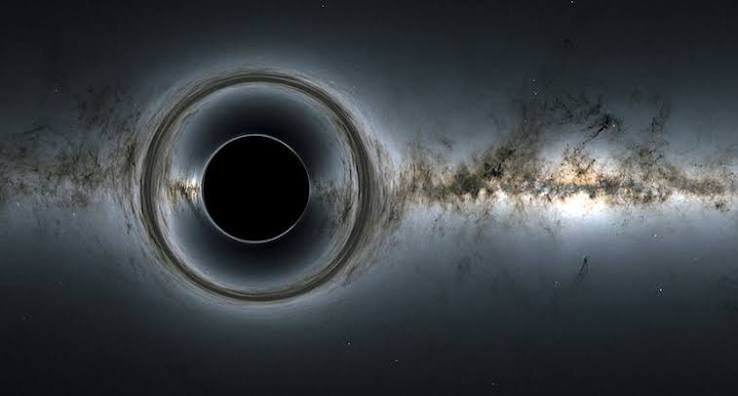
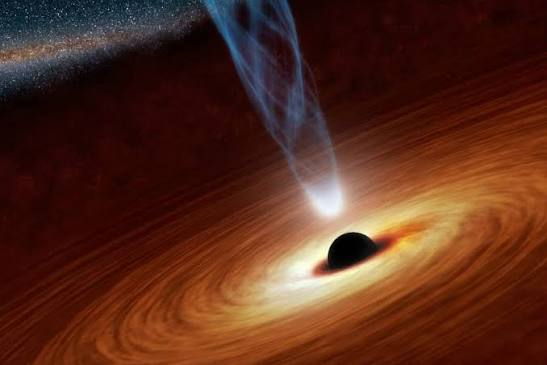
Although a black hole itself appears dark, its surroundings can shine intensely. Gas, dust, and other material may collect in a rotating structure called an accretion disk. As this material moves inward, it can collide, experience friction, and release gravitational energy as heat and radiation. In some systems, the temperature becomes high enough for the surrounding material to emit powerful X-rays. These emissions can make a black hole’s environment detectable across enormous distances. Some black holes also produce narrow jets of energetic particles that travel outward at speeds approaching the speed of light.
These jets are associated with complex interactions involving magnetic fields, rotating material, and the black hole’s surroundings. Importantly, these jets do not mean that matter has escaped from inside the event horizon. They arise from material and energy outside it. By studying the radiation from accretion disks and jets, scientists can learn about how black holes consume matter and influence their cosmic environments.
8. Black Holes Can Merge and Produce Gravitational Waves
Black holes can exist in pairs, orbiting one another in a binary system. Over time, such systems can lose orbital energy through the emission of gravitational waves. Gravitational waves are disturbances in space-time that travel outward from accelerating massive objects. When two black holes spiral toward one another and merge, they can produce a powerful signal detectable by specialised instruments. In 2015, scientists announced the first direct detection of gravitational waves, generated by a merger of two black holes. This discovery provided a new way to study the universe beyond conventional observations using light.
When two black holes merge, the resulting black hole generally has less total mass than the sum of the original masses. The difference is released primarily as energy carried by gravitational waves. These discoveries help researchers test predictions of general relativity and investigate black hole populations that may be difficult to observe using telescopes alone.
9. Black Holes Can Stretch Objects Through Tidal Forces
Black holes can produce an extreme effect known as spaghettification. The term describes how an object can be stretched because gravity pulls more strongly on its nearer parts than on its farther parts. Imagine an object falling toward a black hole feet first. The gravitational pull on its feet may become much stronger than the pull on its head. This difference can stretch the object along its length while compressing it in other directions.
The strength of this effect depends on the black hole’s mass and the object’s distance from it. Around a smaller black hole, the tidal forces near the event horizon can be particularly severe. For a sufficiently large black hole, those forces at the event horizon can be less intense, although falling inside would still be fatal under ordinary physical conditions. Spaghettification illustrates how gravity can behave very differently in extreme environments compared with what we experience on Earth.
10. Black Holes May Eventually Lose Energy
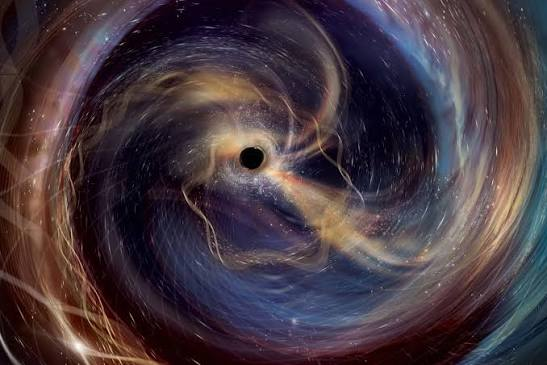
A surprising prediction of theoretical physics is that black holes may gradually lose energy through a process called Hawking radiation. In 1974, physicist Stephen Hawking described how quantum effects near a black hole’s event horizon could cause it to emit radiation. If a black hole loses energy in this way, its mass decreases over time. For black holes formed from stars, this process is expected to be extraordinarily slow.
Their predicted temperatures are extremely low, and Hawking radiation from astrophysical black holes has not yet been directly detected. Smaller hypothetical black holes would radiate more strongly and could evaporate more quickly than larger ones. This idea connects gravity, quantum physics, and thermodynamics. It also raises important questions about what happens to information associated with matter that falls into a black hole. Hawking radiation remains a major topic in theoretical research, showing that black holes may be more complex than their dark appearance suggests.
How Black Holes Help Scientists Understand the Universe
Black hole is not simply unusual objects in space. They offer opportunities to investigate some of the most important questions in modern physics.
First, they allow scientists to test general relativity under extreme gravitational conditions. Observations of stars near Sagittarius A* and measurements of gravitational waves provide ways to compare theoretical predictions with real data.
Second, supermassive black holes can influence the galaxies that host them. Energy released by material around an actively feeding black hole can affect surrounding gas, potentially influencing star formation and galactic development.
Third, black hole research supports advances in astronomy and data analysis. Studying these objects requires observations across different wavelengths, precise measurements, complex simulations, and international scientific collaboration.
Although many mysteries remain, each new observation helps researchers improve their understanding of the universe.
Conclusion
Black holes are among the most fascinating objects in the cosmos because they challenge our everyday understanding of gravity, light, and time. Some form from collapsing massive stars, while supermassive black holes occupy the centers of many galaxies. Their event horizons define boundaries beyond which light cannot escape, and their surroundings can produce intense radiation, powerful jets, and gravitational waves.
Scientists cannot directly observe the interior of a black hole, but they can investigate its influence on stars, gas, light, and space-time. These observations have already transformed our understanding of the universe. As technology improves and new discoveries emerge, researchers will continue investigating how black holes form, grow, merge, and evolve. Their mysteries remind us that the universe still contains many remarkable phenomena waiting to be understood.
FAQs
- What is a black hole in simple words?
A black hole is an extremely dense astronomical object whose gravity is so strong that nothing can escape from inside its event horizon, including light.
- How are black hole formed?
Some black hole form when the cores of massive stars collapse under their own gravity. Other formation pathways, particularly those involving supermassive black holes, are still being studied.
- Can a black hole swallow Earth?
Earth is not in danger of being swallowed by a distant black hole. A black hole would need to come sufficiently close to affect our planet significantly, and no known nearby black hole poses such a threat.
- Can scientists see a black hole?
Scientists cannot see light escaping from inside a black hole’s event horizon. However, they can observe glowing material around it, its gravitational effects, and the shadow it creates against surrounding light.
- What is the event horizon?
The event horizon is the boundary around a black hole beyond which escape to the outside universe is impossible.
- Are all black hole the same size?
No. Black hole have different masses, ranging from stellar-mass objects to supermassive black holes containing millions or billions of times the Sun’s mass.
- What happens if someone falls into a black hole?
The outcome depends on the black hole’s size and the person’s trajectory. Extreme tidal forces may stretch and destroy the person, and crossing the event horizon means they cannot return to the outside universe.
- Do black holes move through space?
Yes. Black hole can travel through space, orbit other objects, and move around the centers of galaxies, just as other massive objects do.
- Can black holes disappear?
According to theoretical predictions, black holes can gradually lose energy through Hawking radiation. For ordinary astrophysical black holes, the expected timescales are vastly longer than the current age of the universe.
- Why do scientists study black hole?
Scientists study black hole to understand gravity, space-time, the behaviour of matter under extreme conditions, gravitational waves, and the evolution of galaxies.


