

Introduction
Starting a e-commerce business involves many important decisions, and one of the most significant is choosing the right business model. Entrepreneurs can establish a traditional business with a physical store or launch an e-commerce business that sells products and services online. Both models offer opportunities for growth, but they differ in terms of investment, customer reach, operating costs, marketing, and customer experience. Traditional businesses have been an essential part of the economy for generations. Retail shops, supermarkets, restaurants, and clothing stores allow customers to visit a physical location, examine products, and interact directly with staff. In contrast, e-commerce businesses use websites, mobile applications, and online marketplaces to sell products and services through
With the growth of digital technology, online shopping has become an important part of modern commerce. However, traditional businesses continue to attract customers who prefer personal interaction and the ability to see products before purchasing them.
Understanding the differences between traditional and e-commerce businesses can help entrepreneurs select a suitable model based on their budget, goals, target audience, and available resources.
Table of Contents
What Is Traditional Business?
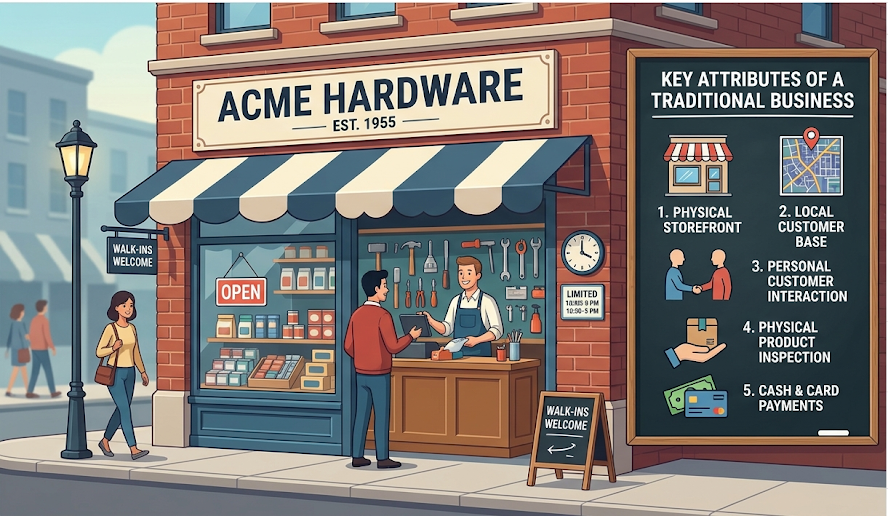
A traditional business is a business that operates through a physical location where customers can visit, explore products, and make purchases. Examples include grocery stores, clothing shops, furniture showrooms, restaurants, and local service centres.
Traditional businesses generally depend on physical infrastructure, such as a shop, office, warehouse, or commercial space. They may also require employees to manage sales, inventory, customer service, and daily operations.
For example, a clothing store in a shopping centre allows customers to try on clothes, compare different styles, and receive assistance from sales staff. Customers can purchase their preferred items and take them home immediately.
Key Features of a Traditional Business
- Physical location: Customers usually visit a store, office, or commercial establishment.
- Direct interaction: Buyers can communicate face-to-face with business owners or employees.
- Local customer base: Many traditional businesses serve customers within a particular neighbourhood, town, or city.
- Physical product inspection: Customers can examine the size, quality, colour, and condition of products before purchasing.
- Location-based expenses: Rent, utilities, maintenance, and staffing can contribute significantly to operating costs.
- Traditional businesses remain useful for products and services that require personal assistance, immediate availability, or physical inspection.
What is an E-Commerce Business?
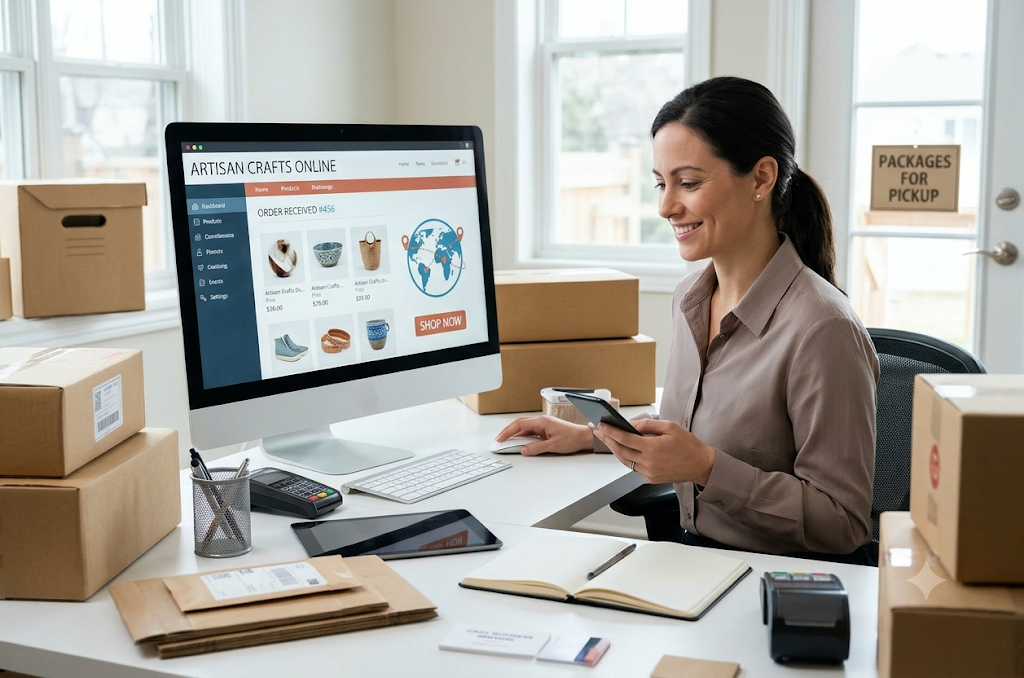
An e-commerce business sells products or services through digital platforms, including websites, mobile applications, and online marketplaces. Customers can browse products, compare prices, place orders, and make payments without visiting a physical store.
Examples include online clothing stores, electronics websites, digital product shops, and businesses selling handmade products through online marketplaces. For example, a small business owner can create an online store to sell handmade jewellery. Customers from different cities can view product photographs, read descriptions, select items, and place orders. The owner can then arrange delivery through a courier service.
E-commerce businesses may operate entirely online or combine digital sales with a physical shop or warehouse.
Key Features of an E-commerce Business
- Online storefront: Products and services are displayed on a website, application, or marketplace.
- Wider customer reach: Businesses can serve customers beyond their immediate geographical area.
- Digital payments: Customers can pay through supported online payment methods, including cards, UPI, and digital wallets.
- Flexible shopping hours: Customers can generally place orders at any time, although support and fulfilment may have limited operating hours.
- Technology-based operations: Inventory systems, analytics, payment gateways, and digital marketing tools help manage business activities.
E-commerce can provide flexibility and growth opportunities, but businesses must also manage website performance, online security, shipping, returns, and customer trust.
10 Key Differences Between Traditional and E-Commerce Businesses
1. Business Location and Accessibility
One of the main differences between traditional and e-commerce businesses is where customers complete their purchases.
Traditional businesses operate from physical locations. Customers must usually travel to a shop or office during its opening hours. The convenience of a traditional business therefore depends partly on its location, transport options, and accessibility.
E-commerce businesses allow customers to shop online from home, work, or other places with internet access. Customers do not need to travel to a store to place an order.
Example: A customer can purchase groceries from a neighbourhood supermarket or order selected products through an online grocery service.
Key difference: Traditional businesses depend on physical accessibility, whereas e-commerce businesses provide digital accessibility.
2. Startup Investment and Operating Costs
Starting a traditional business often requires investment in rent or property, interior design, furniture, equipment, inventory, employee salaries, and utilities. The total investment depends on the type of business and its location.
An e-commerce business may require less investment in physical retail infrastructure. Entrepreneurs can start with an online marketplace or a basic e-commerce website instead of renting a commercial storefront. However, online businesses are not cost-free. Website development, hosting, payment processing, advertising, packaging, inventory, shipping, and returns can create substantial expenses.
Example: A home-based seller may begin selling handmade products through an online marketplace, while a traditional retailer may need to rent and furnish a shop before opening.
Key difference: E-commerce can reduce the need for physical retail space, but the overall cost depends on the business model and its operational requirements.
3. Customer Reach and Market Size
Traditional businesses often attract customers from nearby areas. Their customer base may include local residents, office workers, tourists, and people who regularly visit the location.
E-commerce businesses can reach customers in different cities, states, or countries, depending on their delivery capabilities, payment options, regulations, and marketing strategy.
A traditional shop may depend heavily on foot traffic, while an online store can attract visitors through search engines, social media, online advertisements, and marketplace recommendations. Example: A local bakery may primarily serve its neighbourhood, while an online bakery accepting suitable delivery orders may reach customers across a wider service area.
Key difference: Traditional businesses often focus on local markets, whereas e-commerce businesses can expand their reach more easily through digital channels.
4. Customer Experience and Personal Interaction
Traditional businesses allow customers to interact directly with employees. Buyers can ask questions, receive recommendations, test certain products, and get immediate assistance.
This personal interaction can be especially valuable when customers need help choosing clothing, furniture, electronics, or other products that require inspection.
E-commerce businesses provide a different shopping experience. Customers use product descriptions, photographs, videos, reviews, comparison tools, and online support to make purchasing decisions.
Although online chat and video consultations can provide assistance, they may not completely replace the experience of examining a product physically.
Example: A customer buying shoes in a physical shop can try different sizes before making a decision. An online buyer must rely on the size chart, reviews, and return policy.
Key difference: Traditional businesses emphasise face-to-face service, while e-commerce businesses rely more heavily on digital information and remote assistance.
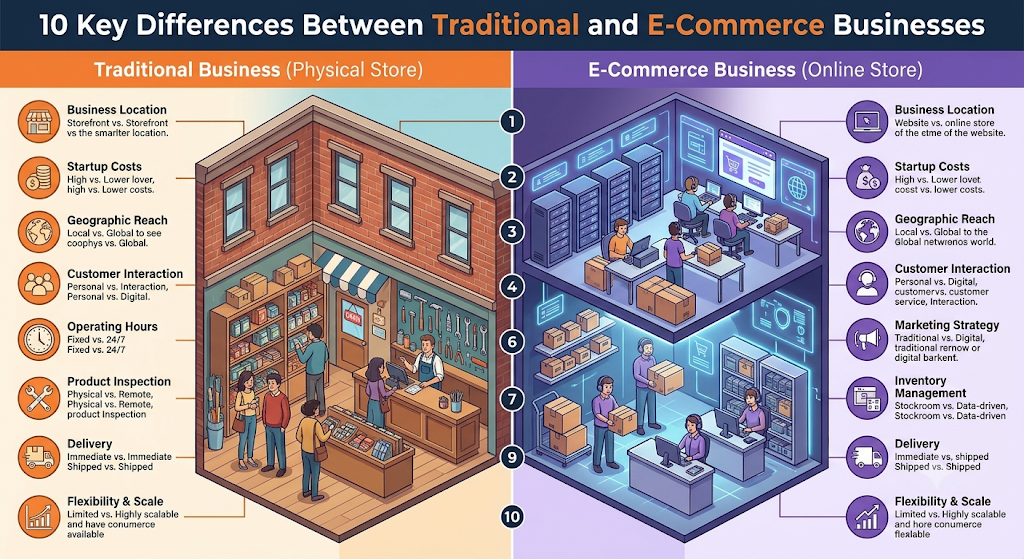
5. Operating Hours and Convenience
Traditional businesses generally operate according to fixed schedules. Customers must visit during opening hours, and sales may stop when the store closes.
E-commerce websites can accept orders around the clock. Customers can browse products and complete purchases whenever it is convenient for them.
However, receiving an order does not mean that the product will be dispatched immediately. Warehouses, delivery services, and customer support teams may follow specific working schedules.
Example: A customer can order a laptop online late at night, while a local electronics shop may already be closed.
Key difference: E-commerce offers greater flexibility for placing orders, while traditional businesses usually operate within defined opening hours.
6. Marketing and Promotion
Traditional businesses often promote their products through local advertisements, banners, flyers, newspaper advertisements, events, and community relationships. Their marketing activities frequently focus on customers in a specific area.
E-commerce businesses can use search engine optimisation (SEO), social media marketing, email campaigns, influencer partnerships, online advertisements, and content marketing.
Digital marketing also allows online businesses to measure certain activities, such as website visits, advertisement clicks, conversion rates, and abandoned shopping carts.
However, digital advertising can become expensive, and online businesses must compete for visibility in crowded markets.
Example: A local clothing shop might distribute promotional flyers, while an online clothing brand may use social media videos and search advertisements to attract customers.
Key difference: Traditional marketing often relies on local visibility, while e-commerce marketing uses digital channels to target and measure online audiences.
7. Product Inspection and Delivery
In traditional stores, customers can often inspect products before purchasing them. They may check material quality, colour, size, weight, or functionality. Many purchases can be taken home immediately.
E-commerce customers usually select products based on digital descriptions and images. The business must then arrange packaging, shipping, and delivery.
Online orders introduce additional considerations, including delivery charges, shipping delays, damaged goods, incorrect items, and return procedures.
At the same time, online stores can provide a larger selection of products than a small physical shop can display.
Example: A customer purchasing a refrigerator from a showroom can inspect its dimensions and finish. An online customer can compare several models but must wait for delivery.
Key difference: Traditional stores offer physical inspection and, in many cases, immediate collection. E-commerce offers remote selection and home delivery.
8. Inventory and Order Management
Traditional businesses often maintain inventory at their physical stores, in warehouses, or in nearby storage facilities. Employees may update stock records manually or use point-of-sale software.
E-commerce businesses can manage inventory through online dashboards, inventory management software, warehouse systems, and integrations with marketplaces.
These systems can help track stock levels, process orders, and reduce the risk of selling unavailable products. However, inaccurate inventory data can still result in cancelled orders and dissatisfied customers.
Some e-commerce businesses use dropshipping or third-party fulfilment services instead of storing all products themselves.
Example: A traditional stationery shop may record daily sales through billing software, while an online stationery store may automatically update stock after each completed order.
Key difference: Both models require inventory management, but e-commerce businesses often depend more heavily on integrated digital systems.
9. Competition and Business Expansion
Traditional businesses compete with other businesses in their local markets. Their success may depend on location, product quality, pricing, customer relationships, and reputation.
E-commerce businesses can face competition from sellers across large geographical areas. Customers can compare products and prices quickly, making it important to provide value, reliable delivery, quality service, and a trustworthy shopping experience.
Physical businesses may need to rent additional premises or open new branches to expand. Online businesses can sometimes expand by increasing website capacity, adding products, or entering new markets. Nevertheless, scaling online sales also requires sufficient inventory, customer support, fulfilment capacity, and compliance with applicable laws.
Example: A local home-decor shop might open another branch to reach a new city. An online home-decor brand might start delivering to that city through its existing website and logistics partners.
Key difference: Traditional expansion often involves additional physical locations, while e-commerce expansion can use existing digital infrastructure, subject to operational capacity.
10. Trust, security, and Customer Relationship
Traditional businesses can build trust through personal relationships, visible premises, consistent service, and recommendations from existing customers.
E-commerce businesses need to establish trust through secure payment processing, accurate product information, transparent pricing, clear return policies, verified customer reviews, and responsive support.
Online stores must also take steps to protect customer information and reduce risks such as fraudulent transactions, account compromise, and phishing.
Traditional businesses can face security issues as well, including theft, payment fraud, and the misuse of customer data. Both models need appropriate safeguards and reliable service practices.
Example: A customer may trust a neighbourhood shop because of years of personal interaction. An online buyer may assess a store through customer reviews, contact details, payment security, and delivery policies.
Key difference: Traditional businesses can benefit from direct relationships, while e-commerce businesses must build confidence through a dependable digital experience.
Advantages and Disadvantages of Traditional Businesses
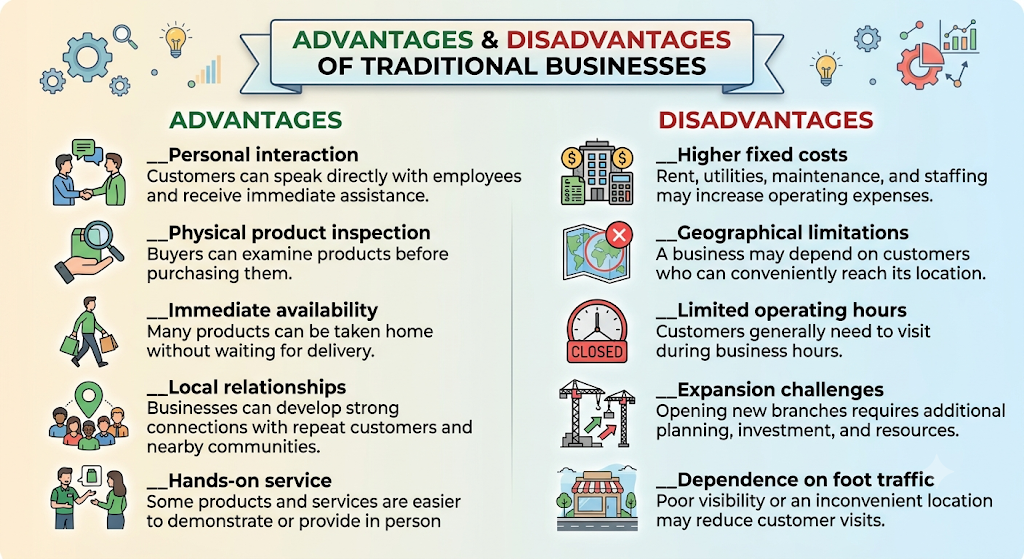
Advantages
- Personal interaction: Customers can speak directly with employees and receive immediate assistance.
- Physical product inspection: Buyers can examine products before purchasing them.
- Immediate availability: Many products can be taken home without waiting for delivery.
- Local relationships: Businesses can develop strong connections with repeat customers and nearby communities.
- Hands-on service: Some products and services are easier to demonstrate or provide in person
Disadvantages
- Higher fixed costs: Rent, utilities, maintenance, and staffing may increase operating expenses.
- Geographical limitations: A business may depend on customers who can conveniently reach its location.
- Limited operating hours: Customers generally need to visit during business hours.
- Expansion challenges: Opening new branches requires additional planning, investment, and resources.
- Dependence on foot traffic: Poor visibility or an inconvenient location may reduce customer visits.
Advantages and Disadvantages of E-Commerce Businesses
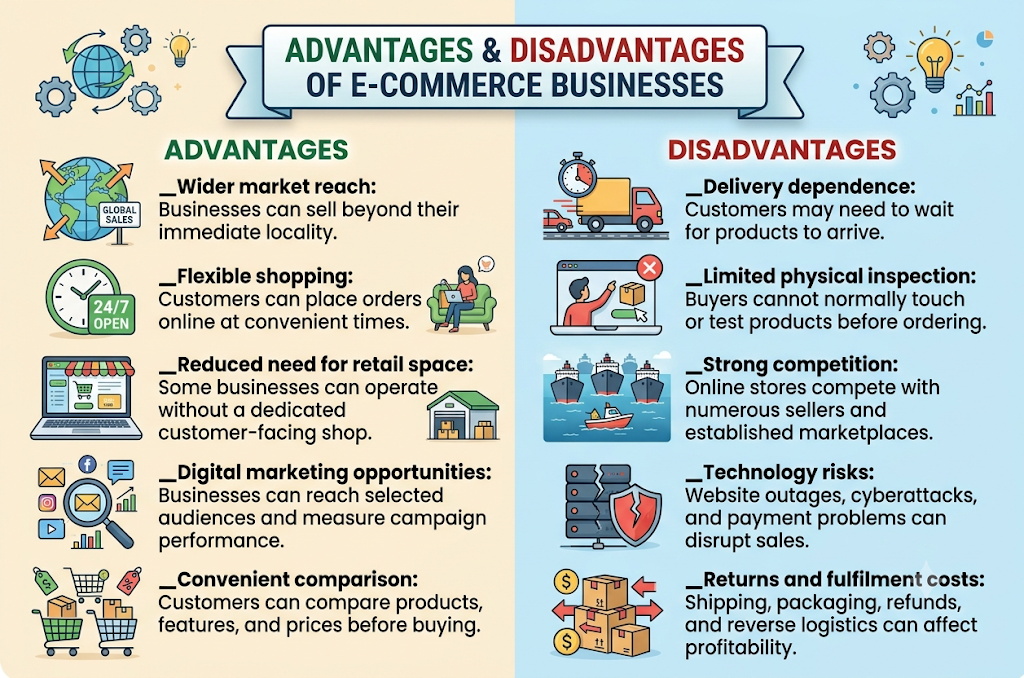
Advantages
- Wider market reach: Businesses can sell beyond their immediate locality.
- Flexible shopping: Customers can place orders online at convenient times.
- Reduced need for retail space: Some businesses can operate without a dedicated customer-facing shop.
- Digital marketing opportunities: Businesses can reach selected audiences and measure campaign performance.
- Convenient comparison: Customers can compare products, features, and prices before buying.
Disadvantages
- Delivery dependence: Customers may need to wait for products to arrive.
- Limited physical inspection: Buyers cannot normally touch or test products before ordering.
- Strong competition: Online stores compete with numerous sellers and established marketplaces.
- Technology risks: Website outages, cyberattacks, and payment problems can disrupt sales.
- Returns and fulfilment costs: Shipping, packaging, refunds, and reverse logistics can affect profitability.
Traditional vs. E-Commerce Business: Comparison Table
| Factor | Traditional Business | E-Commerce Business |
| Business Location | Physical store or office | Website, app, or marketplace |
| Initial Investment | Often higher for physical infrastructure | Can be lower without retail premises |
| Customer reach | Commonly local or regional | Potentially national or international |
| Operating hours | Usually fixed | Online orders can be accepted around the clock |
| Customer interaction | Mainly face-to-face | Mainly remote or digital |
| Product inspection | Often possible before purchase | Usually based on images and description |
| Delivery | Immediate collection may be available | Shipping is generally required for physical goods |
| Marketing | Local and traditional channels | Digital and traditional channels |
| Expansion | May require additional premises | May use existing online infrastructure |
| Main challenges | Fixed cost and location | Competition, logistics, and technology |
The comparison shows that neither model is automatically better for every entrepreneur. The right choice depends on what the business sells, who its customers are, and how it plans to operate.
Which Business Model Is Better for Beginners?
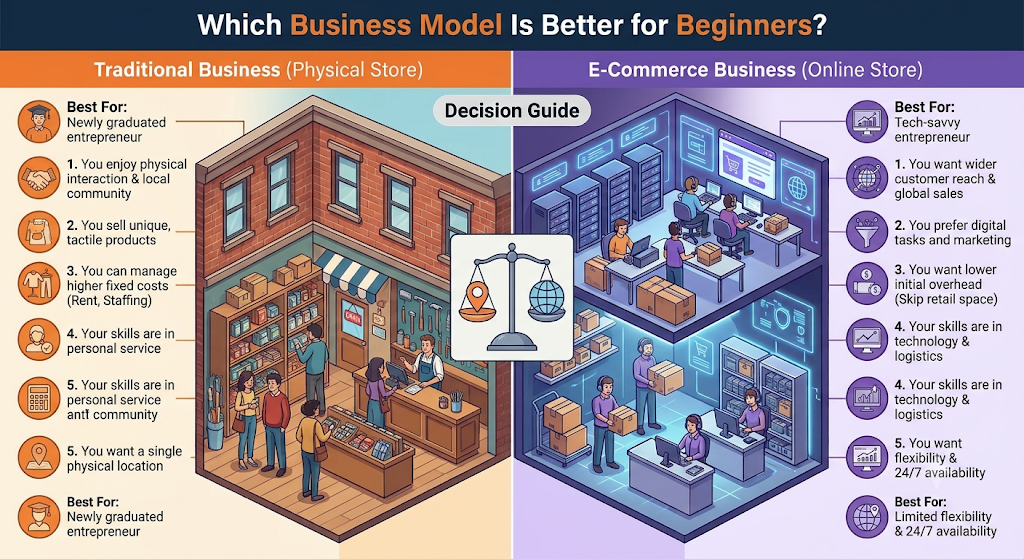
The best business model depends on the entrepreneur’s budget, skills, products, and long-term goals.
Choose a Traditional Business If:
- Your products require physical inspection or personal demonstrations.
- Customers prefer face-to-face interaction.
- You want to serve a specific neighbourhood or local market.
- Your business depends on immediate collection or in-person services.
- You can manage the expenses associated with a physical location.
Examples include local grocery stores, salons, repair shops, restaurants, and physical showrooms.
Choose an E-commerce Business If:
- You want to reach customers beyond your local area.
- Your products can be presented effectively through photographs and descriptions.
- You are comfortable using websites, digital tools, and online payment systems.
- You want to test a business idea without immediately renting a retail shop.
- You can manage packaging, delivery, online support, and returns.
Examples include online clothing stores, handmade-product shops, digital downloads, and niche product stores.
Before making a decision, calculate startup expenses, estimate demand, research competitors, and identify how you will attract customers. Start with a realistic business plan rather than assuming that either model guarantees success.
Can You Combine Traditional and E-Commerce Businesses?
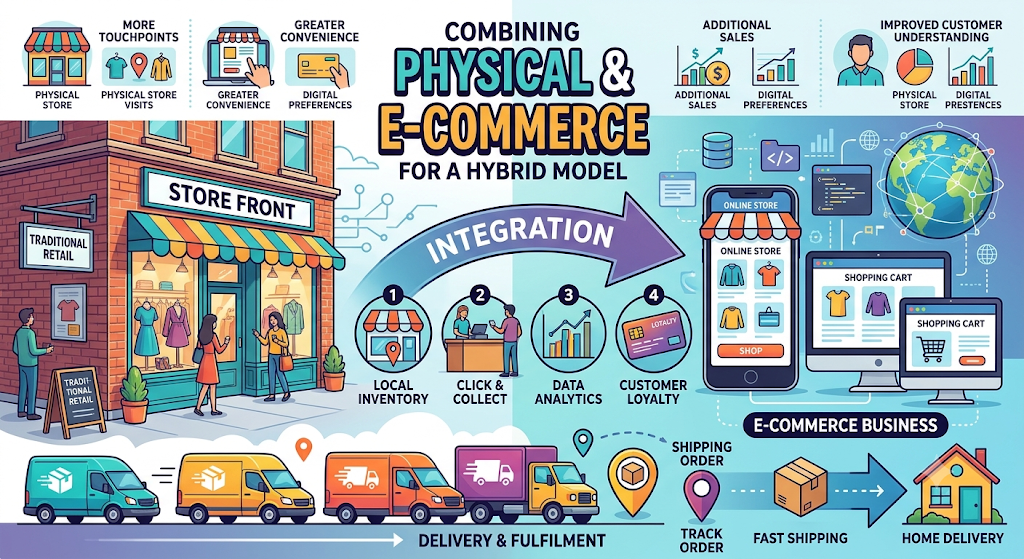
Yes. Entrepreneurs can combine physical and online operations through a hybrid business model. This approach allows a business to maintain a physical shop while also selling through a website or online marketplace.
For example, a local clothing retailer can allow customers to visit its store, try on garments, and receive personal assistance. The same retailer can list selected products online and deliver orders to customers who cannot visit the shop.
A hybrid model can offer several benefits:
- More customer touchpoints: Customers can discover products online and visit the store when needed.
- Greater convenience: Buyers may choose home delivery or in-store collection where supported.
- Additional sales opportunities: The business can serve both local visitors and online shoppers.
- Improved customer understanding: Online and in-store sales data can help identify popular products and customer preferences.
However, a hybrid model also requires coordination between online and physical inventory, consistent pricing, reliable order fulfilment, and clear customer service policies.
For small businesses, it may be practical to begin with one primary sales channel and add another after understanding customer demand and available resources.
Conclusion
Traditional and e-commerce businesses both offer valuable opportunities for entrepreneurs, but they operate in different ways. Traditional businesses provide direct customer interaction, physical product inspection, and immediate access to many products. E-commerce businesses offer digital convenience, wider market reach, and opportunities to operate without a customer-facing retail location.
Choosing between them requires careful consideration of startup costs, target customers, product requirements, marketing methods, and operational capabilities. Entrepreneurs should also evaluate the challenges associated with each model, including fixed expenses for physical stores and logistics or technology risks for online businesses.
For many entrepreneurs, the most suitable option is the one that matches their resources and customers’ expectations. Some may succeed with a traditional shop, while others may prefer an online store. Businesses that need both personal service and digital convenience can also consider combining the two approaches.
Ultimately, long-term success depends on understanding customers, delivering quality products or services, managing costs, and adapting to changing market needs.
FAQs
1. What is the main difference between e-commerce and traditional business? The main difference is how customers purchase products and services. E-commerce businesses sell through websites, mobile applications, or online marketplaces, while traditional businesses generally operate through physical stores or offices.
2. Which is better: e-commerce or traditional business?
Neither model is best for everyone. E-commerce may suit entrepreneurs who want to reach customers online, while traditional business may be better for those who value face-to-face interaction and physical product inspection.
3. Is e-commerce cheaper than a traditional business?
E-commerce can have lower initial costs because it may not require a physical retail shop. However, website development, advertising, inventory, packaging, shipping, and returns can add significant expenses.
4.What are the main advantages of e-commerce?
The main advantages include wider customer reach, flexible shopping hours, convenient online payments, digital marketing opportunities, and the ability to sell without a customer-facing physical store.
5.What are the disadvantages of traditional businesses?
Traditional businesses may face higher rent and maintenance costs, limited operating hours, geographical restrictions, and additional expenses when opening new branches.
6. Can a traditional business sell products online?
Yes. A traditional business can create a website, sell through online marketplaces, or use social media to accept orders. Combining physical and online sales can help businesses serve different customer groups.
7. How do e-commerce businesses attract customers? E-commerce businesses attract customers through search engine optimisation (SEO), social media marketing, online advertising, email campaigns, influencer collaborations, and customer reviews.
8. Is e-commerce suitable for beginners? Yes. Beginners can test business ideas through online marketplaces or small e-commerce websites. However, they should research customer demand, calculate costs, and understand delivery and return requirements before launching.
9. How do traditional businesses build customer trust? Traditional businesses can build trust through personal interaction, consistent product quality, transparent pricing, reliable service, and positive word-of-mouth recommendations.
10. Can e-commerce and traditional businesses work together? Yes. A hybrid business model combines physical stores with online sales. For example, a clothing retailer can allow customers to shop in-store while also accepting website orders and offering home delivery.


