

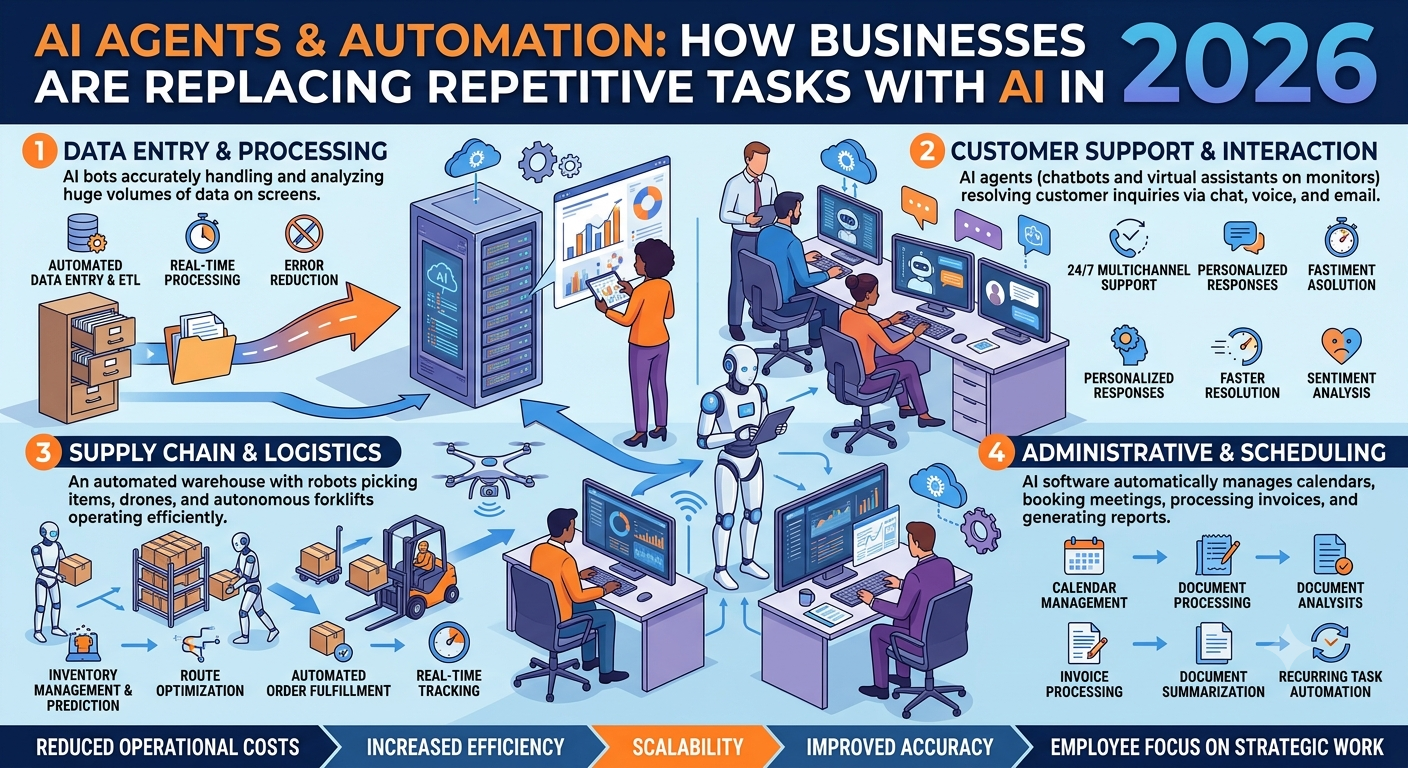
In 2026, businesses are increasingly using AI agents and automation to handle repetitive tasks. AI Agents are now changing how everyday tasks gets done.
The bigger shift, however, is not simply about businesses using AI to save a few minutes here and there. Instead of employees spending hours copying information between systems, responding to the same questions, preparing routine reports, or following predictable workflows, AI-powered systems can increasingly take care of these processes with limited human involvement.
This is creating a new model of work: people focus on decisions, creativity, relationships, and strategy, while AI Agents handle more of the repetitive digital workload.
Table of Contents
What Are AI Agents?
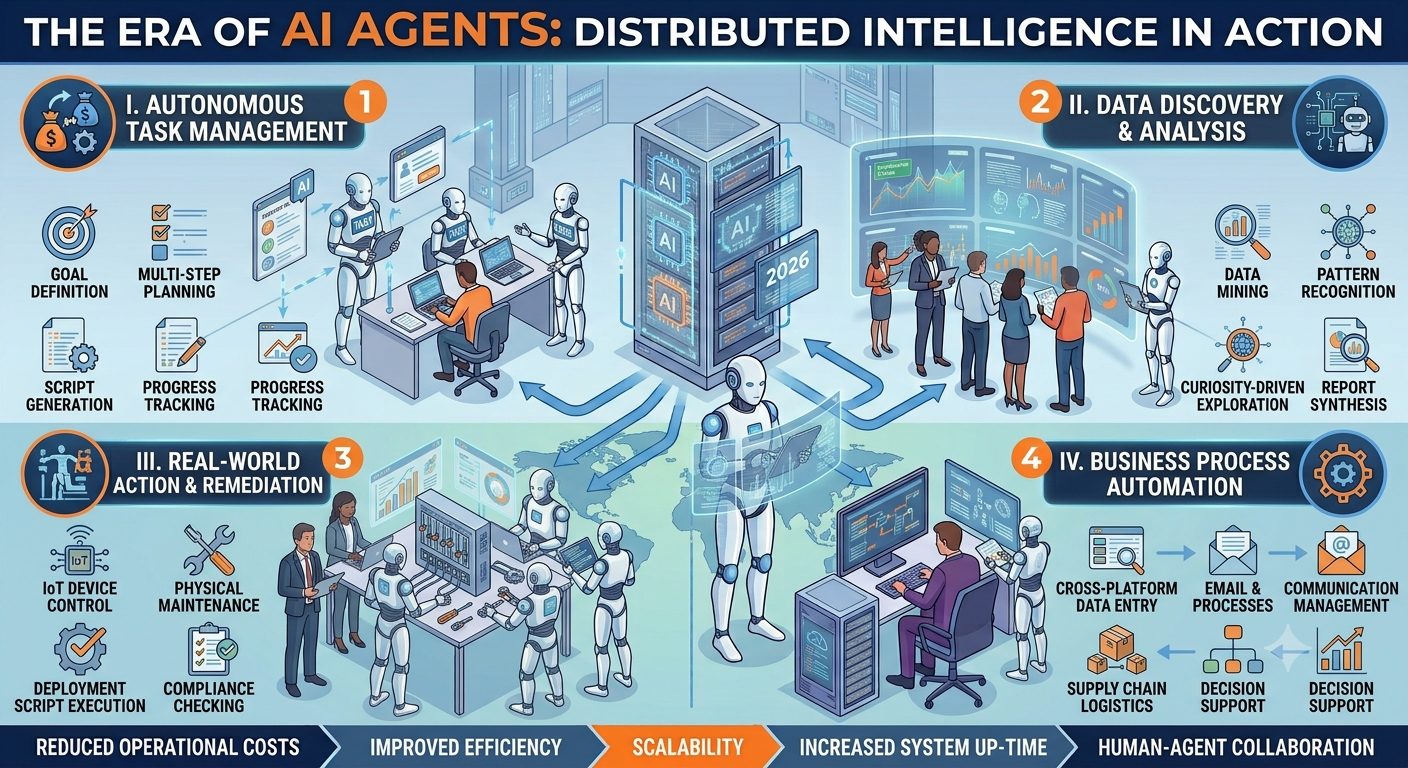
AI agents have the capability to do work more flexibly than old automation.
Instead of being programmed to perform just one specific task, an AI agent can be given a goal, gather information from different sources, figure out what needs to be done, use connected software, and adjust its approach when something unexpected comes up.
For example, a sales AI agent could:
- Read a new customer enquiry
- Check the company’s CRM for relevant information
- Research the customer or their business
- Draft a personalised response
- Schedule a follow-up
- Update the CRM with the latest details
- Identify what the potential customer is actually looking for
- Alert a salesperson when human input is needed
The key difference is that AI agents aren’t limited to carrying out one repetitive task. They can connect several steps together and manage an entire workflow from start to finish, while bringing a human into the process when necessary.
This makes them particularly useful for businesses that handle large volumes of routine digital work, where there are many small tasks that need to happen in the right order.
Departments Using AI Agents
The following services are now using AI Agents:
Customer Service Is Becoming More Automated
Businesses receive thousands of repetitive questions: Where is my order? How do I reset my password? What are your opening hours? Can I change my booking? What is your return policy?
AI-powered support systems can handle many straightforward requests instantly.
More advanced agents can also look at customer records, understand the context of a conversation, and perform actions rather than simply provide information.
An AI agent could potentially check available times and help the customer reschedule directly.
That distinction matters.
The first system provides information. The second helps complete the task.
Human employees can then spend more time dealing with complicated complaints, unusual situations, or customers who genuinely need personal assistance.
Marketing Teams Are Automating Routine Work
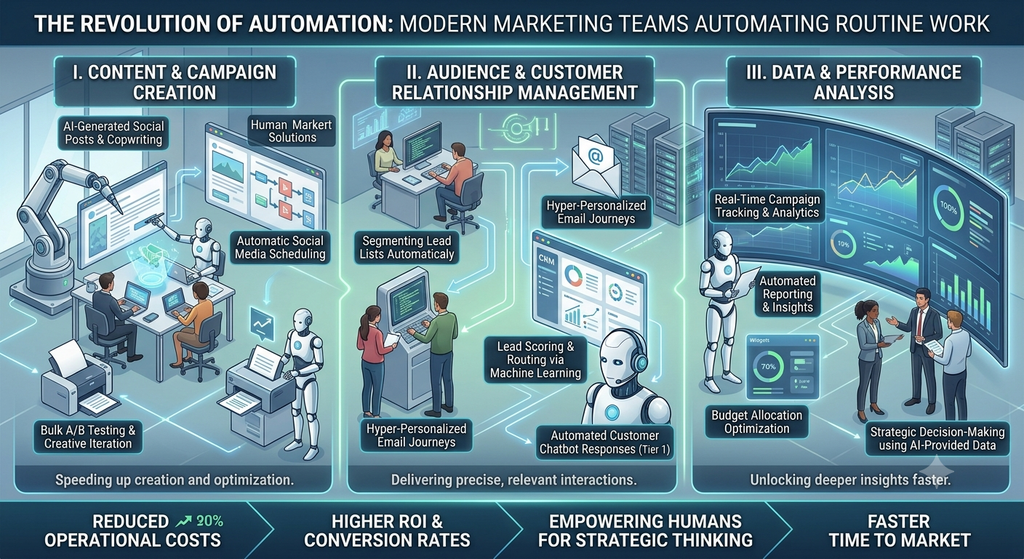
Marketing involves plenty of creative thinking, but it also contains a surprising amount of repetitive administration.
AI agents can perform various tasks that are given in details below:
- Organising leads
- Segmenting audiences
- Drafting email campaigns
- Creating content variations
- Monitoring campaign performance
- Preparing reports
- Identifying potential follow-up opportunities
- Updating marketing databases
This doesn’t mean marketers disappear.
Instead, the role can shift toward deciding what should be communicated, who should receive it, and why.
A marketing manager, for example, might spend less time manually compiling campaign statistics and more time figuring out why a campaign succeeded or failed.
Finance Departments Are Automating Administrative Processes
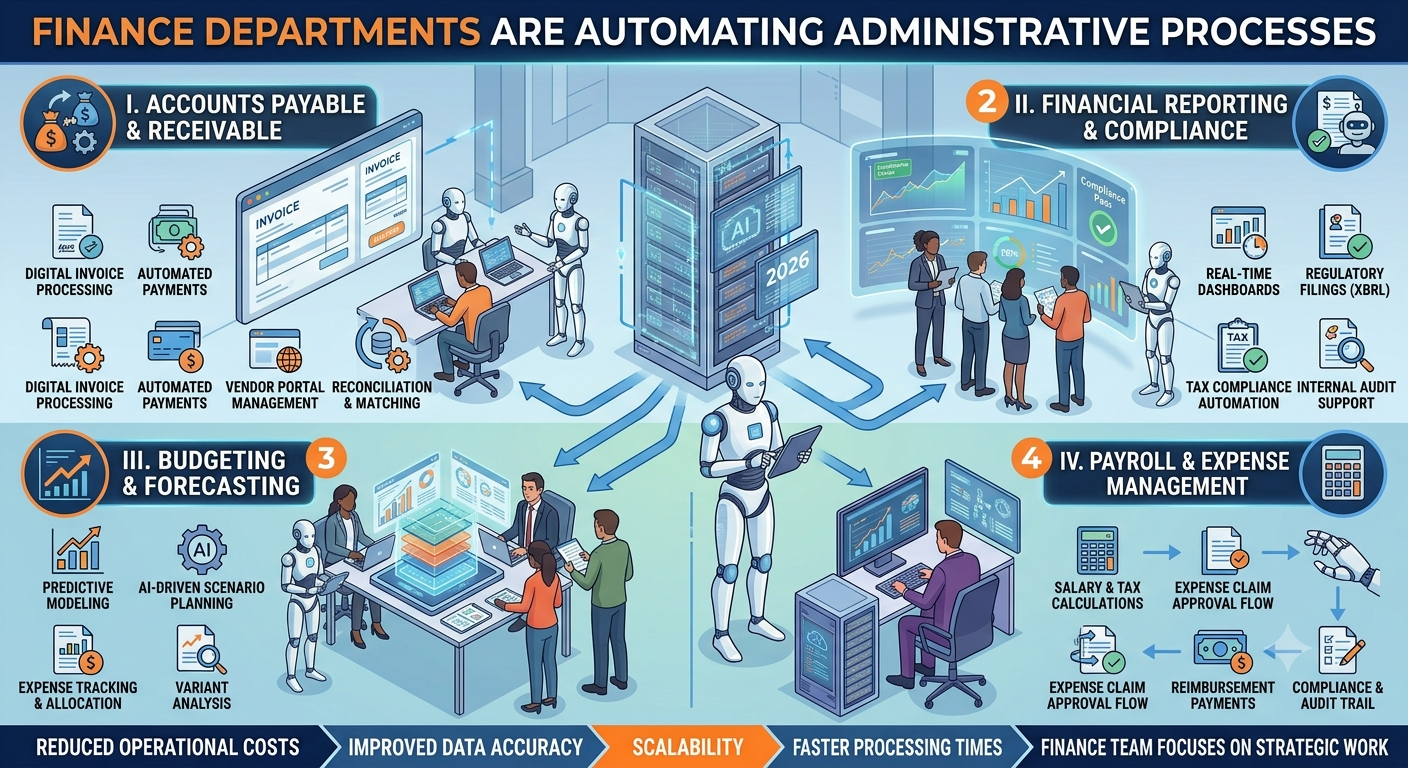
Finance is another area where repetitive processes are common.
Invoices need to be processed. Transactions need to be categorised. Expenses need to be reviewed. Reports need to be prepared. Payment reminders need to be sent.
For example, an AI system could extract information from an invoice, compare it with purchase records, identify inconsistencies, and route exceptions to a finance employee.
The human isn’t removed from the process. Instead, their attention is directed toward the cases that actually require judgment.
IT Departments Are Automating Routine Troubleshooting
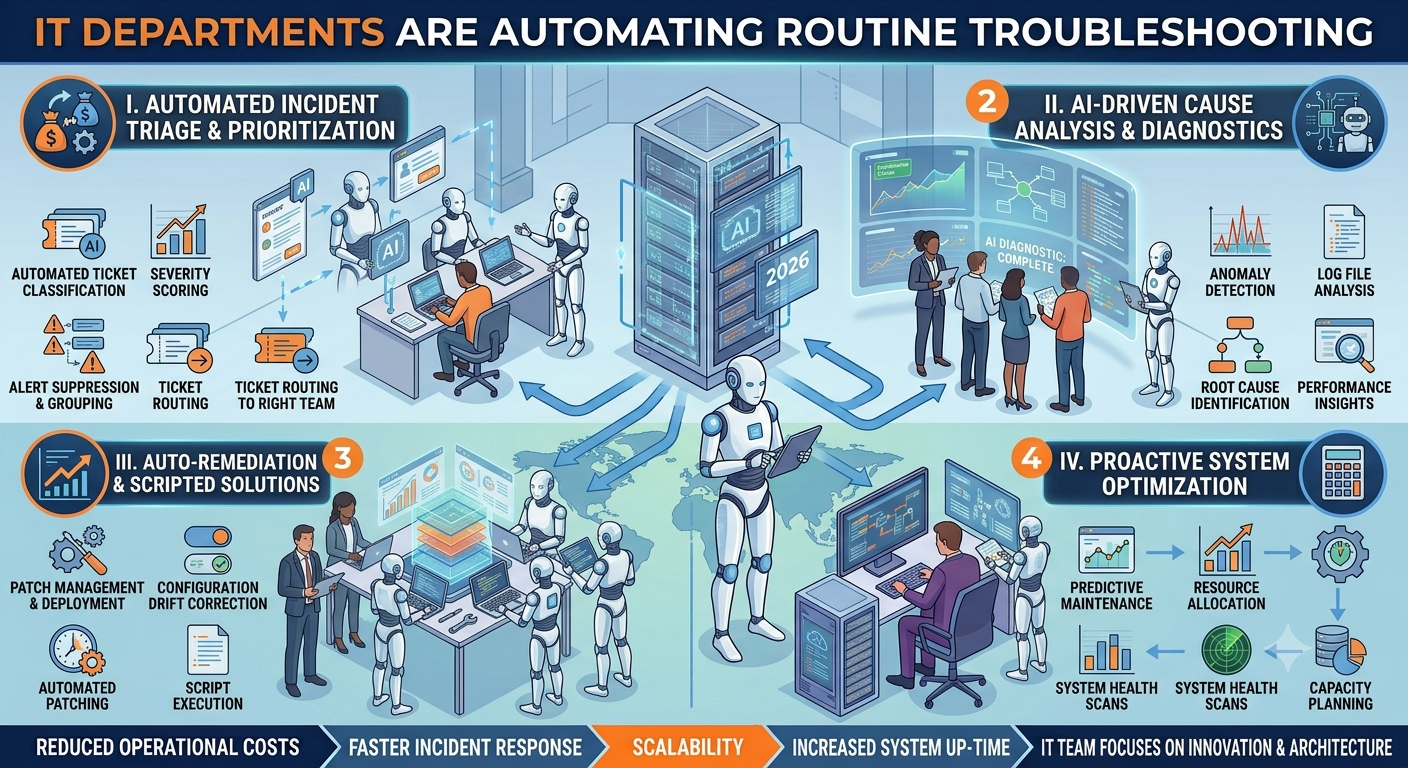
IT teams are currently dealing with several repetitive tasks & requests.
AI agents can potentially handle many basic IT support requests automatically.
They can identify common problems, search internal documentation, guide employees through solutions, and in some environments perform authorised actions.
This can reduce the workload placed on human support teams while giving employees faster answers.
For complex technical problems, however, the AI can escalate the issue to a specialist.
Again, the goal isn’t necessarily to eliminate people. It’s to reduce the number of routine problems that require their direct attention.
What Tasks Should Businesses Automate?
The best starting points are usually tasks that are:
Repetitive: They happen frequently.
Rule-based: There is a relatively clear process for completing them.
Digital: The necessary information already exists electronically.
Low-risk: Mistakes don’t create severe consequences.
The Challenges Businesses Need to Consider
AI automation isn’t magic.
Poorly designed automation can create new problems instead of solving old ones.
One concern is accuracy. AI systems can make mistakes, particularly when information is incomplete or ambiguous.
Then there is accountability.
If an AI agent makes a mistake, who is responsible?
Companies need clear rules around human oversight, permissions, monitoring, and escalation.
Employee training also matters. People need to understand not only how to use AI tools but also when not to trust them.
It is AI handles appropriate tasks, while humans remain responsible for important decisions.
How Small Businesses Can Get Started
AI automation isn’t only for large corporations with huge technology budgets.
Small businesses can start with just simple workflows.
For example:
- Identify one repetitive process.
- See how much time an employee is involved in 1 task and make the imp. measures regarding that
- Document the current workflow.
- Determine which steps can safely be automated.
- Introduce an AI tool or agent.
- Keep human review where necessary.
- Measure the results.
- Improve the workflow before expanding.
A small company doesn’t need 50 AI agents on day one.
Automating one annoying five-hour-per-week process can be a better starting point.
The goal should be measurable improvement, not simply having the latest AI technology.
The Future of Work Is More About Collaboration Than Replacement
The conversation around AI often becomes a debate about whether machines will replace humans.
In practice, the near-term reality is likely to be more nuanced.
Businesses are discovering that AI is particularly useful when combined with human judgement.
AI can process information quickly.
People can understand context.
AI can work continuously.
People can build relationships.
AI can identify patterns.
People can decide what those patterns mean.
That combination can be powerful.
As AI agents become more capable, businesses may increasingly design workflows where machines and employees each handle the parts of the process they are best suited for.
And that may be the real story of AI automation in 2026.
It’s not simply about replacing repetitive jobs.
It’s about replacing repetitive work — and giving people more time to do work that requires genuinely human input.
Conclusion
AI agents are moving beyond the experimental stage and becoming part of everyday business operations.
The biggest opportunity isn’t necessarily creating a company where AI does everything. It’s creating a company where employees don’t have to waste their best hours on work that software can reasonably handle.
That could mean fewer repetitive emails, less manual data entry, faster customer responses, simpler reporting and more streamlined internal processes.
But successful automation isn’t about handing control to AI and walking away.
It’s about finding the right balance.
Let AI handle the repetitive work. Let people handle the work that requires judgement, creativity, empathy and responsibility.
For businesses entering the next phase of AI adoption, that balance may be far more valuable than simply chasing the newest technology.
FAQs About AI Agents and Automation
Below are the FAQs related to AI Agents and Automation:
Q. What is an AI agent?
A. An AI agent is a software system that can understand a goal, make decisions about the steps needed to achieve it, and perform actions using connected tools or systems. Unlike basic automation, AI agents can often handle less predictable workflows.
Q. What business tasks can AI automate?
A. Common examples include customer support, data entry, document processing, scheduling, email management, reporting, lead qualification, invoice processing, IT support and other repetitive digital workflows.
Q. Will AI agents replace human employees?
A. AI is more immediately useful for automating individual tasks and workflows than for replacing entire occupations. The impact varies by industry and job, and many roles are likely to evolve as businesses adopt AI.
Q. Is AI automation only useful for large companies?
A. No. Small and medium-sized businesses can also benefit. In many cases, a small company can start by automating one repetitive process rather than implementing a large AI system.
Q. What is the difference between automation and an AI agent?
A. Traditional automation generally follows predefined rules. AI agents can interpret information, make decisions within defined boundaries, use multiple tools, and adapt their actions based on the situation. Hence, there is now more diversity in the role and the actions. AI Agents can hence perform multiple tasks with a single command. This makes the work easier and faster. The quality as well as the quantity increases.


