

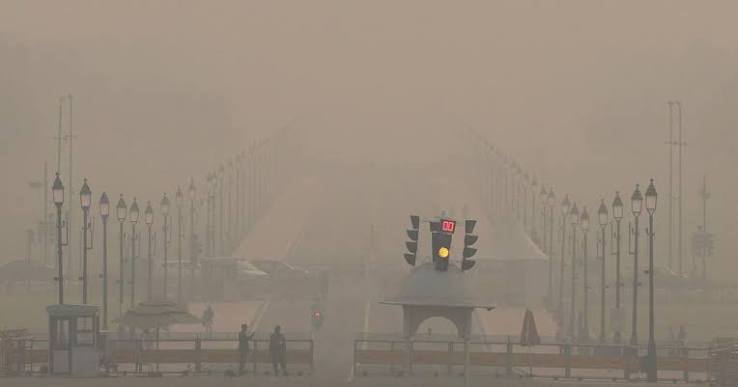
Every year, as the lamps of Diwali go out, a familiar haze settles over the capital. The sky turns a dull grey, eyes begin to sting, and the air quality app on your phone flashes a colour that no one wants to see. People ask the same question again and again: why does Delhi air quality get so bad right after the festival of lights?
The honest answer is that firecrackers are only one part of the story. Think of the problem as a recipe with three ingredients: fuel that keeps adding pollutants to the air, a lid that stops those pollutants from escaping, and a spark that adds a sudden extra load. Diwali is the spark, but the fuel and the lid are already in place. This guide explains each part in simple language, covers the health risks, and shows what you can do to protect yourself.
Table of Contents
What Happens to the Air in the Days After Diwali?
To understand Delhi air quality, it helps to know how air quality is measured and why the days after Diwali matter so much.
Why Timing Matters
Diwali falls in autumn, a season when the weather itself works against clean air. The monsoon has gone, winds are weak and temperatures are starting to fall. Pollutants released during the festival do not get blown away. They hang around, mix with existing pollution and keep the air heavy for days.
How Air Quality Is Measured
India uses the Air Quality Index (AQI), published by the Central Pollution Control Board. It converts several pollutants into a single number and a colour category:
- 0 to 50: Good
- 51 to 100: Satisfactory
- 101 to 200: Moderate
- 201 to 300: Poor
- 301 to 400: Very Poor
- 401 to 500: Severe
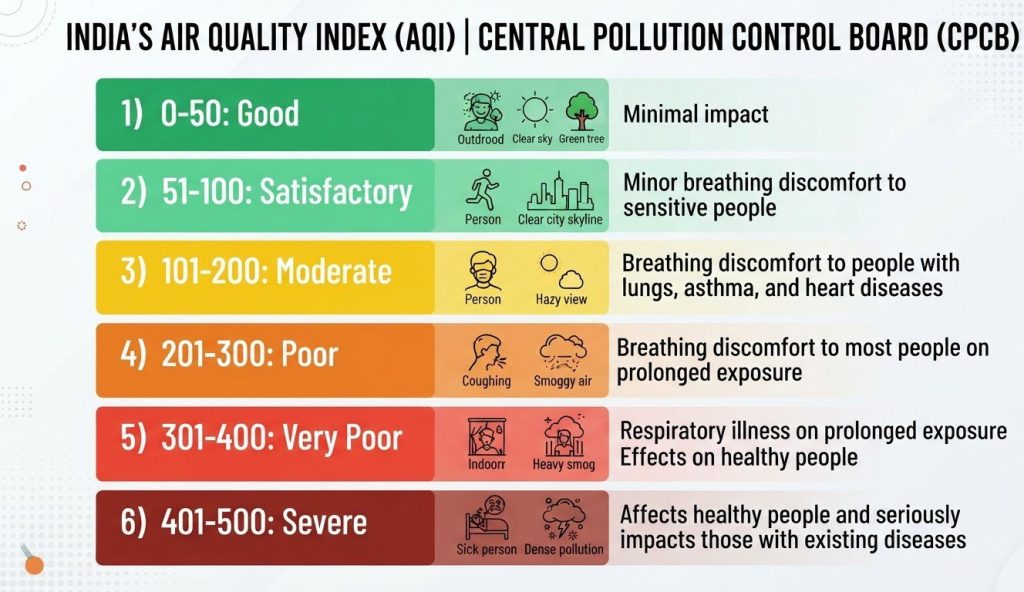
You can check live readings on the official CPCB website. Because these numbers change hourly, always look at a current reading instead of relying on an old forwarded message.
5 Shocking Reasons Delhi Air Quality Gets Worse After Diwali
1. Firecrackers Add a Sudden Burst of Pollutants
Crackers release fine particles and gases such as sulphur dioxide, along with metal compounds that give fireworks their colours. When thousands of people burst them within a few hours, the amount of pollution added to the air rises sharply. Green crackers are promoted as a cleaner option, but they are not pollution-free, and rules about their use change from year to year, so it is best to check official announcements.
2. Stubble Burning in Nearby States
Around the same period, farmers in neighbouring regions clear their fields after the harvest, and burning crop residue is a common practice. Smoke from these fires can travel with the wind towards the capital, pulling down Delhi air quality even before Diwali begins. When the festival adds its own smoke on top, the combined effect is much stronger.
3. Weather Acts Like a Lid
This is the part that surprises many people. In winter, cooler air near the ground can get trapped under a layer of warmer air above it, a condition called temperature inversion. Wind speeds are also low. The result is that pollutants stay close to the ground instead of rising and dispersing. This is why the same amount of pollution can feel far worse in November than in July.
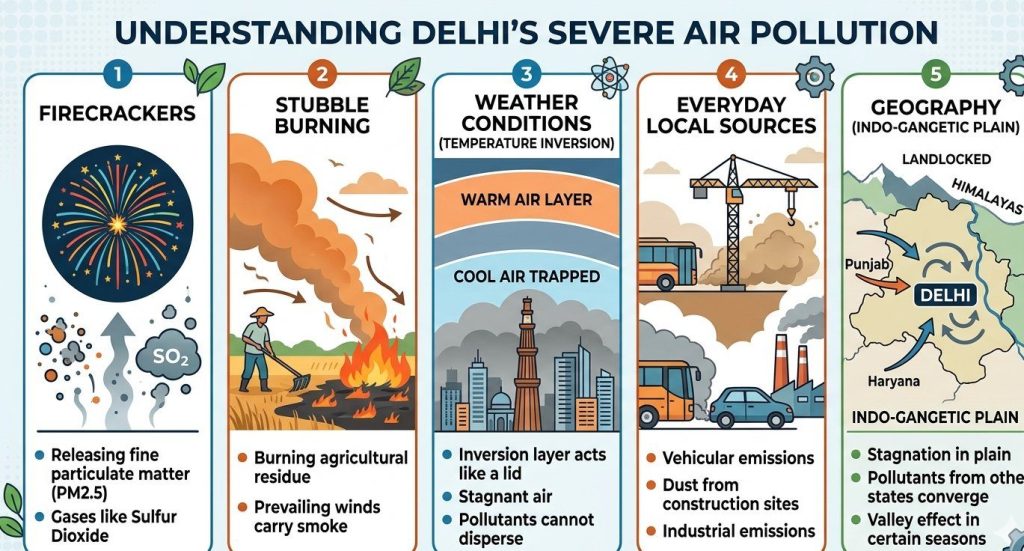
4. Everyday Local Sources Never Stop
Even without Diwali, the city produces a steady stream of pollutants:
- Vehicle exhaust from millions of cars, bikes, trucks and buses
- Dust from roads and construction sites
- Industrial emissions in and around the city
- Burning of waste and biomass, including for heating
When fireworks are added to this base load, a bad situation becomes worse. Experts often say that poor Delhi air quality is not caused by one source, but by many sources that add up.
5. Geography Keeps the Pollution Trapped
Delhi is far from the sea, and it sits in the Indo-Gangetic plain, a vast flat region where the air can stagnate. Without sea breezes or mountains to channel the wind, pollutants spread across the whole region and remain for long periods. That is why the problem affects not only Delhi but also the surrounding National Capital Region.
What Is PM2.5 and Why Is It So Dangerous?
When you read about Delhi air quality, you will often see the term PM2.5.
Understanding Particulate Matter
PM2.5 refers to particles smaller than 2.5 micrometres, much thinner than a human hair. PM10 refers to particles up to 10 micrometres. Their small size is the problem, because they can travel deep into the lungs, and the smallest of them can enter the bloodstream.
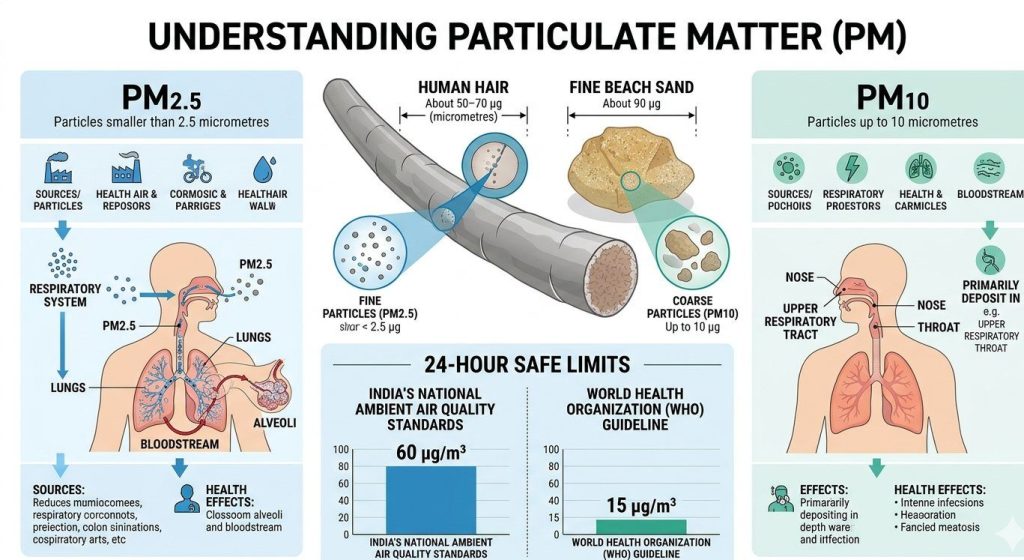
Safe Limits
India’s National Ambient Air Quality Standards set a 24-hour limit of 60 micrograms per cubic metre for PM2.5. The World Health Organization’s 2021 guideline is much stricter, at 15 micrograms per cubic metre over 24 hours. You can read more on the WHO air pollution page.
Health Effects of Poor Delhi Air Quality
Poor Delhi air quality does not affect everyone in the same way.
Short-Term Effects of Poor Delhi Air Quality
Many people notice some or all of these after Diwali:
- Burning or watery eyes
- Cough, sore throat and a heavy feeling in the chest
- Headaches and tiredness
- Breathing difficulty in people with asthma
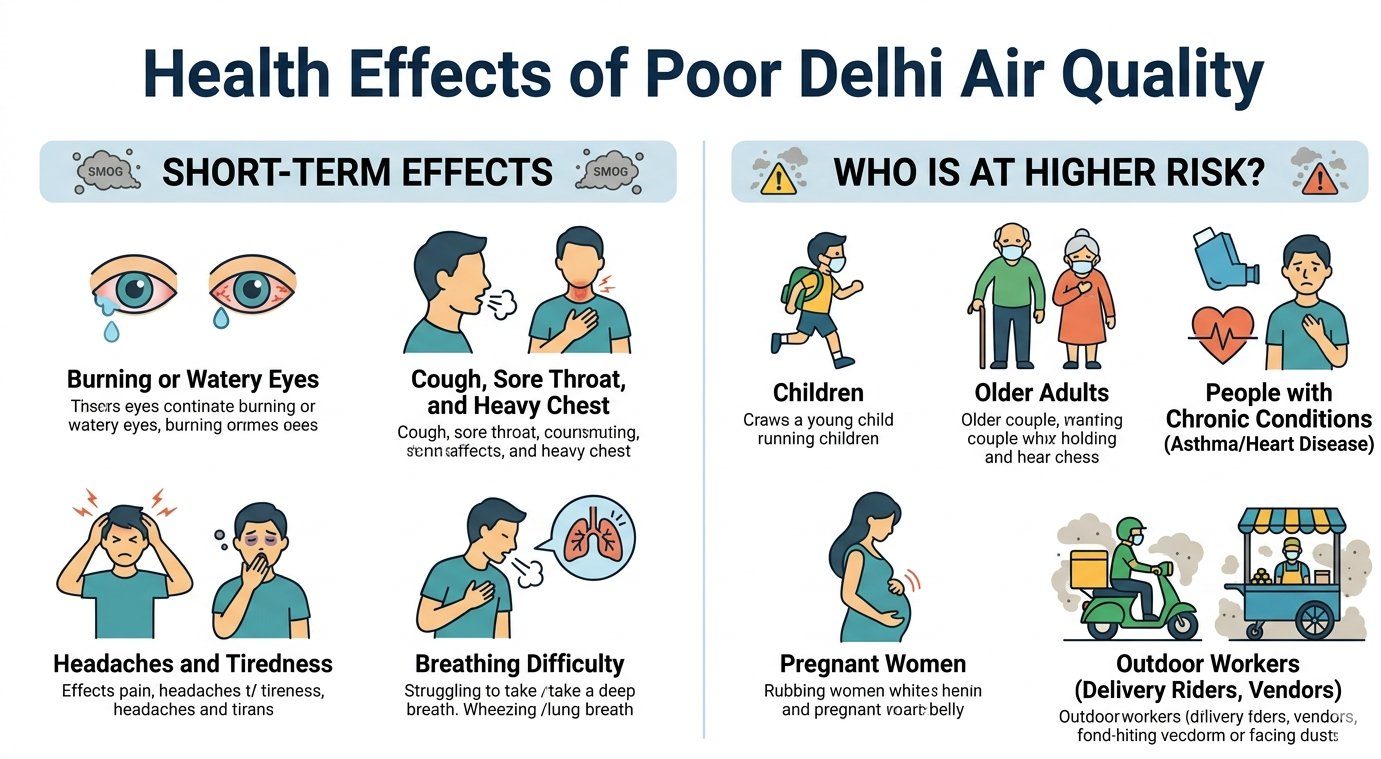
Who Is at Higher Risk?
- Children, whose lungs are still developing
- Older adults
- People with asthma, heart disease or other lung conditions
- Pregnant women
- Outdoor workers, such as delivery riders, traffic police and street vendors
Long-Term Concerns
Repeated exposure over many years is linked with lung and heart problems. This is why Delhi air quality is treated as a public health issue and not just a seasonal inconvenience.
How Authorities Respond
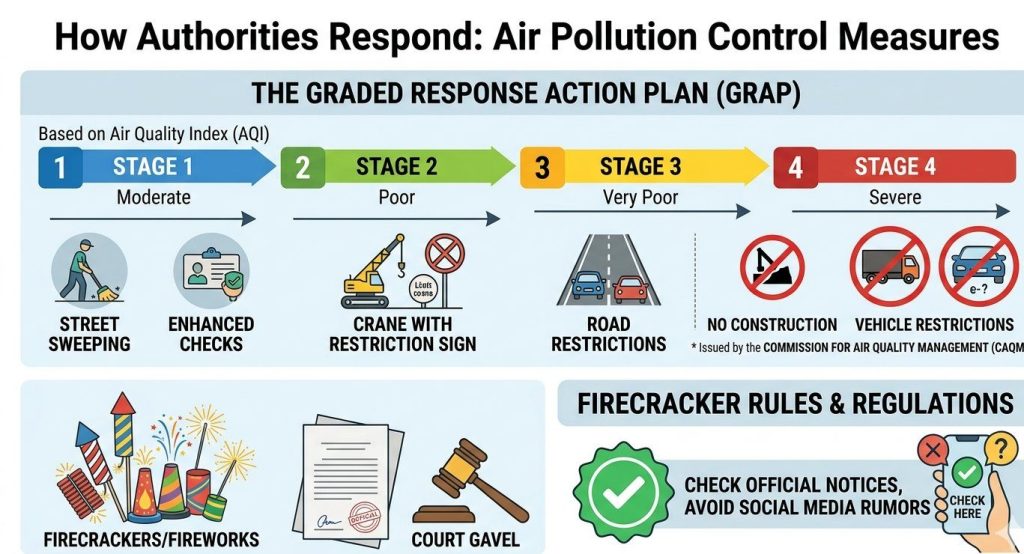
The Graded Response Action Plan
Delhi and the surrounding region use the Graded Response Action Plan, often called GRAP. It sets stages of restrictions that become stricter as the AQI worsens, such as limits on construction activity and certain vehicles. The Commission for Air Quality Management publishes orders and updates about these measures.
Firecracker Rules
Authorities have restricted or regulated firecrackers in Delhi in various years. The rules depend on court orders and government notifications, so check the latest official notice rather than depending on social media posts.
7 Practical Ways to Protect Yourself
These steps cannot clean the air, but they can reduce your exposure when Delhi air quality is poor.
Check the AQI Before Going Out
Look at a reliable live reading and plan outdoor activity for times when the air is cleaner, usually later in the day when the sun has warmed the air.
Wear a Proper Mask
Cloth masks do little against fine particles. A well-fitted N95 or FFP2-type mask offers better protection when you must be outside.
Keep Windows Closed During Peak Pollution
Ventilate your home when the AQI is lower, and keep windows closed when it is at its worst.
Use an Air Purifier Wisely
A purifier with a HEPA filter can help in a closed room. Check the room size it is rated for and replace filters on time.
Avoid Outdoor Exercise on Bad Days
Heavy exercise makes you breathe deeper and faster, which draws more pollution into your lungs. Exercise indoors when the AQI is high.
Stay Hydrated and Eat Well
Water and nutritious food support your body, though they are not a cure for pollution.
Watch for Warning Signs
If you or a family member has severe breathlessness, chest pain or worsening asthma, see a doctor promptly.
3 Common Myths About Delhi Air Quality
Myth 1: It Is Only a Diwali Problem
Air quality in the city often worsens in the weeks around Diwali because of the season, not just the festival. Poor Delhi air quality has many sources that continue all year.
Myth 2: Staying Indoors Makes You Completely Safe
Indoor air is usually cleaner than outdoor air, but fine particles still enter homes through doors, windows and gaps. Closing windows during peak hours and using a purifier helps, but it does not remove the risk entirely.
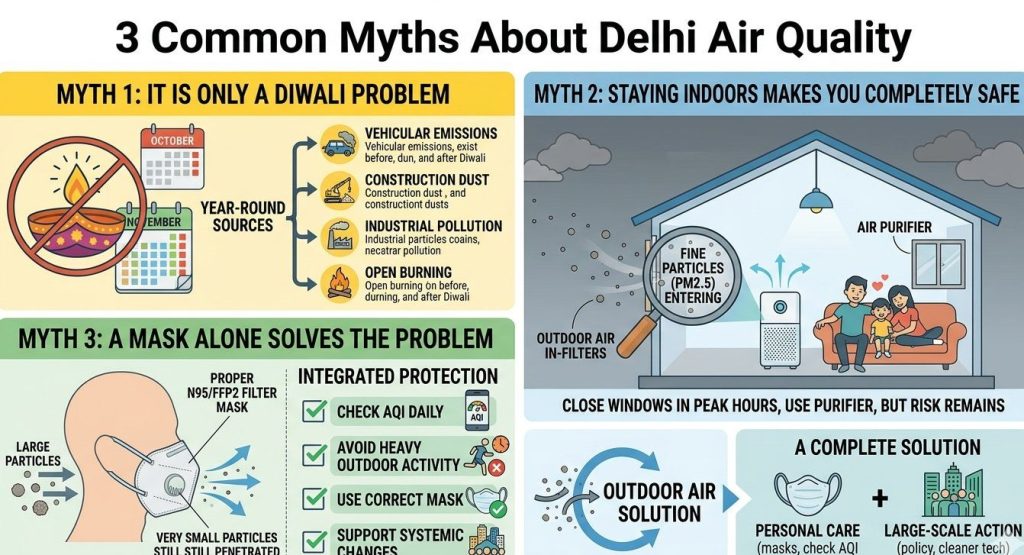
Myth 3: A Mask Alone Solves the Problem
A good mask reduces exposure, but it works best together with other steps such as checking the AQI and avoiding heavy outdoor activity. Improving Delhi air quality needs both personal care and large-scale action.
What Can Improve Delhi Air Quality in the Long Run?
No single action will solve the problem. Progress comes from many changes working together.
Cleaner Celebrations
Light lamps, use diyas and enjoy community events that do not rely on heavy firecrackers. Many families now celebrate with rangoli, music, sweets and decorations.
Better Public Transport and Fewer Private Vehicles
More buses, metro use, carpooling and electric vehicles reduce emissions throughout the year.
Controlling Dust and Waste Burning
Covering construction sites, sweeping roads with proper methods and stopping open waste burning make a real difference.
Regional Cooperation
Because pollution crosses state borders, farmers, governments and cities need to work together on solutions such as alternatives to crop burning.
Frequently Asked Questions (FAQs) About Delhi Air Quality
Why does Delhi air quality worsen after Diwali?
It increases because firecracker smoke is added to existing pollution from vehicles, dust and nearby crop burning, while cool weather and low wind keep the pollutants close to the ground.
Are firecrackers the only cause of poor Delhi air quality?
No. Vehicles, dust, industry, waste burning, stubble burning and weather conditions all contribute. Firecrackers add a sudden extra load.
What is AQI and how is it measured?
AQI is a number from 0 to 500 that summarises air quality based on several pollutants. In India it is published by the Central Pollution Control Board.
What AQI level is considered unhealthy in India?
Readings above 200 fall into the Poor category, and readings above 300 are Very Poor. At 401 and above, air quality is Severe.
What is PM2.5?
PM2.5 is fine particulate matter smaller than 2.5 micrometres. It can enter deep into the lungs and is one of the most harmful air pollutants.
Are green crackers safe?
Green crackers are designed to release fewer pollutants, but they are not pollution-free. Rules about their use can change, so check current official guidance.
Does an N95 mask protect against pollution?
A well-fitted N95 or FFP2-type mask can filter many fine particles and offers better protection than a cloth or surgical mask.
Who should be most careful during high pollution?
Children, older adults, pregnant women and people with asthma or heart and lung conditions should be most careful and limit outdoor exposure.
What is GRAP in Delhi?
GRAP is the Graded Response Action Plan, a set of stage-wise measures that become stricter as the air quality worsens in Delhi and the surrounding region.
How long does the pollution last after Diwali?
It depends on the weather. With low wind and cool temperatures, high pollution can last for several days, and it improves faster when winds pick up or it rains.
Conclusion
The haze that follows Diwali is not a one-night problem. Poor Delhi air quality is the result of everyday sources, seasonal farming practices, weather that traps pollutants and a sudden festival spike. Understanding these layers makes it easier to protect your health today and to support the changes that can improve the air tomorrow. Check the AQI, take precautions and consider celebrating in ways that keep the sky a little clearer for everyone.


