


Introduction
Reliance Jio IPO 2026 became one of the most significant events in India’s stock market. Jio Platforms Limited, the digital services company controlled by Reliance Industries, entered the public market with an offering that attracted considerable attention from retail investors, institutional investors, and financial analysts. Known for transforming India’s telecommunications industry through affordable mobile data and digital connectivity, Jio has expanded its business beyond mobile services. The company’s initial public offering (IPO) marked an important milestone in its growth journey.
The Jio IPO 2026 represents an exciting milestone in India’s evolving business and technology landscape. Its stock market listing has encouraged discussions about the future of India’s digital economy and the opportunities available to public investors.The Jio IPO 2026 has attracted attention from business professionals, stock market followers, and technology enthusiasts across India. As the country continues to embrace digital services, Jio Platforms has become an important name in telecommunications and digital connectivity.
Investors should also consider the company’s financial position, revenue sources, growth plans, competitive environment, and possible risks. Whether you are a beginner learning about IPOs or a reader interested in India’s digital economy, this guide will help you understand the key details and make sense of the discussions surrounding Jio Platforms.
Table of Contents
What Is the Reliance Jio IPO?

An initial public offering, or reliance jio IPO, is the process through which a company offers its shares to public investors for the first time and lists those shares on a stock exchange. The IPO opened for subscription on October 21 and closed on October 23, 2026. The shares subsequently began trading on October 28, 2026.
7 Key Facts About the Reliance Jio IPO 2026
1. India’s Biggest IPO at the Time of Its Launch
The company planned to raise approximately ₹30,213 crore at the upper end of its price band, making it India’s largest IPO at the time. The offering surpassed the previous record held by Hyundai Motor India’s ₹27,800 crore IPO in October 2024.
2. IPO Price Band and Issue Size
The company offered up to 270 million fresh equity shares, with a face value of ₹10 each. The IPO’s price band was not a guarantee of future market performance. Once shares begin trading, their market price can move above or below the issue price depending on investor demand, financial results, market conditions, and expectations about the company’s future.
3. Jio Platforms Received Strong Investor Interest
Reliance Jio IPO attracted considerable attention from investors. <Cite refs={[“turn142285search7″,”turn142285search6”]}/> Strong subscription demand can indicate that investors are interested in a company’s business model and future prospects. Investors should distinguish between demand during an IPO and the company’s long-term ability to generate profits.
4. Jio’s Stock Market Debut Drew Major Attention
Investors who follow newly listed companies should therefore monitor performance over time rather than relying only on the first trading day’s results.
5. Telecommunications Remains Jio’s Core

Jio’s growth story began with telecommunications. The business serves a large subscriber base and has become an important part of the country’s telecommunications industry. Its services support activities such as online education, digital payments, entertainment, remote work, and business communication.
Telecommunications contributed approximately 90% of these figures. <Cite refs{[“turn142285search1″,”turn142285news11”]}/> This concentration is important for investors. Although Jio has opportunities to expand into other technology businesses, its financial performance remains closely connected to its core connectivity operations.
6. Jio Is Expanding Beyond Mobile Connectivity
These areas could create opportunities for additional revenue and strengthen Jio’s position in India’s digital economy. For example, enterprise cloud services can help organisations modernise their technology infrastructure, while AI applications may support automation, customer service, data analysis, and other business processes.
7. Reliance Jio IPO Proceeds Are Intended to Support the Business
Repaying or prepaying borrowings can help a business manage its financial obligations and potentially reduce future interest expenses. For investors, understanding how a company plans to use IPO proceeds is an important part of evaluating the offering. At the same time, the company’s financial position may improve if the proceeds are used effectively to reduce debt.
Why Does the Reliance Jio IPO Matter to India’s Economy?

The Reliance Jio IPO is significant for several reasons.
Finally, the company’s future investments in connectivity, cloud computing, and AI could influence the development of India’s technology ecosystem. The extent of that impact will depend on execution, competition, customer demand, and profitability.
What Are the Potential Opportunities for Investors?
Reliance Jio IPO Platforms has several characteristics that investors may consider attractive.
Large customer base: Its established telecommunications business gives the company access to a substantial market.
Multiple growth areas: Broadband, enterprise services, cloud computing, and AI could provide opportunities beyond mobile connectivity.
Digital transformation: Businesses and consumers continue to depend on digital infrastructure, creating potential demand for connectivity and technology services.
These factors can support a positive long-term business outlook. However, potential opportunities must be weighed against the company’s valuation and the risks associated with operating in competitive markets.
What Risks Should Investors Understand?

Every stock market investment involves risk, including investments in well-known companies.
- Valuation Risk
A company may have strong business prospects but still be expensive at a particular share price.
- Competition
The telecommunications industry is competitive. Pricing decisions, network quality, subscriber retention, and investment requirements can influence profitability.
- High Capital Expenditure
Spending on network expansion, spectrum, data centres, and new technologies can affect cash flow.
- Execution Risk
Expansion into AI, cloud computing, and enterprise technology does not guarantee commercial success. New services must attract customers and generate sustainable returns.
- Regulatory Risk
Telecommunications and digital services operate under regulatory frameworks.
Investors should read the risk factors in the official Red Herring Prospectus and consider their own financial circumstances before investing.
How Can Investors Evaluate Reliance Jio IPO Platforms After Listing?
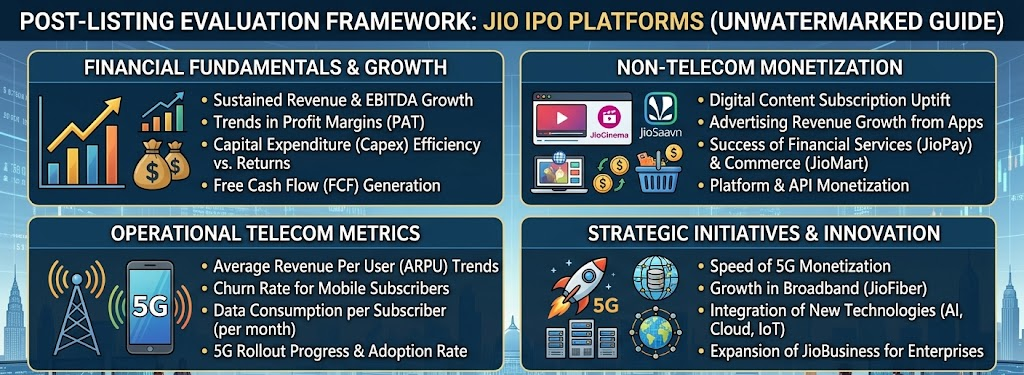
Here are some useful factors to monitor:
- Profitability: Examine operating margins, net profit, and earnings per share.
- Capital expenditure: Understand how much the company invests in network infrastructure and new businesses.
- New business revenue: Look for evidence that cloud, enterprise, and AI-related services are contributing financially.
Investors should use official company disclosures, stock exchange filings, and credible financial reporting rather than relying on rumours or unverified social media claims.
Conclusion
The Jio IPO 2026 marked a major milestone in India’s stock market and the development of its digital economy. Its record-setting issue size, strong investor interest, market debut, established telecommunications operations, and expansion into emerging technologies made it an important event for investors to follow. At the same time, the company’s future performance will depend on sustainable revenue growth, profitability, financial discipline, competition, and its ability to turn investments in new technologies into successful businesses.
For investors, the most important lesson from the Jio IPO is to make informed decisions rather than follow market excitement alone. Investors should regularly review financial statements, company announcements, valuation measures, and industry developments before deciding whether a stock suits their financial goals. A positive outlook combined with careful research can help investors develop a more balanced understanding of market opportunities. Following the company’s progress over the coming quarters will help readers better understand its long-term performance and contribution to India’s digital future.
FAQs
1. What is the Jio IPO 2026? It is Initial Public Offering controlled by Reliance Jio IPO Industries. Its shares began trading on October 28, 2026.
2. What was the Jio IPO price band? The announced price band was ₹1,065 to ₹1,119 per share.
3. What is the difference between Jio Platforms and Reliance Industries?
Reliance Industries is a diversified business group with operations across several sectors, including energy, retail, and digital services. Jio Platforms is its digital services subsidiary, which includes the telecommunications business and other technology-related operations.
4. When did Jio Platforms list on the stock market? Jio Platforms listed on October 28, 2026.
5. Was the Jio IPO India’s biggest public offering? Yes. At the time of its launch, it was India’s largest IPO by issue size, surpassing Hyundai Motor India’s October 2024 offering.
6. How can investors check Jio Platforms’ latest financial results?
Investors can check Jio Platforms’ official announcements, stock exchange filings on the NSE and BSE websites, and quarterly financial reports to understand its revenue, profits, debt, and business growth.
7. Is the Jio IPO a guaranteed profitable investment? No. Investors should evaluate valuation, financial performance, market conditions, and personal risk tolerance.
8.Where can investors find official Jio IPO information? Investors can consult the company’s official disclosures, the Securities and Exchange Board of India (SEBI), and the National Stock Exchange (NSE) or Bombay Stock Exchange (BSE) websites.
9. What makes the Jio IPO important for India’s digital economy?
The Jio IPO highlights the growing importance of telecommunications, digital connectivity, and technology services in India. Its public listing also gives investors an opportunity to follow the company’s financial performance and future expansion.
10. What factors could affect Jio Platforms’ share price after listing?
Jio Platforms’ share price may be affected by quarterly earnings, subscriber growth, competition, new technology investments, market conditions, regulatory changes, and investor sentiment.


