

Quantum computing could threaten modern encryption. Discover how quantum computers work, the risks to digital security and how post-quantum cryptography protects data.
Introduction
Every time someone makes an online payment, signs in to an account, sends a private message or stores information in the cloud, encryption helps protect that data. It works quietly in the background, making it difficult for unauthorised people to read sensitive information.
However, advances in computing are creating new questions about how long today’s security methods will remain reliable. One technology attracting particular attention is quantum computing. Unlike conventional computers, quantum machines use principles of quantum physics to process information. This different approach could allow them to solve certain mathematical problems much more efficiently.
The concern is especially important for public-key encryption. Some widely used systems depend on mathematical problems that are extremely difficult for ordinary computers but could become manageable for a sufficiently powerful quantum computer.
This does not mean that today’s quantum machines can break everyone’s passwords or access encrypted bank accounts. Practical quantum attacks against widely used cryptographic systems would require much more capable and reliable machines than those currently available.
Nevertheless, security researchers are preparing for that possibility. New cryptographic methods are already being developed and standardised to protect information in a future where quantum computers may become more powerful.
In this guide, we explain what quantum computing means, how quantum computers operate, which encryption methods could be affected and how organisations can prepare for future cybersecurity challenges.
Table of Contents
- What Is Quantum Computing?
- What Is a Quantum Computer and How Does It Work?
- Why Could Quantum Computing Threaten Modern Encryption?
- How Does Shor’s Algorithm Affect Encryption?
- Can Quantum Computers Break All Types of Encryption?
- What Is Post-Quantum Cryptography?
- How Are Governments and Technology Companies Preparing?
- What Is Meant by Applied Quantum Computing?
- How Can You Learn Quantum Computing?
- The Future of Quantum Computing and Cybersecurity
- Frequently Asked Questions
- Conclusion
1. What Is Quantum Computing?
Quantum computing is a field of computing that uses principles from quantum mechanics to process information. Quantum mechanics describes how extremely small particles, such as electrons and photons, behave.
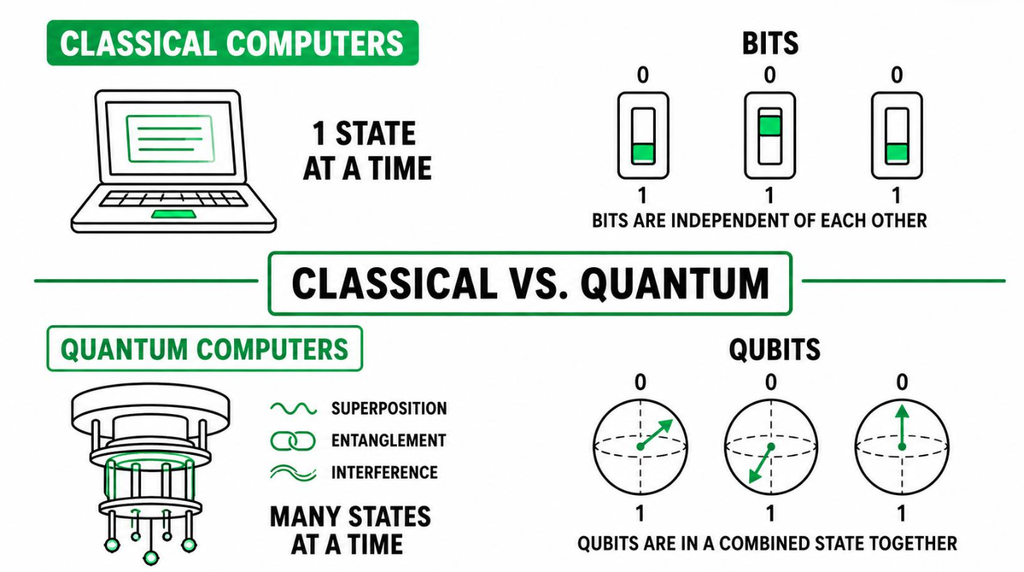
Traditional computers store information using bits. Each bit has one of two possible values: 0 or 1. These bits are combined to perform calculations, run applications and process information.
Quantum computers use a different unit called a qubit, or quantum bit. A qubit can be prepared in a combination of the states represented by 0 and 1. This property is known as superposition.
Quantum systems can also use entanglement and interference. Together, these properties allow quantum algorithms to approach certain problems differently from classical algorithms.
How Is Quantum Computing Different from Classical Computing?
The main distinction is the way information is represented and manipulated.
- Classical computing: Uses ordinary bits that represent either 0 or 1.
- Quantum computing: Uses qubits that can be prepared in superpositions of quantum states.
- Quantum operations: Use quantum gates to change qubit states and control how possible outcomes interact.
Quantum computers are not replacements for every traditional computer. They are being developed for specialised tasks where quantum algorithms may offer an advantage.
Why Is Quantum Computing Important?
Researchers are investigating this technology because it may help with problems that are difficult to model using conventional methods.
Potential research areas include:
- Simulating molecules and chemical reactions.
- Studying new materials and their properties.
- Exploring selected optimisation problems.
- Investigating complex physical systems.
- Understanding the future security of cryptographic algorithms.
Its relationship with cybersecurity is particularly important. Some quantum algorithms could weaken the mathematical assumptions behind encryption systems that protect internet communications.
For this reason, quantum computing is not only a scientific development. It is also becoming an important subject for technology companies, governments and information-security professionals.
2. What Is a Quantum Computer and How Does It Work?
A quantum computer is a specialised machine that uses quantum systems to perform calculations. Instead of relying only on conventional electronic logic, it controls physical qubits and applies carefully designed quantum operations.
Different research teams are developing qubits using different technologies. These include superconducting circuits, trapped ions, neutral atoms and photons. Each method has its own engineering requirements and technical limitations.
What Are Qubits?
A qubit is the basic unit of quantum information.
A normal computer bit has a definite value of either 0 or 1. A qubit can be prepared in a combination of these states, with different probability amplitudes.
When a qubit is measured, the result is a definite classical value. This is why it is inaccurate to say that a quantum computer simply reads every possible answer at the same time.
The advantage comes from designing quantum operations so that useful outcomes become more likely when the system is measured.
What Is Superposition?
Superposition is a property that allows a quantum system to exist in a combination of possible states before measurement.
Quantum algorithms use this property to represent and manipulate information in ways that are different from ordinary binary computing.
However, superposition alone does not guarantee faster calculations. The algorithm must be designed so that the quantum states work together to produce a useful result.
What Is Quantum Entanglement?
Entanglement occurs when two or more qubits share a connected quantum state. Their measurement results can be correlated in ways that cannot be explained by treating each qubit as an independent classical object.
This property is important in many quantum computing operations. It allows information to be distributed across multiple qubits as part of a combined quantum state.
How Does a Quantum Computer Process Information?
A quantum computation generally involves several stages:
- Qubit preparation: The machine prepares qubits in the required initial states.
- Quantum gates: A sequence of operations changes the states of the qubits.
- Algorithm execution: The operations are arranged to solve a particular problem.
- Measurement: The quantum system is measured to obtain classical results.
- Classical processing: Conventional computers may process the results and help control the overall system.
One major challenge is that qubits are extremely sensitive to their surroundings. Heat, vibrations and other environmental disturbances can introduce errors. Researchers are therefore working on better hardware, improved control systems and quantum error correction.
3. Why Could Quantum Computing Threaten Modern Encryption?
Encryption protects information by transforming readable data into a form that cannot easily be understood without the correct key.
For example, when someone visits a secure website, cryptographic methods help protect information exchanged between the browser and the website. Similar methods are used in online banking, messaging services, cloud storage and digital identity systems.
Many existing security systems depend on mathematical problems that conventional computers cannot solve efficiently at the key sizes used in practice.
A sufficiently powerful quantum computer could change this situation for certain cryptographic methods.
The Role of Public-Key Cryptography
Public-key cryptography uses a pair of mathematically related keys:
- A public key can be shared with other people.
- A private key must be protected by its owner.
These systems support secure communication, digital signatures and identity verification.
RSA and elliptic-curve cryptography are important examples of public-key methods. Their security relies on mathematical problems that are difficult for classical computers to solve efficiently.
Why Could These Systems Become Vulnerable?
A quantum computer running an appropriate algorithm could solve some of the mathematical problems used by these systems much more efficiently.
If such a machine becomes sufficiently powerful and reliable, it could potentially undermine certain forms of key exchange and digital signatures.
This could affect systems that depend on these methods, including secure communication protocols, digital certificates and software-signing processes.
It is important to distinguish a future theoretical capability from a current attack. Today’s quantum computers are not capable of carrying out these large-scale cryptographic attacks against widely deployed keys.
What Is the Harvest Now, Decrypt Later Risk?
One concern is known as harvest now, decrypt later.
In this scenario, an attacker collects encrypted information today and keeps a copy of it. The attacker may attempt to decrypt that information in the future if sufficiently capable quantum computers become available.
This creates a problem for information that must remain confidential for many years.
Examples include:
- Government and diplomatic communications.
- Long-term business records.
- Sensitive research information.
- Personal and financial records.
- Confidential healthcare information.
Organisations should therefore consider how long their information needs protection, rather than waiting until quantum computers can perform practical attacks.
4. How Does Shor’s Algorithm Affect Encryption?
Shor’s algorithm is one of the most important discoveries in quantum computing research because of its possible effect on public-key cryptography..
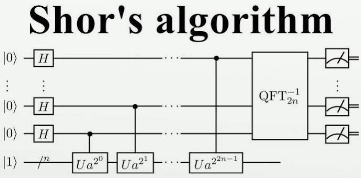
Developed by mathematician Peter Shor in the 1990s, the algorithm showed that a sufficiently capable quantum computer could factor large integers efficiently compared with the best known classical approaches.
This matters because RSA security relies on the difficulty of factoring very large numbers into their prime factors.
Which Cryptographic Systems Could Be Affected?
Shor’s algorithm is relevant to several widely used public-key systems.
RSA: RSA relies on the difficulty of factoring large integers. A sufficiently powerful quantum computer could use Shor’s algorithm to undermine its security.
Diffie-Hellman: Traditional Diffie-Hellman key exchange relies on the difficulty of solving discrete logarithm problems. These problems are also vulnerable to Shor’s algorithm.
Elliptic-Curve Cryptography: ECC is used in digital signatures and key exchange. Its security also relies on a mathematical problem that Shor’s algorithm can solve efficiently on a sufficiently capable quantum computer.
Does This Mean Encryption Is Already Broken?
No. The existence of Shor’s algorithm does not mean that current quantum machines can break real-world encryption.
Large-scale attacks would require a fault-tolerant quantum computer with enough reliable qubits and the ability to perform a very large number of operations while controlling errors.
Building such machines remains a significant scientific and engineering challenge.
However, the possibility is serious enough that researchers and organisations are already planning the transition to quantum-resistant cryptographic methods.
5. Can Quantum Computers Break All Types of Encryption?
Quantum computing does not affect every cryptographic method in the same way.
The biggest concern is directed towards certain public-key systems. Symmetric encryption and cryptographic hash functions face different theoretical effects.
Understanding this distinction helps explain why cybersecurity experts are not expecting every form of digital protection to become useless.
Impact on Symmetric Encryption
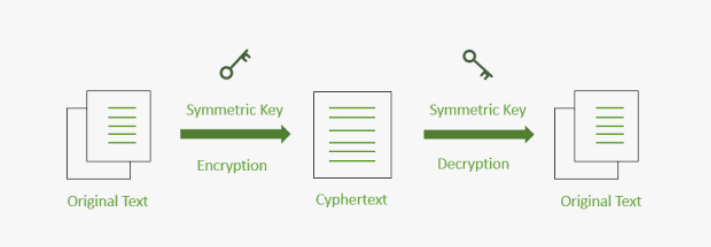
Symmetric encryption uses the same secret key to encrypt and decrypt information.
The Advanced Encryption Standard (AES) is a widely used example. It supports secure communication, file protection and many other applications.
Grover’s algorithm offers a theoretical quadratic speedup for searching an unstructured set of possibilities. In simplified terms, this can reduce the effective security margin of a symmetric key if its length remains unchanged.
However, this does not mean AES becomes instantly breakable. Larger key sizes, such as AES-256, provide a stronger security margin against this type of theoretical quantum speedup.
Impact on Hash Functions
A cryptographic hash function converts information into a fixed-length output. Hash functions are used in digital signatures, integrity checks, password-related systems and many other security applications.
Grover’s algorithm can also affect certain search problems involving hash functions. The impact depends on the algorithm and security parameters being used.
This is why security planning must consider the complete cryptographic system rather than focusing on encryption alone.
Public-Key vs Symmetric Encryption
| Cryptographic method | Potential quantum impact |
|---|---|
| RSA | Vulnerable to Shor’s algorithm |
| Diffie-Hellman | Vulnerable to Shor’s algorithm |
| Elliptic-curve cryptography | Vulnerable to Shor’s algorithm |
| AES | Grover’s algorithm reduces the theoretical security margin |
| Cryptographic hash functions | Certain search attacks may gain a quadratic speedup |
The key lesson is that quantum computing creates different risks for different cryptographic tools. Organisations will need to review key exchange, encryption, digital signatures and hashing as part of their security strategy.
6. What Is Post-Quantum Cryptography?
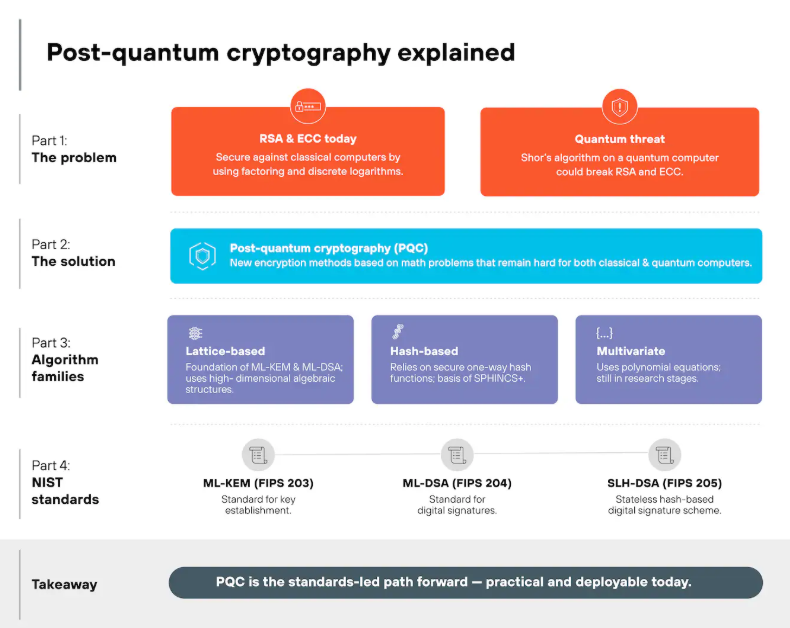
Post-quantum cryptography refers to cryptographic algorithms designed to resist attacks from both conventional computers and sufficiently powerful quantum computers.
These algorithms are designed to operate on ordinary computing hardware. A company does not need to purchase a quantum computer to use post-quantum cryptography.
Its purpose is to provide alternative security methods for systems that may become vulnerable as quantum computing develops.
Why Is Post-Quantum Cryptography Necessary?
Digital information can remain sensitive for a long time. Some records must be protected for years or even decades.
If an attacker stores encrypted information today, future advances could potentially make that information easier to decrypt. This is one reason organisations are evaluating quantum-resistant security methods before large-scale quantum attacks become practical.
Post-quantum cryptography aims to reduce this risk by replacing vulnerable cryptographic methods with alternatives designed to withstand quantum attacks.
What Are the NIST Post-Quantum Cryptography Standards?
The US National Institute of Standards and Technology (NIST) finalised three important post-quantum cryptography standards on August 13, 2024.
1. FIPS 203 – ML-KEM
ML-KEM stands for Module-Lattice-Based Key-Encapsulation Mechanism. It is designed to help two parties establish a shared secret key over a public communication channel.
It is based on the CRYSTALS-KYBER algorithm.
2. FIPS 204 – ML-DSA
ML-DSA stands for Module-Lattice-Based Digital Signature Algorithm. It is designed to create and verify digital signatures, helping confirm the authenticity and integrity of information.
It is based on CRYSTALS-Dilithium.
3. FIPS 205 – SLH-DSA
SLH-DSA stands for Stateless Hash-Based Digital Signature Algorithm. It provides another method for creating digital signatures using hash-based cryptography.
It is derived from SPHINCS+.
These standards give organisations established options for beginning their transition towards quantum-resistant cryptography.
Is Post-Quantum Cryptography the Same as Quantum Cryptography?
No. The terms describe different approaches.
Post-quantum cryptography uses mathematical algorithms that are designed to resist quantum attacks. These algorithms can run on conventional computers.
Quantum cryptography uses principles of quantum physics for cryptographic purposes. Quantum key distribution is one example.
Although both areas relate to future security, they are not interchangeable.
7. How Are Governments and Technology Companies Preparing?
Preparing for quantum-related security risks involves more than selecting a new encryption algorithm. Organisations must understand where cryptography is used and how existing systems can be updated without disrupting services.
Governments, technology companies and research institutions are working on standards, migration plans and practical implementations.
Governments Are Developing Security Standards
NIST has played a major role in evaluating and standardising post-quantum cryptographic algorithms.
The publication of FIPS 203, FIPS 204 and FIPS 205 in August 2024 provided organisations with standardised algorithms for key establishment and digital signatures.
These standards give software developers, service providers and security teams a common foundation for planning future upgrades.
Technology Companies Are Evaluating New Solutions
Technology companies are assessing how post-quantum algorithms can be integrated into websites, cloud services, operating systems and communication protocols.
They must consider more than security. New algorithms can have different requirements for processing power, memory, key sizes and network communication.
Testing is therefore necessary before organisations introduce changes across large systems.
What Can Organisations Do Now?
Businesses and institutions can begin preparing through practical steps:
- Identify where RSA, Diffie-Hellman and elliptic-curve cryptography are used.
- Create an inventory of certificates, keys and cryptographic software.
- Determine which information needs long-term confidentiality.
- Review systems supplied by third-party vendors.
- Evaluate suitable post-quantum standards.
- Test updated algorithms before large-scale deployment.
- Create a planned migration process and review it regularly.
Early preparation can make the eventual transition more manageable.
8. What Is Meant by Applied Quantum Computing?
Applied quantum computing refers to the practical use of quantum computing technology to address real-world problems in science, industry, research and business.
While quantum computing theory explains how quantum systems process information, applied quantum computing focuses on developing algorithms, building systems and testing applications that could provide useful results.
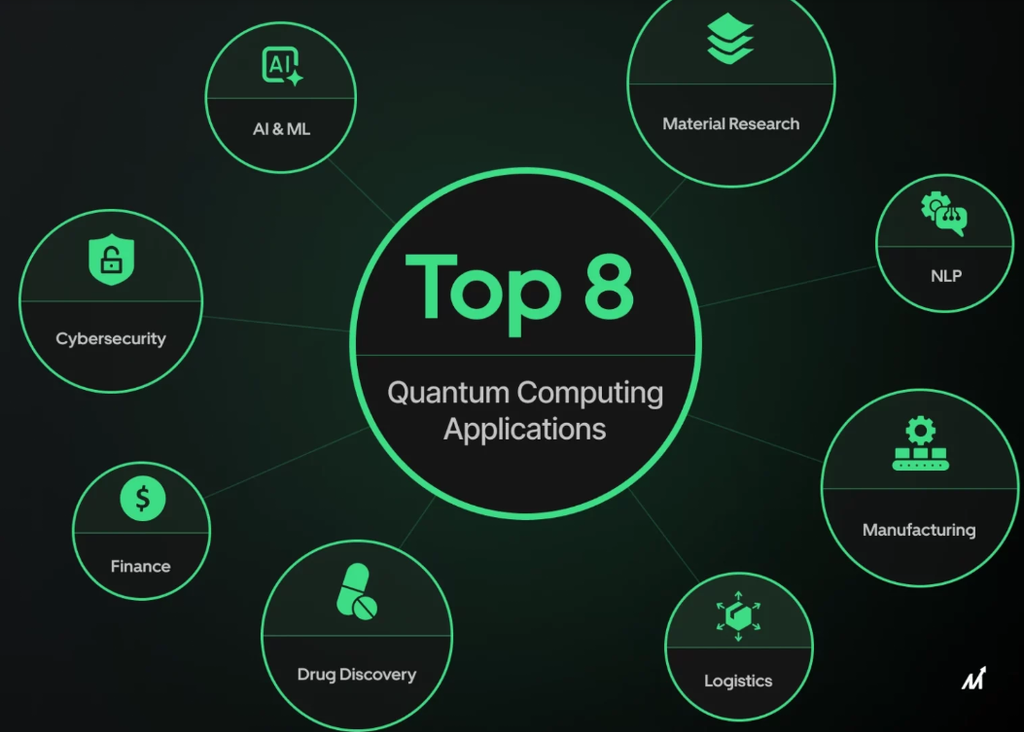
Applications of Quantum Computing
1. Drug Discovery and Healthcare
Quantum computers may eventually help researchers simulate molecular structures and chemical interactions. Better simulations could support parts of drug discovery and pharmaceutical research.
This remains an active research area, and practical benefits must be demonstrated for specific tasks.
2. Financial Modelling
Researchers are exploring quantum algorithms for selected optimisation and risk-analysis problems.
Potential areas include portfolio optimisation and complex modelling. However, a general advantage over existing financial computing methods has not been established.
3. Materials Science
Understanding how atoms and molecules interact can help scientists investigate new materials.
Quantum simulation may eventually support research into batteries, catalysts and other advanced materials.
4. Artificial Intelligence and Machine Learning
Quantum machine learning is an emerging research area. Scientists are investigating whether quantum techniques can help with particular data-processing and optimisation tasks.
It is not yet established that quantum computers offer a general advantage over classical machine learning systems.
5. Cybersecurity Research
Quantum algorithms help researchers understand how future machines could affect existing cryptographic methods.
This research also supports the development and evaluation of stronger security systems.
Why Is Applied Quantum Computing Important?
Applied quantum computing connects scientific theory with practical experimentation. It helps researchers test algorithms, understand hardware limitations and identify problems where quantum technology may be useful.
The field is still developing, but its possible applications make it an important area of technology research.
9. How Can You Learn Quantum Computing?
Students, software developers and technology professionals can begin learning quantum computing without owning specialised hardware.
Many educational resources provide introductory explanations, programming exercises and quantum circuit simulators.
A useful learning plan should combine mathematics, basic physics and programming.
Start With the Required Mathematics
Some mathematical knowledge makes quantum computing easier to understand.
Begin with:
- Linear algebra.
- Complex numbers.
- Probability.
- Matrix operations.
- Basic quantum mechanics.
These subjects help explain qubits, quantum states, quantum gates and measurement.
Understand the Core Concepts
Before moving to advanced algorithms, become familiar with:
- Qubits.
- Superposition.
- Entanglement.
- Quantum interference.
- Quantum gates.
- Quantum circuits.
Understanding these concepts provides a foundation for studying more advanced topics.
Explore Quantum Programming Platforms
Learners can use programming tools and simulators to experiment with quantum circuits.
Some platforms and resources include:
- IBM Quantum and Qiskit.
- Google Quantum AI educational resources.
- Microsoft Azure Quantum.
- Amazon Braket.
Access, available hardware and learning features may vary across platforms.
Should You Take a Quantum Computing Course?
A structured quantum computing course can help learners follow a clear study plan.
Before enrolling, review the course syllabus and check whether it covers mathematical foundations, quantum circuits, programming exercises and practical examples.
Beginners may prefer an introductory course before studying advanced quantum algorithms. Combining programming experience with mathematics and physics can also make the learning process easier.ics, computer science and physics knowledge can be particularly helpful.
10. The Future of Quantum Computing and Cybersecurity
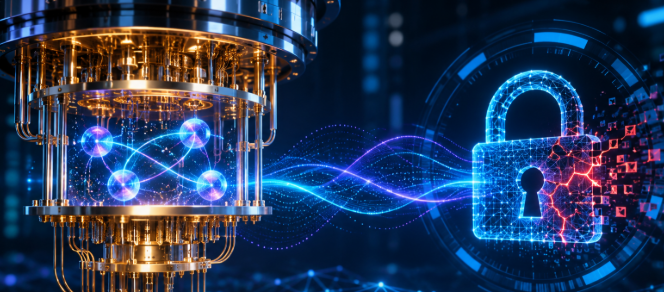
The future of quantum computing could significantly influence how organisations protect digital information. As quantum hardware improves, cybersecurity professionals will need to consider the long-term security of cryptographic algorithms, digital identities and communication systems.
However, the development of large-scale fault-tolerant quantum computers remains a major engineering challenge. It is not possible to predict exactly when such machines will become capable of threatening widely used public-key cryptography.
Will Quantum Computers Replace Traditional Computers?
Quantum computers are not expected to replace classical computers for everyday activities such as browsing, document editing, gaming or running ordinary business applications.
Instead, they are expected to work alongside conventional computing systems for selected specialised tasks.
Will Encryption Become Obsolete?
No. Encryption will remain essential for protecting digital information.
The important change will be the adoption of cryptographic algorithms designed to resist quantum attacks. Post-quantum cryptography provides a path towards maintaining digital security as quantum technology develops.
Why Should Businesses Prepare Now?
Cryptographic systems are deeply integrated into digital infrastructure. Replacing them can take years because organisations need to update applications, devices, certificates, protocols and third-party services.
Businesses that begin preparing early can identify vulnerable systems and plan a controlled transition.
Quantum computing is therefore not just a scientific development. It is also a long-term cybersecurity planning issue.
11. Frequently Asked Questions About Quantum Computing
1. What is quantum computing in simple words?
Quantum computing is a type of computing that uses quantum mechanical principles to process information. It uses qubits instead of classical bits and can provide advantages for certain specialised computational problems.
2. What is a quantum computer?
A quantum computer is a computing device that processes information using qubits, quantum gates and quantum algorithms. It is designed to solve particular problems that may be difficult for conventional computers.
3. Can quantum computers break modern encryption?
A sufficiently powerful, fault-tolerant quantum computer running Shor’s algorithm could threaten public-key systems such as RSA and elliptic-curve cryptography. Current quantum computers cannot yet perform these attacks against widely deployed encryption at practical scale.
4. What is Shor’s algorithm?
Shor’s algorithm is a quantum algorithm that can efficiently factor large integers and solve discrete logarithm problems in theory. These capabilities could undermine the mathematical foundations of several widely used public-key cryptographic systems.
5. What is post-quantum cryptography?
Post-quantum cryptography refers to cryptographic algorithms designed to resist attacks from both conventional and sufficiently powerful quantum computers. These algorithms can run on ordinary computing hardware.
6. Are quantum computers faster than normal computers?
Not for every task. Quantum computers may provide advantages for certain specialised problems, but conventional computers remain more practical and efficient for most everyday computing activities.
7. What is meant by applied quantum computing?
Applied quantum computing refers to using quantum computing technology to explore practical problems in areas such as materials science, healthcare, optimisation, finance and scientific research.
8. Can students learn quantum computing?
Yes. Students can begin by learning linear algebra, probability, quantum mechanics and programming fundamentals. They can then explore quantum programming tools such as Qiskit and cloud-based quantum simulators.
9. What is the difference between quantum cryptography and post-quantum cryptography?
Quantum cryptography uses quantum physics for cryptographic tasks, such as quantum key distribution. Post-quantum cryptography uses mathematical algorithms designed to resist attacks from future quantum computers and runs on conventional computers.
10. When will quantum computers break RSA encryption?
There is no reliable date for when a sufficiently powerful, fault-tolerant quantum computer capable of breaking widely used RSA keys will exist. Researchers are preparing in advance because cryptographic migrations take considerable time.
12. Conclusion
Quantum computing represents a major development in computer science, with the potential to transform scientific research, engineering and selected computational applications. At the same time, it presents an important challenge to modern cybersecurity.
A sufficiently powerful quantum computer could use Shor’s algorithm to threaten public-key cryptographic systems such as RSA and elliptic-curve cryptography. However, this does not mean that all encryption is already broken or that today’s quantum computers can access protected information at will.
The development of post-quantum cryptography provides a practical way to prepare for these future risks. Standards such as NIST’s ML-KEM, ML-DSA and SLH-DSA are important steps towards protecting digital systems against quantum-enabled attacks.
Ultimately, quantum computing should be viewed as both a technological opportunity and a long-term security consideration. Governments, businesses, developers and cybersecurity professionals need to understand its capabilities and prepare their systems for the next generation of computing.


