

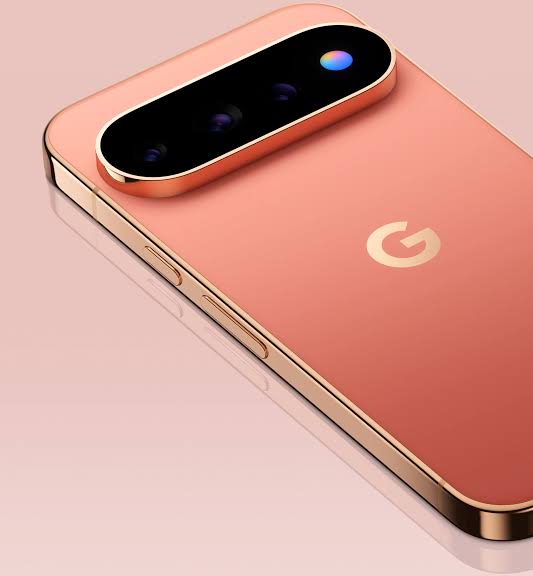
Google Pixel 11 is Google’s newest flagship, pairs a polished design with a capable camera system, useful AI tools and years of promised software updates. With the new Tensor G6 chip and a strong focus on photography and Gemini-powered tools, it aims to deliver a smarter and more seamless Android experience. In this review, we’ll explore the seven key reasons why the Google Pixel 11 is being considered one of the best Android phones of 2026.
Table of Contents
Google Pixel 11 at a Glance
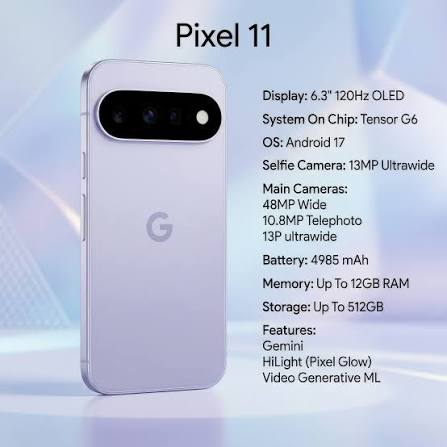
The Google Pixel 11 is Google’s latest mainstream flagship, and it arrives with a clear focus: make everyday smartphone tasks smarter without turning the phone into an overcomplicated gadget. On paper, you get a 6.3 inch OLED screen, the new tensor G6 chip, 3 rare cameras led by a bigger 48 MP main sensor, Gemini-based features, and 7 years of OS, security and pixel drop updates.
In India, the phone starts at ₹89,999. Buyers can pair 12 GB of ram with either 256 GB or 512 GB of storage. The phone measures 152.8 x 72 x 8.6mm and weighs 197g, making it relatively compact for a premium smartphone.
Key specifications
| Feature | Google Pixel 11 |
|---|---|
| Display | 6.3-inch Actua OLED |
| Resolution | 1080 x 2424, 422 PPI |
| Refresh rate | 60–120Hz |
| Peak brightness | Up to 3,000 nits |
| Processor | Google Tensor G6 |
| RAM | 12GB |
| Storage | 256GB / 512GB |
| Main camera | 48MP wide |
| Ultrawide | 13MP |
| Telephoto | 10.8MP, 5x optical zoom |
| Maximum Super Zoom | Up to 30x |
| Front camera | 10.5MP autofocus |
| Battery | 4,985mAh typical |
| Wired charging | Up to 55% in about 30 minutes with compatible charger |
| Wireless charging | Qi2.2, up to 25W |
| Software | Android 17 |
| Updates | 7 years |
| Water resistance | IP68 |
| Starting price in India | ₹89,999 |
On paper, these specifications make the Google Pixel 11 a serious flagship. But specifications alone do not explain why it is attracting so much attention. The more interesting story is how Google’s hardware, computational photography and AI features work together.
1. A Refined Design That Finally Feels More Practical
Google has not abandoned the distinctive Pixel identity, but the company has made an important physical change. Google has slimmed the camera bar by roughly 40%. That makes the rear design look less bulky and, according to Google, makes the phone virtually wobble-free when used with a Made by Google case.
The phone uses a polished Gorilla Glass Victus 2 back and a satin-finish aluminium frame. Dust and water protection comes from an IP68 rating. The 197g weight is another advantage. The Google Pixel 11 is not an ultra-light phone, but it remains manageable compared with many large premium devices. At 6.3 inches the screen is easir to handle with one hand than those on bigger flagships.
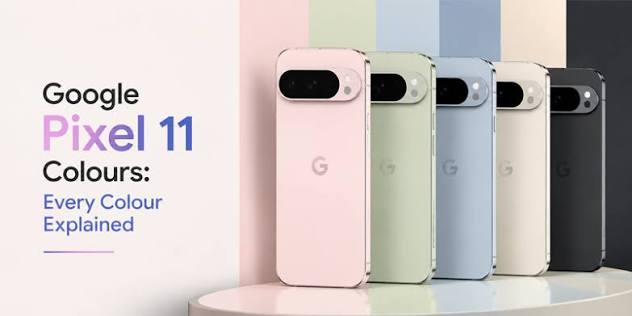
Google offers the phone in four colours: Frost, Pistachio, Hibiscus and Obsidian. The styling is recognisably Pixel, but it looks more mature and refined.
Why the Design Matters
Design improvements are not always about making a phone dramatically thinner. Small changes can make a device more comfortable to live with every day. A less prominent camera bar, durable glass, an aluminium frame and IP68 protection all contribute to that experience.
If you want a high-end android phone that is not oversized, this is among the best reasons to choose the Pixel 11.
2. A Bright, Smooth 6.3-Inch Display
The Google Pixel 11 comes with a 6.3-inch Actual OLED display with a 20:9 aspect ratio. It has a resolution of 1080 x 2424 pixels and a 60–120Hz Smooth Display refresh rate.
The biggest headline is brightness. Brightness is where this display stands out, heating 3000 nits at its peak and 2000 nits with HDR. That should make outdoor visibility considerably easier, particularly under strong sunlight.
Protecting the screen is Corning Gorilla Glass Vicuts 2. Along with the IP68 rating, this gives the phone a reasonable level of protection against the everyday accidents that premium phones inevitably face.
Whether you are watching videos, scrolling feeds, playing games, or editing photos the OLD screen gives you rich contrast and true, inky blacks. The 120Hz refresh rate also makes scrolling and animations feel much smoother than a conventional 60Hz screen.
How Does This Screen Stack Up Against Rivals?
Not necessarily. The Pixel 11 Pro offers a higher-resolution LTPO panel and a wider 1–120Hz refresh range. So buyers who care deeply about display specifications may still prefer the Pro model.
You get a compact 6.3-inch OLED screen, a high refresh rate and extremely high peak brightness without moving into the more expensive Pro tier.
3. The Camera System Is the Real Star
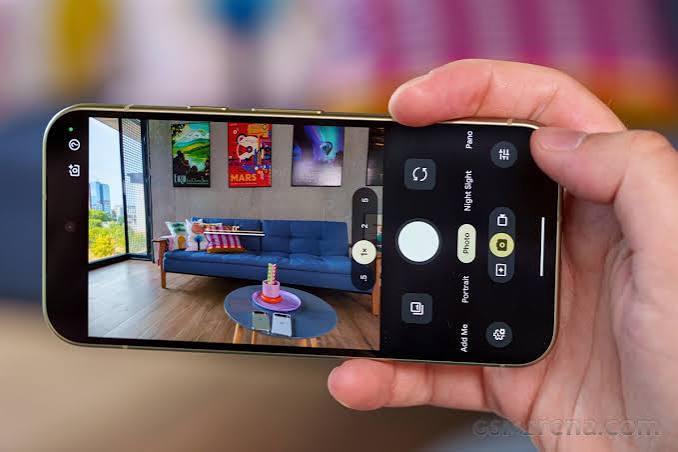
Camera performance has always been one of the biggest reasons people consider Pixel phones, and the Google Pixel 11 pushes that idea further. On the back, you get 3 lenses: A 48MP main camera built around a big 6 inch sensor, a 13MP ultra wide, and a 10.8MP telephoto that zooms 5x optically.
Low-light photography gets Faster
Tensor G6 and the updated image signal processor work with Google’s computational photography models.
Google says Night Sight can now capture up to 4.5 times faster while maintaining the quality expected from the feature.
That matters because computational photography is not only about final image quality. Speed matters too. If processing takes too long, you can miss the moment.
Magic Capture is Designed for Spontaneous Moments
One of the more interesting additions is Magic Capture. With a single tap, the phone can capture video and photos and automatically create a curated collection ready to share.
This is a good example of Google’s overall approach with the Google Pixel 11. Instead of simply adding another camera mode, the company is trying to reduce the amount of work the user has to do after taking a photo or video.
The phone also includes features such as Camera Coach, Add Me, Macro Focus, Night Sight, Astrophotography, Portrait Mode, Best Take, Magic Eraser, Photo Unblur and Zoom Enhance.
Video Capabilities
The rear cameras can record 4K video at 24, 30 and 60fps. The front camera supports 4K recording at 30 and 60fps.
There are also features such as Audio Magic Eraser, 10-bit HDR video, Macro Focus Video, Cinematic Pan and several stabilisation modes.
For casual creators, travellers and social-media users, the combination of good hardware and computational tools could make the Google Pixel 11 particularly attractive.
4. Tensor G6 Brings Faster and Smarter AI
The Google Pixel 11 is powered by the new Tensor G6 chip, accompanied by Google’s Titan M3 security coprocessor.
Google says Tensor G6 is its fastest and most powerful Tensor chip yet. The company claims a 25% improvement in web browsing and 15% quicker app launches, while the chip’s TPU provides 50% more compute for AI workloads.
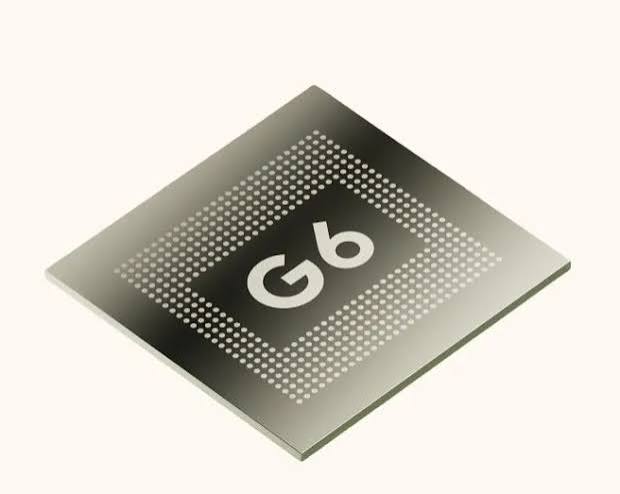
Google also says on-device AI tasks can be processed up to 3.5 times faster while using up to 3.5 times less energy in the relevant workloads. These claims are important because Google has never positioned Tensor purely around benchmark numbers. Its bigger advantage is the integration of AI into everyday phone functions.
Gemini is built into Experience
The Google Pixel 11 uses Gemini Intelligence and the latest Gemini Nano model for on-device AI experiences.
Features such as Gemini Live, Circle to Search, Live Translate and Call Assist make the phone more useful beyond traditional smartphone functions.
The goal is not simply to have an AI chatbot on the phone. Google wants AI to assist with tasks across the device while keeping more processing on the phone where possible.
That approach makes the Google Pixel 11 feel different from a phone that simply adds an AI app to an otherwise conventional Android interface.
5. Battery Life and Faster Wireless Charging
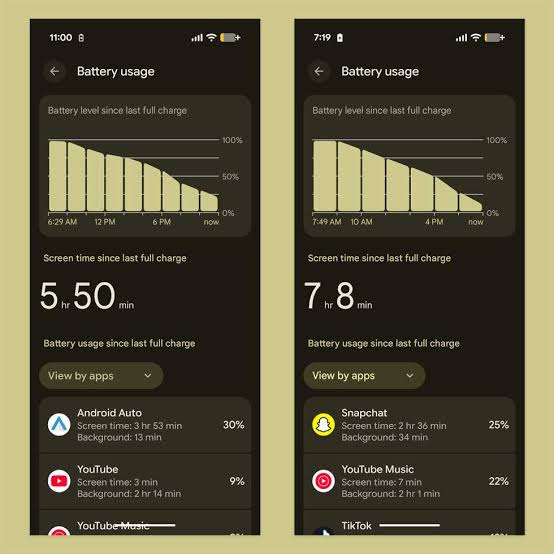
The Google Pixel 11 has a typical 4,985mAh battery, and Google rates it for more than 30 hours of battery life.
Real-world battery performance will naturally depend on brightness, network conditions, camera usage, gaming, navigation and AI features. Still, the larger battery and Tensor G6 efficiency improvements should make the phone suitable for a full day of normal use.
Charging is also more convenient.
With a compatible 30W USB-C PPS charger or higher, Google says the phone can reach up to 55% charge in about 30 minutes.
Wireless charging is another highlight. The Google Pixel 11 supports Qi2.2-certified Pixelsnap wireless charging at up to 25W.
That makes wireless charging more practical for users who prefer dropping their phone onto a magnetic charging accessory rather than connecting a cable.
What about Heavy Users?
Heavy gaming, continuous camera recording and high-brightness outdoor use will obviously consume more power than ordinary messaging and browsing.
So the 30+ hour rating should not be interpreted as a guarantee of 30 hours of screen-on time. It is better understood as Google’s overall endurance claim under its testing conditions.
For typical users, however, the battery package looks competitive.
6. Long-Term Software Support and Security
One of the strongest reasons to consider the Google Pixel 11 is how long Google plans to support it.
The phone launches with Android 17 and receives seven years of OS, security and Pixel Drop updates.
That is important for buyers who keep their phones for four, five or even seven years. A phone that remains supported for a long period can be a better long-term purchase than a device that receives only a few major Android upgrades.
Security is also a major focus.
The Google Pixel 11 combines Tensor G6 with Titan M3, Google’s security architecture and a Trusty trusted execution environment. Google also says the phone uses post-quantum cryptography for secure boot.
The company has also included anti-malware, anti-phishing and spam/scam protection in supported Google Phone and Messages experiences.
For people who use their phone for banking, work, payments, passwords and personal documents, these protections are more meaningful than a small benchmark improvement.
7. A clean Android Experience With Useful AI
The final reason the Google Pixel 11 is being described as one of the strongest Android phones of 2026 is the software experience.
Pixel phones are built around Google’s version of Android rather than a heavily customised interface. That means the phone feels closely connected to Google’s own services.
There is less visual clutter, and features such as Circle to Search, Gemini, Live Translate and Call Assist are integrated into the broader experience.
The Google Pixel 11 also benefits from Google’s computational photography and AI editing tools. Features such as Magic Eraser, Best Take, Photo Unblur and Edit with Ask Photos can reduce the need for separate editing applications.
This is where Google’s hardware-and-software strategy becomes particularly convincing.
A 48MP camera is useful. A powerful processor is useful. A bright display is useful. But when all three are connected to software that can automatically improve photographs, organise captured moments and provide contextual assistance, the experience becomes more cohesive.
Google Pixel 11: Pros and Cons
Pros
- Excellent camera-focused feature set
- 48MP main camera with improved light sensitivity
- 5x optical telephoto and up to 30x Super Zoom
- Bright 3,000-nit peak display
- Compact 6.3-inch form factor
- Tensor G6 with stronger AI performance
- Gemini and several built-in AI features
- 12GB RAM as standard
- 256GB and 512GB storage options
- More than 30 hours of claimed battery life
- 25W Qi2.2 wireless charging
- IP68 dust and water resistance
- Seven years of software and security updates
- Titan M3 security and post-quantum secure boot
Cons
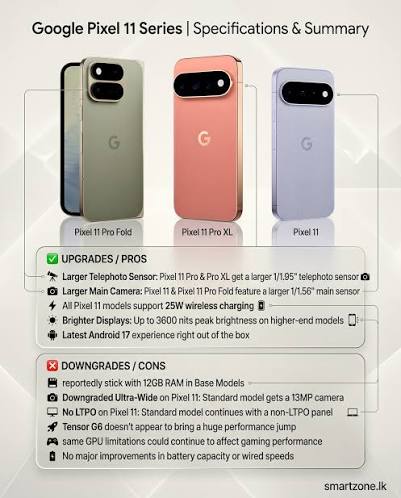
- ₹89,999 starting price makes it expensive
- 60–120Hz display range is less flexible than the Pro model’s LTPO panel
- 1080p-class resolution is not as high as some premium competitors
- 30W-class wired charging is not class-leading
- Tensor performance is designed around Google’s AI experience rather than raw benchmark dominance
- Some advanced camera and AI features may be more useful to enthusiasts than casual users
Is Google Pixel 11 Worth Buying?
The answer depends on what you expect from a flagship phone.
If your priority is gaming performance above everything else, you may find phones built around other flagship chipsets more appealing. Likewise, buyers who want extremely fast wired charging or the highest-resolution display may find alternatives worth considering.
But the Google Pixel 11 makes a compelling argument in a different way.
It combines a compact premium design, an excellent display, upgraded cameras, Google’s computational photography, Tensor G6, Gemini-powered assistance, strong security and seven years of software support.
The camera system is particularly impressive for a standard model. The combination of a 48MP main sensor, 13MP ultrawide and 5x telephoto gives users considerably more flexibility than a basic dual-camera setup.
The software support is equally important. At ₹89,999, this is not a budget phone, so the ability to keep receiving major software and security updates for seven years helps justify the long-term investment.
For someone who wants a premium Android phone that feels smart rather than merely powerful, the Google Pixel 11 is one of the most interesting choices of 2026.
Frequently Asked Questions
- What is the price of Google Pixel 11 in India?
The Google Pixel 11 starts at ₹89,999 in India. The phone is offered with 256GB and 512GB storage options, both with 12GB of RAM.
- What processor does Google Pixel 11 use?
The phone is powered by Google’s Tensor G6 processor. It is designed to improve everyday performance as well as on-device AI and computational photography.
- How good is the Google Pixel 11 camera?
The phone has a 48MP main camera, a 13MP ultrawide camera and a 10.8MP 5x telephoto camera. It supports up to 30x Super Zoom and includes Google’s computational photography features.
- Does Google Pixel 11 have a telephoto camera?
Yes. The phone includes a 10.8MP telephoto camera with 5x optical zoom and optical image stabilisation.
- Does Google Pixel 11 support 5G?
Yes. The phone supports 5G connectivity, including supported Sub-6GHz bands.
- How long will Google Pixel 11 receive updates?
Google promises seven years of OS, security and Pixel Drop updates for the phone.
- Is Google Pixel 11 waterproof?
It has an IP68 rating for dust and water resistance. However, water resistance can diminish with wear and damage, so it should not be treated as permanently waterproof.
- How fast does Google Pixel 11 charge?
With a compatible 30W USB-C PPS charger or higher, Google says the phone can reach up to 55% charge in around 30 minutes. It also supports Qi2.2 wireless charging at up to 25W.
- How much RAM does Google Pixel 11 have?
The phone comes with 12GB of RAM. Storage options are 256GB and 512GB.
- Is Google Pixel 11 good for gaming?
The Tensor G6 provides strong everyday performance, but the phone’s biggest strengths are Google’s AI, camera processing and software experience. Buyers whose main priority is sustained high-end gaming should compare it with gaming-focused and performance-focused flagship phones before purchasing.
- Does Google Pixel 11 come with Android 17?
Yes. The phone launches with Android 17.
- Is Google Pixel 11 better than Pixel 11 Pro?
The standard model is aimed at users who want a balanced flagship at a lower price. The Pixel 11 Pro offers a more advanced display and camera system, including higher-end telephoto hardware and additional professional features. For most users, the standard model offers a strong balance of features and price.
Conclusion
The Google Pixel 11 is not trying to win the flagship race by simply offering the biggest screen or the most aggressive charging speeds. Instead, Google has focused on making the entire smartphone experience work together.
The upgraded 48MP camera, 5x optical zoom, 30x Super Zoom, bright Actua display, Tensor G6, Gemini Intelligence, improved wireless charging and seven years of updates form a well-rounded package.
Its biggest advantage may ultimately be the way these features complement each other. The camera benefits from AI processing, the processor powers Google’s intelligent features, and the long software-support period makes the hardware more valuable over time.
At ₹89,999, the Google Pixel 11 is undeniably expensive. It is also not perfect for every type of user. But if your priorities are photography, clean Android software, useful AI, security and long-term support, it deserves a place near the top of the 2026 Android flagship conversation.
That combination is exactly why the Google Pixel 11 can make a credible claim to being one of the best Android phones of 2026.


