


There are some places in the world that leave you speechless the moment you see them. Egypt’s pyramids are one of those places.
For more than 4,000 years, these enormous stone monuments have stood beside the Nile, watching kingdoms rise and disappear, cities grow around them, and generations of travelers arrive in awe. Even if you’ve seen hundreds of photographs of the pyramids, nothing quite prepares you for standing beneath them and realizing just how massive they are.
But the pyramids weren’t created overnight, and the famous pyramids of Giza weren’t the beginning of the story. Their history is a fascinating journey of experimentation, engineering, religion, and royal ambition.
From the first great stone pyramid at Saqqara to the spectacular monuments of Giza, Egypt’s pyramids reveal how an ancient civilization gradually transformed an idea into one of humanity’s greatest architectural achievements.
So, if you’re planning a trip to Egypt—or simply curious about what lies behind those iconic photographs—let’s take a journey through the story of the pyramids.
Table of Contents
Saqqara: Where the Pyramid Story Begins
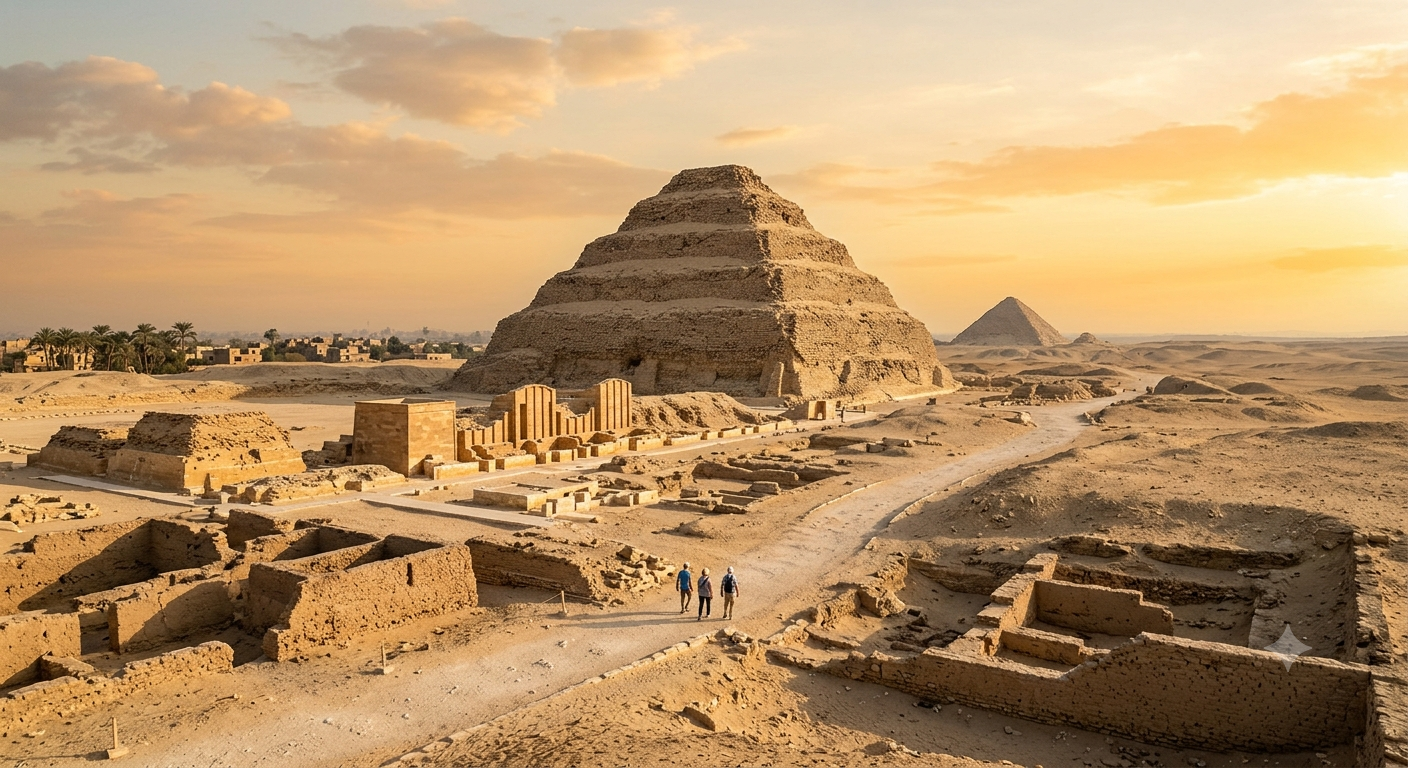
Our journey starts at Saqqara, one of Egypt’s oldest and most important archaeological sites. This is the site where people take many photos with their cameras for memory.
Long before the great pyramids appeared, Egyptian kings were buried in rectangular structures called mastabas. These were relatively low, flat-roofed tombs, often constructed from mud-brick.
Then, around 2670 BCE, everything changed.
During the Third Dynasty, King Djoser commissioned a revolutionary new monument. His architect and vizier, Imhotep, took the traditional mastaba and transformed it into something much more ambitious.
Instead of building one level, he stacked six increasingly smaller structures on top of one another & therefore came Step Pyramid of Djoser.
Rising about 62 meters (204 feet), it became one of the earliest monumental structures built primarily from stone. More importantly, it established the basic concept that would eventually lead to Egypt’s famous smooth-sided pyramids.
The pyramid itself stood at the center of a huge walled complex covering around 40 acres. The complex included courtyards, chapels, ceremonial spaces, and an extensive underground network of tunnels and chambers.
Walking around Saqqara today, you can almost feel that you’re looking at the opening chapter of a much larger story.
The Egyptians had discovered that stone could be used to create monuments on an entirely new scale.
They were ready to experiment.
Dahshur: The Egyptians Learn From Their Mistakes
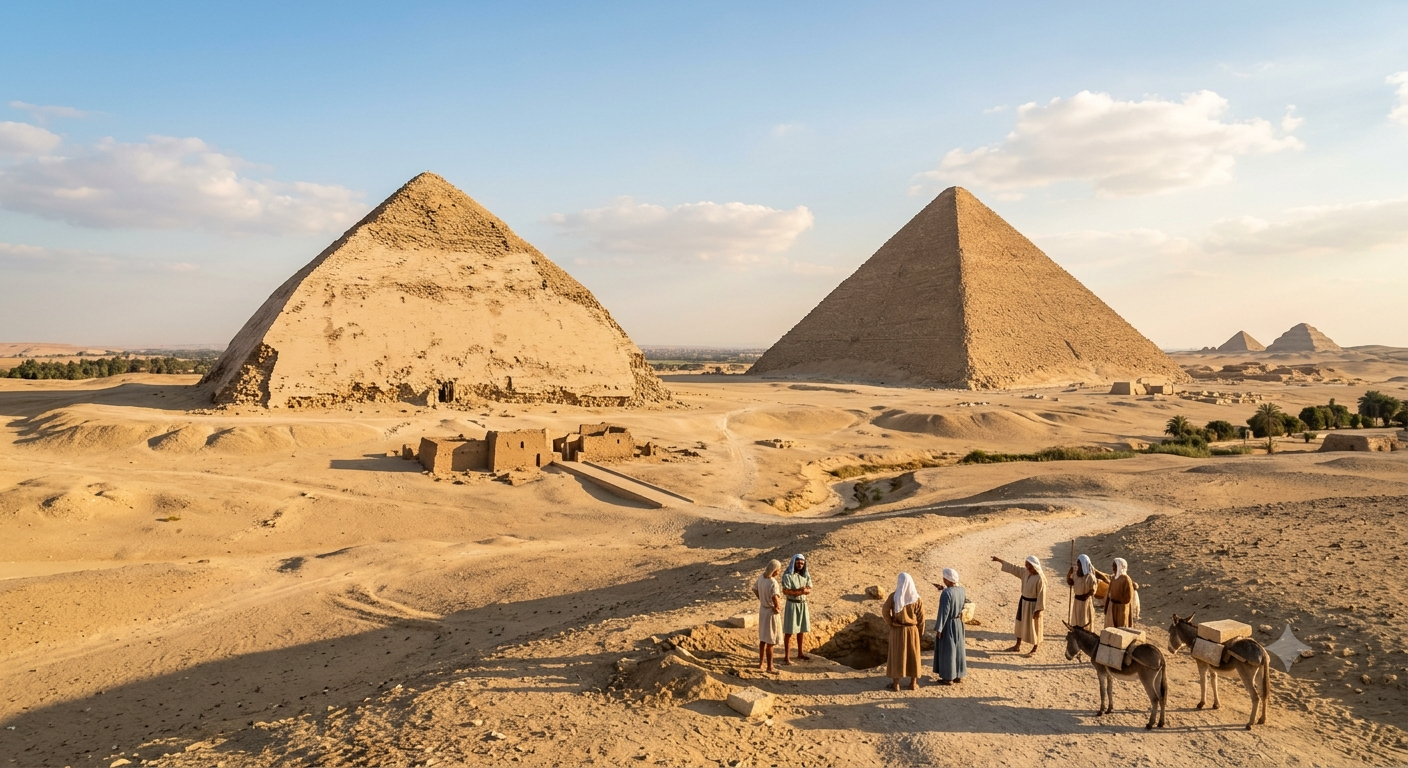
From Saqqara, the story continues to Dahshur, where Pharaoh Sneferu took pyramid building to another level.
Sneferu, the founder of the Fourth Dynasty, was responsible for three major pyramid projects. Together, they show how Egyptian architects gradually figured out how to create the smooth-sided pyramids that would eventually reach their greatest expression at Giza.
The Meidum Pyramid
The Meidum Pyramid is like a stepped pyramid before being transformed into a smooth-sided monument.
Unfortunately, something went wrong.
Large sections of the outer structure eventually collapsed, leaving behind the unusual ruins we see today.
Although the exact circumstances remain debated, the monument demonstrates something important: pyramid building involved experimentation, and the ancient Egyptians did not always get it right on the first attempt.
The Bent Pyramid
Sneferu’s next major project was the Bent Pyramid at Dahshur.
It is impossible to mistake this pyramid for any other. The lower portion rises at a steep angle of roughly 55 degrees, but halfway up, the angle changes to about 43 degrees.
The unusual shape appears to reflect an engineering decision made during construction. The builders apparently recognized that continuing with the original steep slope could put too much stress on the structure.
So they changed the angle.
Rather than abandoning the project, they adapted the design and continued building.
The result is one of the most distinctive pyramids in Egypt.
The Red Pyramid
This time, the builders produced a much more successful smooth-sided structure. It was constructed at a consistent angle of around 43 degrees and reached approximately 105 meters (344 feet).
Originally, its reddish stone would have been covered by polished white limestone, giving the pyramid a much brighter appearance than it has today.
Standing before it, you can see the progression clearly: the Egyptians were gradually turning architectural experimentation into engineering expertise.
Giza: Standing Before the Great Pyramid
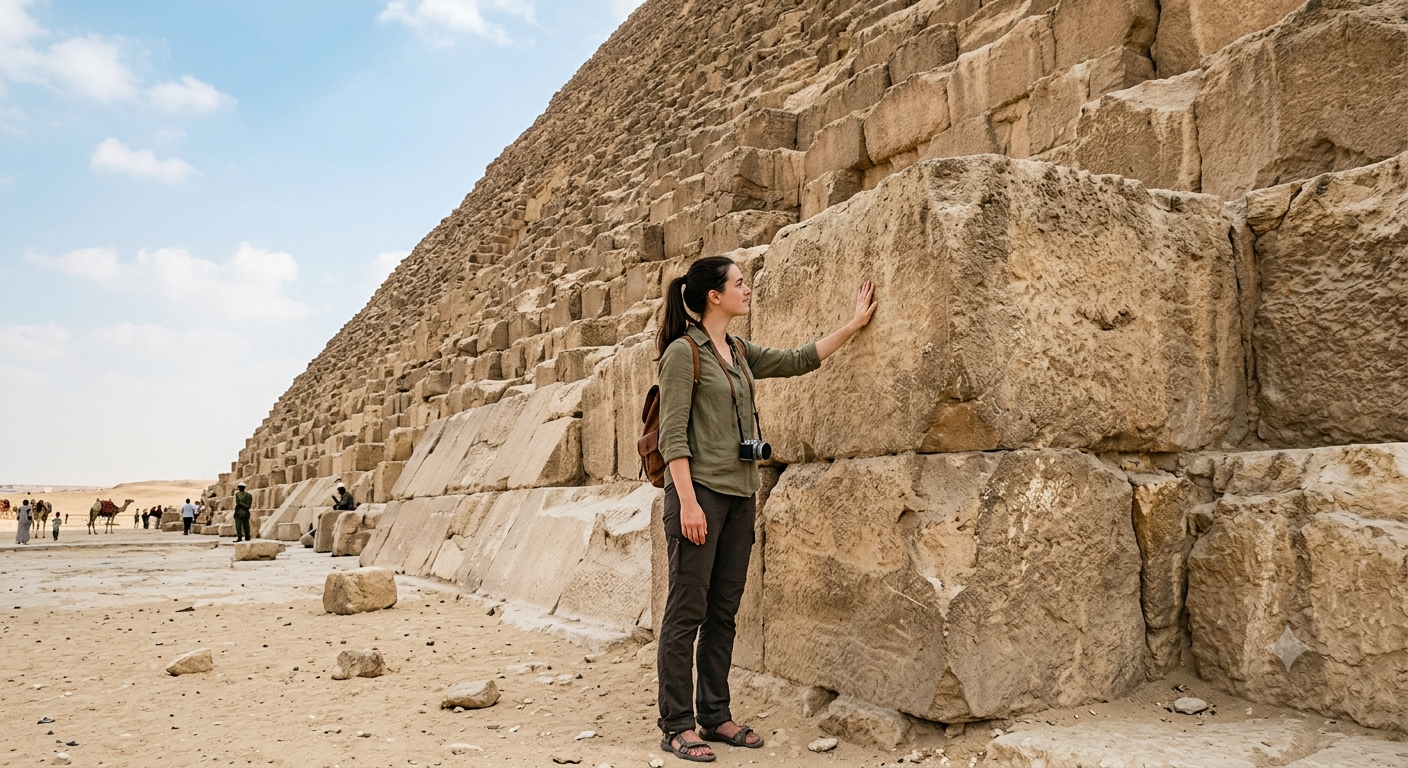
Eventually, the journey brings us to the place that has become almost synonymous with ancient Egypt: Giza.
And this is where the scale of the pyramid story becomes difficult to comprehend.
Built for Pharaoh Khufu around 2600 BCE, the Great Pyramid of Giza was originally approximately 146.6 meters (481 feet) high.
Each side of its square base measures roughly 230 meters (756 feet).
Even today, the first sight of the Great Pyramid can be overwhelming. Photographs make it look impressive, but they don’t really communicate its scale. When you’re standing at the base and looking up, the individual stones themselves seem enormous.
The pyramid is estimated to contain around 2.3 million stone blocks, with a total mass of roughly 6 million tonnes.
Most of the core limestone came from nearby quarries, while fine white limestone from Tura was transported to Giza for the outer casing.
The builders also used enormous granite blocks inside the pyramid. Some came from Aswan, hundreds of kilometers south of Giza.
How did the ancient Egyptians move all this material?
That’s one of the enduring questions surrounding the Great Pyramid.
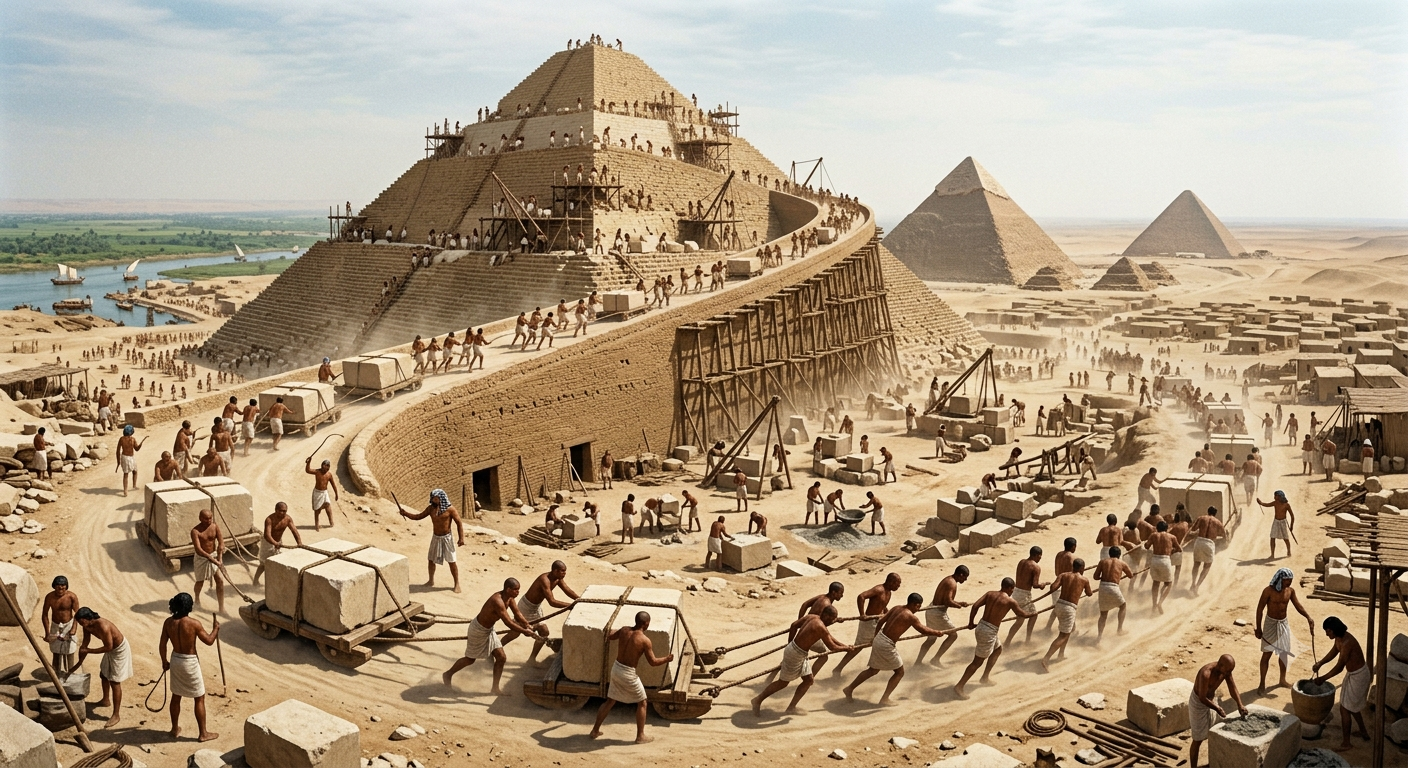
Archaeologists have proposed several theories involving ramps, sledges, boats, ropes, and carefully organized teams of workers. Different ramp designs—including straight, zigzagging, and spiraling ramps—have been suggested.
We understand many aspects of the construction process, but there is still no universally accepted explanation for every stage.
And perhaps that’s one reason the pyramid remains so fascinating.
Inside the Great Pyramid
If you have the opportunity to explore the interior of the Great Pyramid, the experience is completely different from seeing it from outside.
Instead of enormous open spaces, you encounter narrow passages, steep corridors, and carefully engineered chambers.
The internal layout includes the Subterranean Chamber, the Queen’s Chamber, the impressive Grand Gallery, and the King’s Chamber.
The Grand Gallery is particularly striking. It stretches for approximately 47 meters and rises about 8.5 meters high.
The King’s Chamber was built from huge granite blocks, and above it are five layers of relieving chambers designed to help manage the enormous weight of the pyramid above.
Another fascinating discovery is the Diary of Merer, a collection of ancient papyrus records dating back around 4,500 years.
Merer was an official involved in transporting materials, and his diary provides valuable evidence about the movement of limestone from Tura during Khufu’s reign.
It is an extraordinary reminder that behind the monumental pyramid was a huge logistical operation involving boats, workers, quarrying, transportation, food, and administration.
Who Actually Built the Pyramids?
One of the most persistent myths about the pyramids is that they were built entirely by enormous armies of enslaved people.
Archaeological discoveries suggest a far more complicated picture.
Near Giza, excavations at Heit el-Ghurab, sometimes called the “Lost City of the Pyramid Builders,” uncovered evidence of a large settlement associated with the construction workforce.
The settlement contained bakeries, breweries, workshops, storage areas, and living quarters.
Evidence suggests that the workforce included skilled craftsmen and organized laborers who received food and other provisions.
Inscriptions found inside the Great Pyramid also reveal that workers were organized into teams with distinctive names.
So rather than imagining thousands of people randomly hauling stones through the desert, it is more useful to picture a highly organized workforce supported by an extensive system of food production, transportation, administration, and skilled craftsmanship.
Exploring the Giza Pyramids and the Sphinx
The Great Pyramid is only part of the Giza experience.
Nearby are the pyramids of Khafre and Menkaure, built by Khufu’s successors.
Khafre’s pyramid is slightly smaller than Khufu’s, although its higher position can make it appear almost as tall. One of its most recognizable features is the surviving section of smooth limestone casing near the top.
Then there’s the Great Sphinx.
With the body of a lion and a human head, this enormous monument was carved directly from natural limestone bedrock. It stretches for roughly 73 meters (240 feet).
The Sphinx is traditionally associated with Khafre, although researchers have debated aspects of its dating and construction history.
The third major pyramid, built for Menkaure, is considerably smaller than the pyramids of Khufu and Khafre.
Together, these monuments form the spectacular landscape that has made Giza one of the most recognizable archaeological sites on Earth.
Why Were the Pyramids Built?
It’s easy to look at a pyramid and think of it simply as a gigantic tomb.
But for the ancient Egyptians, the purpose went much deeper.
Egyptian religion viewed death as a transition rather than an absolute ending. The deceased king was expected to continue his existence in the afterlife and join the divine world.
The pyramid formed part of a much larger religious complex involving temples, rituals, priests, offerings, and beliefs about the ka and ba, different aspects of a person’s spiritual existence.
The king could also become associated with gods such as Osiris and Ra.
By the Fifth Dynasty, these beliefs were being written directly onto the walls of royal pyramids.
The pyramid of Unas at Saqqara contains the Pyramid Texts, among the oldest surviving religious writings from ancient Egypt.
These spells and prayers were intended to protect the deceased king and guide him safely into the afterlife.
So the pyramids were not simply enormous buildings designed to impress future generations. They were part of a carefully planned religious system centered on death, rebirth, and eternal life.
Experiencing the Pyramids Today
One of the most remarkable things about visiting Egypt is the contrast between the modern world and these ancient monuments.
You can spend the morning navigating the streets of Cairo, surrounded by traffic and modern buildings, and then suddenly find yourself standing beside a structure that was already ancient thousands of years ago.
At Saqqara, you can see where the pyramid story began.
At Dahshur, you can follow the experiments that helped Egyptian builders perfect their designs.
And at Giza, you can stand beneath the Great Pyramid and see the extraordinary result of generations of architectural knowledge.
The pyramids aren’t just monuments to ancient kings.
They are monuments to the people who designed them, quarried their stones, transported their materials, organized their workforce, developed their engineering techniques, and built something that has survived for more than four millennia.
And that’s what makes visiting them so special.
You aren’t simply looking at ruins.
You’re standing in front of a piece of human history that is still here.
FAQs
Below are the FAQs
Q. How old are the Egyptian pyramids?
A. The earliest major pyramid, Djoser’s Step Pyramid at Saqqara, dates to around 2670 BCE. The Great Pyramid of Giza was built approximately a century later, around 2600 BCE.
Q. Which is the oldest pyramid in Egypt?
A. The Step Pyramid of Djoser at Saqqara is generally considered the earliest large-scale stone pyramid in Egypt.
Q. Which is the largest pyramid in Egypt?
A. The Great Pyramid of Giza, built for Pharaoh Khufu, is the largest of Egypt’s pyramids. It originally stood about 146.6 meters (481 feet) tall.
Q. How many stones were used to build the Great Pyramid?
A. The Great Pyramid is commonly estimated to contain around 2.3 million stone blocks, although the exact number is uncertain.


