

Introduction
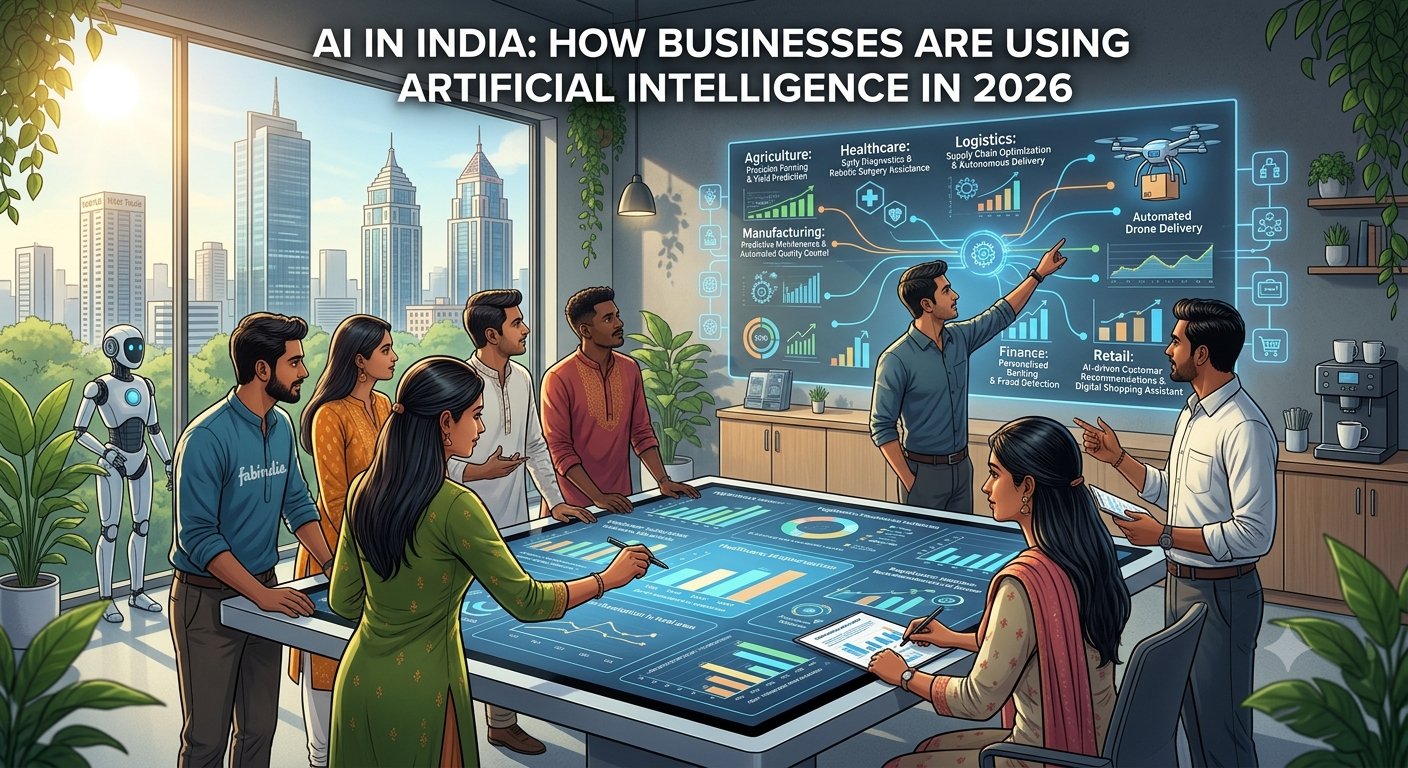
Now days AI in India moved beyond being a futuristic technology. In 2026 businesses using AI for their works like, automate repetitive work, understand customers, improve decision making, and develop new products and services. Businesses are updating their technologies from small AI experiments towards integrating AI into everyday business processes. Recent research in business shows that businesses are redesigning processes around AI and in some cases, using it to create new products and reinvent business models.
AI in India is not related to small businesses and technology companies. Healthcare, retailers, bank, manufacturers, educational institutions, marketing agencies, and small businesses are exploring practical applications of AI. Businesses adopt AI in India it is becomes a important part of business transformation. Companies focus is incresed on practical integration and measurable business value.
Table of Contents
What is Artificial Intelligence in Business?
Artificial intelligence in business refers to using computer systems that can analyse information, recognise patterns, generate content, make predictions, or assist with decisions and tasks that traditionally required human effort. Generative AI can create texts, images, codes, summaries, reports, and other contents. Businesses allows AI to step further AI systems to plan and execute multiple steps towards a goal using connected tools and business data.
In modern businesses entrepreneurs use several forms of AI like, machine learning, generative AI, natural language processing, computer vision, and predictive analytics. AI in India is increased rapidly in businesses and all other platforms. In 2026 AI in India increasingly being explored for customer services, software developments, supply chains, finances, knowledge managements, and other workflows.
AI- Powered Customer service
Customer service is one of the most important applications of AI in Indian businesses. Companies use AI Chatbots and virtual assistance to answer frequently asked questions, provide product information, track orders, schedule appointments, and guide customers. This process allows customer to get answers of their questions without waiting for human representative and at any time. AI understand the business database and solve queries accordingly.
AI systems can potentially go beyond answering questions by performing approved actions, such as updating customer information or processing certain requests. For example, customer’s query is about his orderhe may ask “Where is my order?” An AI system can identify the customer, retrieve the order status, provide an estimated delivery date, and escalate the issue if something unusual occurs.
In banking system also AI support employees. Bank of America has enhanced its AI-powered EricaAssist tool to provide contextual guidance to customer service representative in real time.
AI in Marketing and Advertising
AI in India is used for advertising and marketing also, marketing and advertising are major areas of AI in India. AI can analyse customers behaviour, purchase history, website activity and campaign performance to help marketers understand what customers want. then businesses create more personalised campaigns.
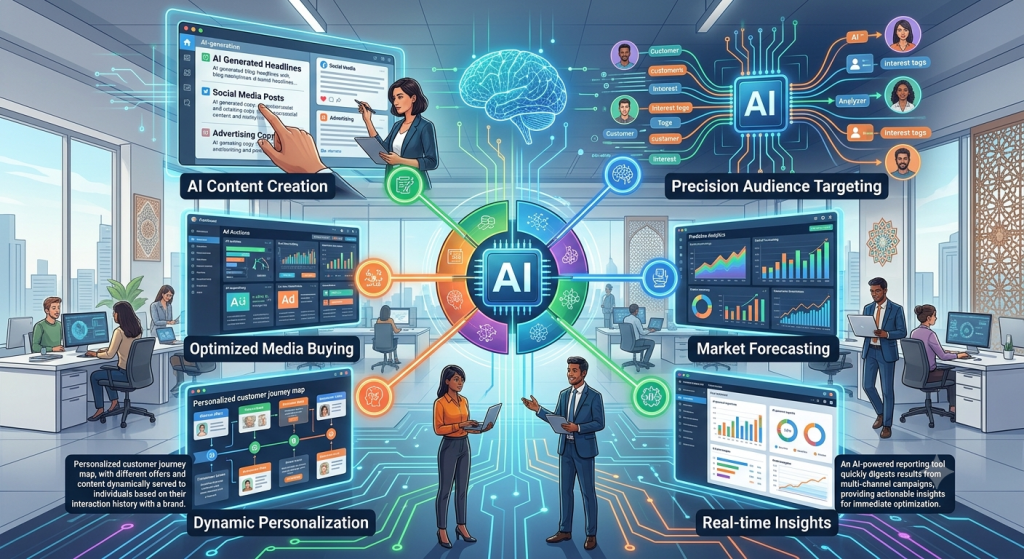
AI helps marketing teams to produce:
- Blog ideas
- social media posts
- Email drafts
- Advertisements
- Product descriptions
- Marketing summaries
Marketers can use AI to generate drafts and then human professionals review and improve them. Instead of creating everything manually this is helpful and time consuming in markets. AI also help businesses to test different marketing messages and identify which approaches are more likely to engage particular audiences.
AI for Business decision Making
AI in India is also helps to generate huge amounts of data every day in businesses. The challenge is turning that data into useful information. AI and machine learning can analyse large dataset much faster than traditional manual processes. businesses can use AI-powered analytics to identify trends, detect unusual activity, forecast demand, and support strategic decisions.
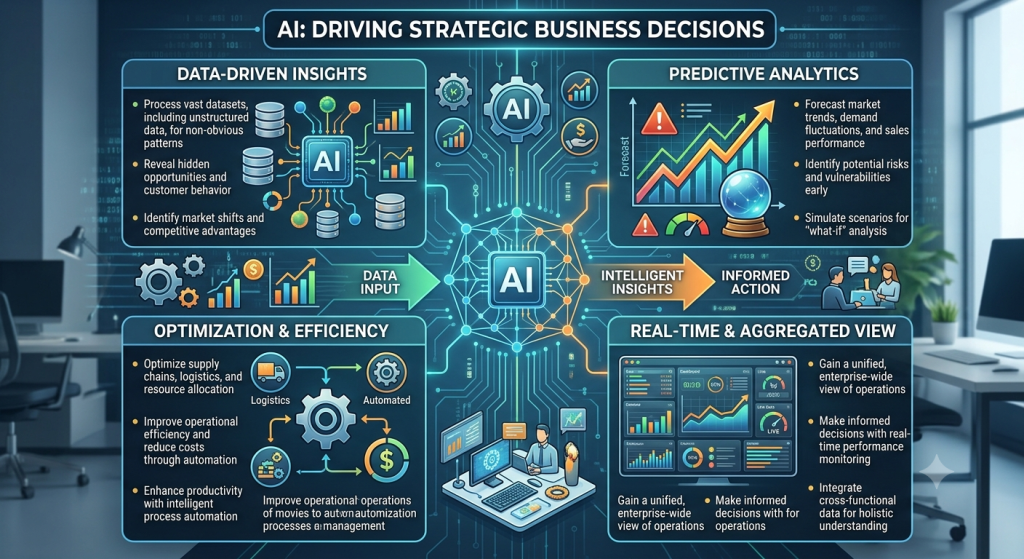
For example, a shopkeeper can analyse previous sales, seasonal trends, promotions and customer behaviour to estimate how many products it may need in the coming weeks. This may help businesses to reduce waste, manage inventory, and make better purchasing decisions. AI in India increasing towards measuring business outcomes rather than simply counting how many AI tools an organisation has deployed.
AI in Sales
AI in India is used for administrative work, sales teams use AI to reduce administrative work and focus on customers. AI tools help sales professionals to identify potential customers, organise leads, summarise conversations, draft follow up emails, and analyse customers interactions. For example, after a sales meeting, an AI assistance can summarise the discussion, identify customer requirements, and prepare a draft follow up message.
AI also help sales teams prioritise leads by analysing customer behaviour and historical sales data. This can save data and allow sales professionals to spend more time building relationships.
AI in Finance and Accounting
AI in India deals with large volumes of documents, transactions, invoices, and financial data. AI can help automate many repetitive activities. Businesses also use AI to:
- Identify unusual transactions
- Process invoices
- Categorise expenses
- Forecast cash flow
- Assist with financial reporting
- Detect potential fraud
For banks and financial institutions fraud detection is particularly important. AI systems can examine transaction patterns and identify activities that appear unusual. Financial decisions require careful oversight.
AI in Human Resources
Human resource departments also adapt AI in India. AI helps to organise applications, identify relevant skills, schedule interviews, and answer candidate questions. Is is helpful to recruitment teams to arrange all the procedure with the help of AI. Also AI helps candidates to to find company information, about company policies, benefits, training programs, and internal procedures through AI-powered assistance.
For example, a employee might ask, “What is company’s sick leave policy?” then AI will help to the candidate by giving all the necessary information about sick leaves. Instead of waiting for human representative to answer AI will answer the questions anytime. However companies must be careful when using AI in their work like, hiring the candidates. Recruitment systems should be monitored for unfair bias, inaccurate recommendations, and inappropriate use of personal information.
AI in software Development
AI in India experiencing major changes in software development because of generative AI and AI coding assistance. Software engineering is already one of the major areas of enterprise AL deployment, alongside operations, marketing and customer service. Software developers also use AI for:
- Generate code
- Explain existing code
- Find potential bugs
- Create test cases
- Write documentation
- Convert code between programming languages
Software developers use AI in India for their daily tasks, AI does not eliminate the need for software developers. instead, it can act as a productivity tool that helps developers complete certain tasks faster. after giving help from AI developers should need to review generated codes because AI can produce incorrect, insecure, or inefficient solutions.
AI in supply chain and Operations
Supply chains do many activities like, interconnected activities, including purchasing, manufacturing, inventory management, transportation,and delivery. AI in India also help businesses forecast demand, optimise inventory, predict delays, and identify potential problems. For example, if an AI system detects that demand for a particular product is increasing then a company can adjust its production or purchasing plans.
Manufacturers can also use AI to monitor equipment and predict when maintenance may be required. This approach, known as predictive maintenance, can help reduce unexpected equipment failures and downtime. In 2026, businesses in India increasingly looking at AI not just as a separate software tool but as part of core operational workflows.
AI in Retail and E-Commerce
AI is also used in retail and E-commerce to make shopping more personalised. AI will recommends products based on customer preferences, improve search results, and assist with inventory planning. If a customer could say ” I need a laptop under 30,000 for daily office use.” An AI in India should give him all the detailed information about all models available in market for purchasing a laptop. Retailers are already experimenting with AI systems that help customers to discover the product and create shopping list.
The Future of AI in Business
AI in India is likely to become important into everyday business operations. Instead of opening a separate AI application whenever they need help, employees may interact with AI directly through the software they already use. AI could become a common layer connecting business data, applications, workflows, and employe
AI may change how companies operate systems to complete multi-step processes under defined permissions.At the same time, businesses will need to balance innovation with security, privacy, accuracy, transparency, and human accountability.The future will therefore not simply be about using more AI. It will be about using the right AI for the right business problem.
Conclusion
Artificial intelligence in India is changing day-by-day. From customer service to marketing and finance, cyber security, software development, healthcare, retail, and supply chain management, AI in India is becoming part of everyday business processes. However, for successful AI adoption requires more than purchasing an AI tool. Businesses need quality data, skilled employee, security controls, responsible governance and clear goals. AI in India is also used in cyber security, in healthcare, for content creation, and personalised customer Experiences.
There are many benefits of using AI in businesses like, to increase productivity, low operation cost, better customer service, decision making. The companies that benefit most from AI will likely be those that combine Artificial Intelligence with human expertise. In 2026, AI is no longer simply a technology it is an important part of how modern business run and create value.
Frequently asked Questions (FAQs)
1. What are the biggest benefits of AI for businesses?
In businesses the the use of AI is increased because it helps business to increase productivity, decision making, marketing, sales, finance, data analysis, supply chain management.
2. How businesses using AI in 2026?
Businesses uses AI for customer service, marketing, sales and increase their overall productivity. AI helps companies automate repetitive tasks, analyse information and provide personalised customer experience.
3. What challenges do businesses face when adapting AI?
common challenges like, data privacy, cyber security, bias,and the need for proper AI governance that are common challenges businesses face.


[…] Tell the AI prompts how you want the answer […]
[…] is changing rapidly with the growth of artificial intelligence. Developers no longer use AI only to generate small pieces of code or explain programming concepts. A newer generation of AI […]