

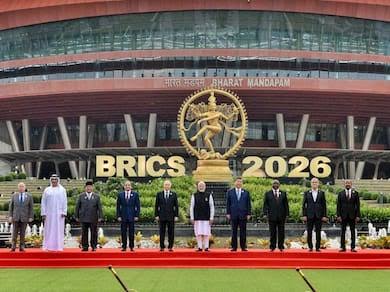
The BRICS Summit 2026 concluded in New Delhi on September 13, marking one of the most significant diplomatic gatherings India has hosted in recent years. Held at Bharat Mandapam over two days, the 18th edition of the summit brought together leaders from all 11 BRICS member nations at a moment of genuine global tension — wars in West Asia, ongoing trade disputes, and mounting pressure from the Global South for a bigger seat at the table. Here are five historic takeaways from what unfolded.
Table of Contents
- A Milestone Summit: 20 Years of BRICS, India’s 4th Chairship
- Takeaway #1: The 140-Point New Delhi Declaration
- Takeaway #2: A Careful Stand on Global Conflicts
- Takeaway #3: AI Governance Enters the BRICS Summit 2026 Agenda
- Takeaway #4: A Push for Global Governance Reform
- Takeaway #5: Trade, De-Dollarisation, and Standing Up to Tariffs
- The Diplomatic Balancing Act Behind the Scenes
- What Happens Next: China Takes Over as Chair
- Why the BRICS Summit 2026 Matters
- Conclusion
- FAQs
A Milestone Summit: 20 Years of BRICS, India’s 4th Chairship
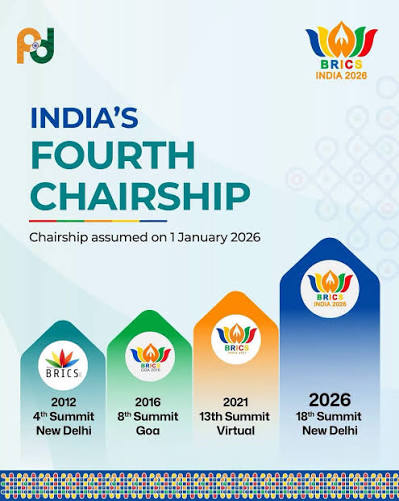
The BRICS Summit 2026 carried extra symbolic weight this year, arriving exactly 20 years after the bloc’s formation. India held the BRICS chairmanship for the fourth time in its history, having previously hosted in 2012, 2016, and 2021, under the theme “Building for Resilience, Innovation, Cooperation and Sustainability.” The BRICS summit 2026 brought together all 11 member nations — Brazil, Russia, India, China, South Africa, Egypt, Ethiopia, Indonesia, Iran, Saudi Arabia, and the United Arab Emirates — a grouping that together represents nearly half the world’s population, around 40 percent of global GDP, and roughly 26 percent of global trade.
Leaders including Chinese President Xi Jinping and Russian President Vladimir Putin were among those attending in person, gathering for the now-familiar family photograph at Bharat Mandapam that has become a symbol of each BRICS summit. Prime Minister Narendra Modi, chairing the proceedings, later thanked fellow leaders publicly for making the New Delhi summit “very productive and outcome oriented.”
Takeaway #1: The 140-Point New Delhi Declaration
The single most significant outcome of the BRICS Summit 2026 was the unanimous adoption of the New Delhi Declaration — a sweeping, 140-point document covering everything from conflict zones and terrorism to trade, climate, technology, and development. Leaders formally adopted the declaration on the BRICS summit 2026’s first day, despite real divisions among member nations over conflicts in both Iran and Ukraine.
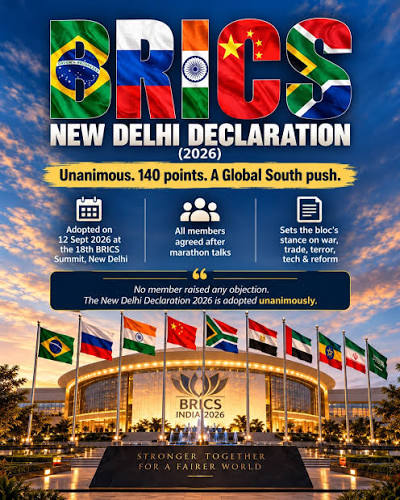
The declaration strongly condemned the April 22, 2025 terror attack in Jammu and Kashmir, which killed 26 people, and separately expressed sharp concern over strikes on nuclear facilities, warning that such attacks on peaceful, IAEA-safeguarded infrastructure breach international law. On the Israel-Gaza conflict, the bloc demanded an immediate ceasefire, insisted on unimpeded humanitarian aid delivery, firmly rejected any forced relocation of Palestinian civilians, and backed full UN membership for Palestine alongside a two-state solution based on 1967 borders with East Jerusalem as its capital.
Takeaway #2: A Careful Stand on Global Conflicts
One of the more revealing aspects of this year’s declaration was what it deliberately avoided saying. Despite Russia being a founding BRICS Summit 2026 member, the document never once names the Russia-Ukraine war directly, instead offering only a generic call for international disputes to be resolved through “dialogue, consultation, and diplomacy.” The declaration did, however, criticize unilateral sanctions not authorized by the UN Security Council — a position that indirectly touches on the broader sanctions regime tied to the conflict without naming it outright.
A similar pattern of careful, non-naming language extended to the Middle East. The declaration called for restraint amid regional tensions but stopped short of directly condemning US-Israeli strikes or Iran’s own targeting of Gulf countries. It did address several other flashpoints more specifically, expressing concern over the situation in Sudan, calling for a Syrian-led political transition and the withdrawal of occupying forces, and welcoming the Lebanon ceasefire while condemning attacks on UN peacekeepers there.
Takeaway #3: AI Governance Enters the BRICS Agenda
For the first time, artificial intelligence governance was formally folded into the bloc’s core agenda at this year’s summit. Leaders committed to implementing the BRICS Summit 2026 Leaders’ Statement on the Global Governance of Artificial Intelligence, explicitly referencing India’s own AI Impact Summit held in February 2026 and China’s World AI Conference in Shanghai as touchpoints for this new commitment.
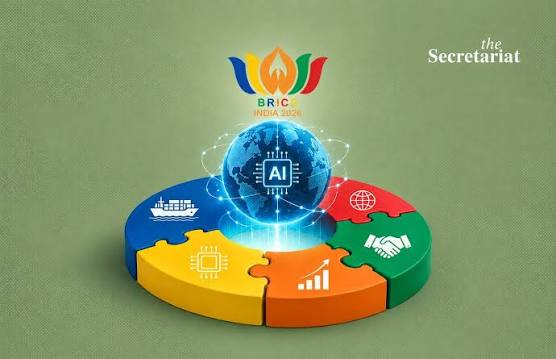
This addition effectively places AI governance alongside trade and finance as a genuine pillar of BRICS Summit 2026 cooperation going forward, rather than treating it as a peripheral, future-facing concern. The declaration paired this AI commitment with parallel pledges on cybersecurity and coordinated efforts to counter cross-border scam networks, reflecting a recognition that AI-related risks and opportunities now intersect directly with the bloc’s existing security and economic priorities.
Takeaway #4: A Push for Global Governance Reform
A consistent thread running through the entire New Delhi Declaration was a call to reform global governance institutions that member nations feel no longer reflect today’s economic and geopolitical realities. The declaration explicitly called for the international system to become more just, equitable, representative, democratic, effective, and accountable — language aimed squarely at institutions like the United Nations Security Council and the broader international financial architecture, including bodies like the IMF.
This reform push is far from new territory for BRICS, but the 2026 declaration renewed it with particular emphasis, backing expanded roles for both India and Brazil at the United Nations specifically. Analysts have noted that this reform-focused messaging reflects the bloc’s broader, long-running effort to position itself as a genuine voice for the Global South within institutions historically dominated by Western powers.
Takeaway #5: Trade, De-Dollarisation, and Standing Up to Tariffs
Trade tensions loomed heavily over this year’s proceedings, arriving less than a year after former US President Donald Trump threatened BRICS Summit 2026 member nations with tariffs of up to 10 percent over what he described as the bloc’s “anti-American” policies. In response, the New Delhi Declaration explicitly opposed unilateral trade tariffs, secondary economic sanctions, and protectionist carbon border adjustment measures that don’t comply with World Trade Organisation rules — language widely read as a direct, if unnamed, rebuke of recent US trade policy.
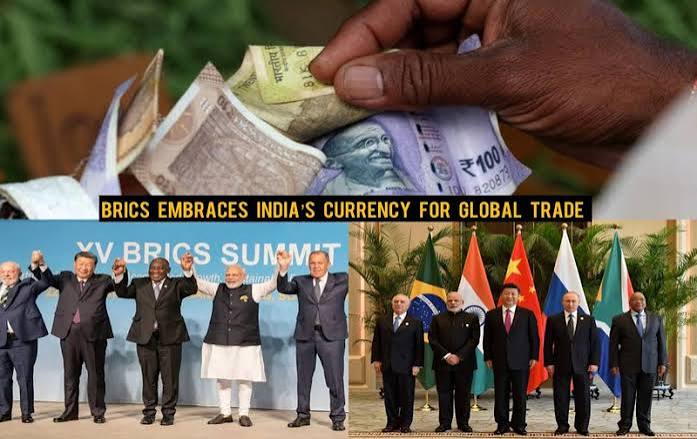
De-dollarisation — the long-running BRICS Summit 2026 effort to reduce global reliance on the US dollar for trade and reserves — also featured prominently in this year’s discussions, continuing a theme that has grown more urgent for member nations amid repeated tariff threats and sanctions regimes tied to the dollar-based financial system.
The Diplomatic Balancing Act Behind the Scenes
Reaching unanimous agreement on the New Delhi Declaration was reportedly no small feat. The summit followed a rockier stretch for the bloc, including a BRICS foreign ministers’ meeting held in New Delhi back in May that ended without any joint statement at all, due to a split in consensus over the war in West Asia. That earlier failure made this September’s unanimous adoption considerably more notable.
According to analysts covering the summit, India used its strong bilateral ties with all member nations and worked extensively behind the scenes to help finalize the declaration, with convincing the UAE and Iran — two nations on opposite sides of the ongoing regional conflict — described as the single biggest hurdle India had to overcome. One expert quoted in coverage of the summit suggested that members “invested in the success of this non-Western grouping” would be reasonably satisfied with what was, ultimately, a fairly modest but meaningful outcome.
What Happens Next: China Takes Over as Chair
With India’s 2026 chairship now concluded, China is set to take over as the next BRICS chair, with responsibility for hosting the 19th BRICS Summit in 2027. Chinese President Xi Jinping used his remarks at the New Delhi summit to call for deeper cooperation among member nations going forward, signaling continuity in the bloc’s broader direction even as leadership formally shifts to Beijing.
Why the BRICS Summit 2026 Matters
Beyond the specific commitments in the New Delhi Declaration, this year’s summit carries broader significance simply because of what BRICS summit 2026 itself now represents on the world stage. A bloc covering roughly half the global population and 40 percent of global GDP reaching unanimous agreement on a 140-point document — even one carefully worded to avoid naming its most divisive conflicts directly — sends a clear signal that the grouping remains functionally cohesive despite genuinely significant internal disagreements between members like Russia, Iran, Saudi Arabia, and the UAE.
For India specifically, successfully chairing a summit of this scale, and reportedly playing a central diplomatic role in bridging the UAE-Iran divide, reinforces the country’s growing profile as a genuine bridge-builder within a fractured, increasingly multipolar global order.
Conclusion
The BRICS Summit 2026 in New Delhi didn’t resolve the world’s most pressing conflicts, nor did it fundamentally reshape global trade or financial systems overnight. But by unanimously adopting a genuinely comprehensive 140-point declaration — spanning terrorism, Gaza, AI governance, global institutional reform, and trade — despite real fractures among its own members, the bloc demonstrated a level of cohesion that few expected heading into the summit. As chairship now passes to China ahead of 2027, the New Delhi Declaration will likely serve as the reference point against which the bloc’s next chapter gets measured.
FAQs
1. When and where was the BRICS Summit 2026 held?
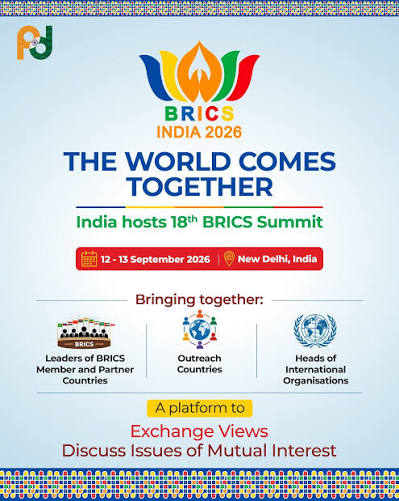
The 18th BRICS Summit was held on September 12-13, 2026, at Bharat Mandapam in New Delhi, India, under India’s fourth BRICS chairship.
2. What is the New Delhi Declaration?
The New Delhi Declaration is a 140-point document unanimously adopted by BRICS leaders at the 2026 summit, covering positions on global conflicts, terrorism, trade, climate, artificial intelligence, and global governance reform.
3. Which countries are part of BRICS in 2026?
The 11-member BRICS bloc includes Brazil, Russia, India, China, South Africa, Egypt, Ethiopia, Indonesia, Iran, Saudi Arabia, and the United Arab Emirates.
4. Did the BRICS Summit 2026 address the Russia-Ukraine war?
Not directly. The declaration avoided naming the Russia-Ukraine war, instead calling generically for disputes to be resolved through dialogue and diplomacy, while criticizing unilateral sanctions not authorized by the UN Security Council.
5. Who will host the next BRICS summit?
China will take over as BRICS chair following India’s 2026 chairship, and will host the 19th BRICS Summit in 2027.
6. What did the BRICS Summit 2026 say about AI?
For the first time, AI governance was formally added to the BRICS agenda, with leaders committing to implement the BRICS Leaders’ Statement on the Global Governance of Artificial Intelligence, alongside parallel commitments on cybersecurity.


