

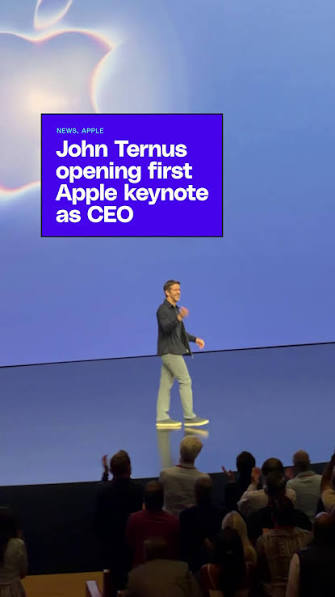
Eight days into the job, John Ternus walked onto the Apple Park stage on September 9, 2026, for the biggest moment of his career so far — his first keynote as Apple’s Chief Executive Officer. What followed was an hour-plus presentation that delivered the company’s first foldable iPhone, a new flagship lineup, updated wearables, and a clear, deliberate statement about where Apple believes it stands in the AI race. Here’s everything that happened.
Table of Contents
- A Cheeky Handoff From Tim Cook
- Ternus’s Steve Jobs-Style Opening
- The iPhone Duo: Apple’s First Foldable
- iPhone 18 Pro and Pro Max
- New Apple Watch Series 12 and Ultra 4
- AirPods 5
- Apple’s AI Strategy, According to Ternus
- Pricing, Leasing, and Release Dates
- How Rivals Reacted Before Apple Even Took the Stage
- Early Reactions to Ternus’s Debut
- Why This Keynote Mattered
- Conclusion
- FAQs
A Cheeky Handoff From Tim Cook
Apple’s keynote video opened with a genuinely clever, self-aware touch. Rather than simply introducing John Ternus directly, the video built what one reviewer described as “a cinematic debate about what makes for a great opening scene,” ultimately leading into outgoing CEO Tim Cook narrating his own walk into Apple Park — before turning to the camera and revealing that he isn’t actually the main character of this particular story. That role, Cook made clear, belonged to John Ternus.

It was a small but deliberate moment of support from Cook, who officially transitioned to Executive Chairman on September 1, handing the CEO title to John Ternus after leading Apple for over a decade. Observers noted that the segment struck the right tone — supportive without feeling forced, and confident without overselling itself, something Apple’s introductory videos don’t always manage to pull off.
Ternus’s Steve Jobs-Style Opening
Once he took over, John Ternus leaned directly into Apple’s own history for his opening framing — a move several observers compared explicitly to Steve Jobs’s original 2007 iPhone unveiling. Rather than opening with hardware specs, John Ternus posed a question: if you were designing the ideal version of a personal technology “hub” from scratch, what would it need?
“Now, if you were designing the ideal version of this hub from scratch, how would you do it?” John Ternus asked. “Well, first, you would want something that is always with you, deeply personal, and able to bring intelligence to the moments when it matters most.” He went on to list the core qualities such a device would need — always within reach, a powerful processor, a great display, constant high-speed connectivity, high-quality sensors, and a battery that lasts all day — before pivoting to the answer: “Today, we’re going to take these experiences even further with the next generation of iPhone.”

It was a calculated rhetorical structure, echoing the exact “here’s the ideal device, and here it is” formula Jobs used to introduce the original iPhone nearly two decades earlier — a clear signal that John Ternus, despite coming from an engineering rather than a marketing background, understands Apple’s own presentational playbook well.
The iPhone Duo: Apple’s First Foldable
The headline announcement of the event was the iPhone Duo, Apple’s first-ever foldable iPhone and, according to CNN’s coverage, the biggest change to the iPhone’s design in its nearly 20-year history. Interestingly, the device’s actual name diverged from months of rumors pointing to “iPhone Ultra” — Apple ultimately went with the simpler, more descriptive “Duo” instead.

The Duo unfolds into a single, continuous 7.6-inch display — a screen size reported to be roughly 80% larger than the current iPhone Pro’s display and about 50% larger than the Pro Max’s. When closed, a 5.4-inch outer display allows for regular use without unfolding the device. Despite housing this significantly larger unfolded screen, Apple emphasized that the Duo is also the thinnest iPhone the company has ever made. Ternus described the project’s origins simply: the initial idea was built around the belief that “a larger display would open up entirely new possibilities,” and that the final product “reflects what’s possible when we bring our very best teams together.”
Software-wise, iOS 27 has been specifically adapted for the Duo’s folding hardware, including a new Split View feature that lets two apps run side-by-side, the ability to save app pairs for quick access later, and orientation-aware adjustments as the device moves between folded and unfolded states. Apple also confirmed that major third-party apps — including Netflix, Zoom, and Slack — have already been updated to take advantage of the larger unfolded display, and that Apple Pencil support for the Duo is coming later this year.
iPhone 18 Pro and Pro Max
Alongside the Duo, Apple introduced the iPhone 18 Pro and iPhone 18 Pro Max, which — as widely rumored beforehand — look largely similar to last year’s models on the outside, with the more significant changes happening under the hood and in the camera system. The standout new feature is a variable aperture on the main 48-megapixel wide-angle camera, letting the lens adjust more like a traditional camera for better control over depth of field and low-light performance. Both models run on Apple’s new 2-nanometer A20 Pro chip.

Pricing was confirmed at the event: the iPhone 18 Pro starts at $1,199, while the iPhone 18 Pro Max starts at $1,299. Notably, the standard iPhone 18 was absent from the lineup entirely — as expected, Apple is holding that model back for a spring 2027 launch alongside the iPhone 18e and a second-generation iPhone Air.
New Apple Watch Series 12 and Ultra 4
Apple also refreshed its wearables lineup with the Apple Watch Series 12 and Apple Watch Ultra 4. The Series 12 was shown in a 46mm aluminum case with a glass ceramic build, WR-50M water resistance, and both GPS and Cellular connectivity options. Apple highlighted an updated sensor array capable of sampling certain health metrics up to 60 times more frequently than before, continuing the company’s steady push deeper into health and fitness tracking. As with the rest of the lineup, AI featured heavily in Apple’s framing of the new watches’ capabilities.
AirPods 5
Rounding out the hardware announcements, Apple introduced AirPods 5, priced at $129, or $149 for the version that includes a wireless charging case. Apple described the new AirPods as offering “industry-leading” active noise cancellation, improved sound quality, hands-free access to the new Siri AI, and Live Translation support. The feature list recapped during the event’s presentation included personalized spatial audio, adaptive audio, transparency mode, conversation awareness, up to 5 hours of battery life with active noise cancellation enabled, next-generation adaptive EQ, IP57 dust, sweat, and water resistance, voice isolation, custom EQ, camera remote functionality, and volume control via swipe gestures.
Apple’s AI Strategy, According to John Ternus
Beyond the hardware itself, one of the more closely watched aspects of John Ternus’s debut was how he chose to position Apple within the broader AI conversation — an area where the company has faced persistent criticism over delays to its own AI ambitions. His answer was direct: according to John Ternus, the iPhone is already the best personal device for artificial intelligence that exists, and Apple’s approach is distinguished specifically by its stronger commitment to user privacy compared to rivals.

Rather than framing AI in technical terms — processor benchmarks, chip architecture, or performance metrics that most regular users wouldn’t find meaningful — John Ternus chose to describe Apple Intelligence and the new Siri AI in purely functional terms: as a genuine personal assistant. Analysts covering the event noted this as a deliberate choice, emphasizing usage and everyday value over raw technical specifications. John Ternus described the iPhone itself as an “intelligent personal hub,” reinforcing that Apple’s AI strategy centers on making the iPhone the primary way people interact with AI, rather than introducing entirely new AI-first hardware.
Pricing, Leasing, and Release Dates
Along with confirming prices across its new lineup, Apple also introduced a notable new option: the ability to lease a new iPhone rather than buying it outright, a move that follows recent price increases across several of Apple’s newest devices. For the iPhone Duo specifically, the base model starts at $1,999, with the highest-configuration version reportedly reaching as much as $3,199 — making it the most expensive iPhone Apple has ever released.
Release timing varies by product. The Apple Watch Series 12, Watch Ultra 4, and AirPods 5 were all available for pre-order starting the same day as the event, September 9, with general availability following on September 18. The iPhone Duo follows a slightly different, later timeline, with pre-orders opening October 16 and retail availability the following week — reflecting the added manufacturing complexity of Apple’s first foldable device. iOS 27 itself is set to ship on September 14, bringing Siri AI to compatible devices in beta form, initially in English only, with no availability in the European Union at launch.
How Rivals Reacted Before Apple Even Took the Stage
In a sign of just how closely competitors were watching Apple’s foldable ambitions, two of Apple’s biggest rivals in the Chinese smartphone market moved to get ahead of the announcement entirely. The day before Apple’s event, both Huawei and Xiaomi unveiled their own new foldable devices — Xiaomi introduced the 18 Fold, a passport-sized foldable, while Huawei revealed the Mate XT2, a trifold smartphone considerably more complex in form factor than Apple’s book-style Duo.
The timing was almost certainly not a coincidence, and it underscores how significant Apple’s long-awaited entry into the foldable category is seen as being, even by competitors who have already had several years’ head start building out their own foldable lineups.
Early Reactions to Ternus’s Debut
Initial commentary on John Ternus’s first keynote performance has been largely positive, with particular praise directed at how he handled the balance between honoring Apple’s presentational traditions and establishing his own distinct leadership identity. One review noted that where Tim Cook’s Vision Pro launch had struggled to generate more than a “modest ripple” of public excitement, John Ternus’s iPhone Duo reveal landed with considerably more impact — despite the product not even being available for purchase yet.
Analysts have also pointed out that John Ternus, unlike Cook or Jobs before him, comes from a strictly engineering background rather than a design or marketing one, having spent 25 years at Apple working on projects including Apple Silicon Macs and the Vision Pro. Some have suggested this technical grounding could prove valuable as AI increasingly becomes a hardware-software integration challenge rather than a purely software one. Notably, John Ternus’s presentation style also broke from tradition in one specific way — he skipped a formal, direct self-introduction on stage entirely, a choice one reviewer interpreted as intentional, signaling that the products themselves, not their new leader, were meant to remain the central focus of the event.
Why This Keynote Mattered
Beyond the individual product announcements, this keynote carried outsized significance simply due to its timing. Apple has faced sustained criticism over the past two years regarding delays to its AI ambitions, with some coverage going so far as to describe the company as facing a genuine “AI crisis” heading into this leadership transition. John Ternus’s very first public event as CEO was always going to be read, at least in part, as a referendum on whether Apple’s AI strategy under new leadership represents real progress or simply a continuation of previous promises.
By pairing a genuinely significant hardware milestone — the company’s first foldable iPhone in nearly two decades of iPhone history — with a clearly articulated, privacy-focused AI positioning, John Ternus appears to have given Apple a strong opening statement, even if the ultimate success of Siri AI and the iPhone Duo’s sales performance remain very much unproven questions for the months ahead.
Conclusion
John Ternus’s first keynote as Apple’s CEO delivered exactly the kind of high-stakes moment his new role demanded — a genuinely significant hardware announcement in the iPhone Duo, a refreshed flagship and wearables lineup, and a clear, deliberately framed statement about Apple’s approach to AI. Whether this proves to be the start of a strong new chapter for Apple or simply an impressive opening act remains to be seen, but as a debut performance, it gave Ternus a considerably stronger launching point than many expected just eight days into the job.
FAQs
1. Who is John Ternus?
John Ternus is Apple’s CEO, having taken over from Tim Cook on September 1, 2026. He previously served as Apple’s Senior Vice President of Hardware Engineering for 25 years, working on projects including Apple Silicon Macs and the Vision Pro.
2. What is the iPhone Duo?
The iPhone Duo is Apple’s first foldable iPhone, featuring a 7.6-inch inner display and a 5.4-inch outer display. It starts at $1,999, with pre-orders opening October 16, 2026.
3. How much does the iPhone 18 Pro cost?
The iPhone 18 Pro starts at $1,199, while the iPhone 18 Pro Max starts at $1,299, both featuring Apple’s new A20 Pro chip and a variable-aperture main camera.
4. What did John Ternus say about AI during the keynote?
Ternus stated that the iPhone is already the best personal device for artificial intelligence, emphasizing Apple’s focus on privacy and framing the iPhone as an “intelligent personal hub” rather than introducing separate AI-specific hardware.
5. When does the iPhone Duo release?
Pre-orders for the iPhone Duo open on October 16, 2026, with retail availability following the next week — later than the rest of Apple’s September lineup, due to the added manufacturing complexity of its foldable design.
6. What other products did Apple announce at this event?
Alongside the iPhone Duo and iPhone 18 Pro lineup, Apple introduced the Apple Watch Series 12, Apple Watch Ultra 4, and AirPods 5, priced at $129 (or $149 with a wireless charging case).


