


Introduction
One growing concern is deepfake AI scams, in which fraudsters use artificial intelligence to create fake videos, audio recordings, or images that appear to show real people. Artificial intelligence (AI) is changing how people communicate, create videos, and share information online. However, the same technology can also be misused to deceive people. .
Deepfake AI technology can imitate someone’s face, voice, expressions, and speaking style. Scammers may use these techniques to impersonate family members, business executives, celebrities, or government officials. They can then ask for money, personal information, passwords, or verification codes.
For example, a person might receive a phone call that sounds exactly like a family member asking for urgent financial help. Another person might watch a video of a company executive announcing a suspicious investment opportunity. Although these recordings may appear genuine, they could be artificially generated or manipulated.
Understanding how deepfake AI scams work is an important step toward protecting yourself. This article explains ten practical ways to identify suspicious videos and calls, along with safety measures you can follow to reduce the risk of becoming a victim.
Table of Contents
What Are Deepfake AI Scams?
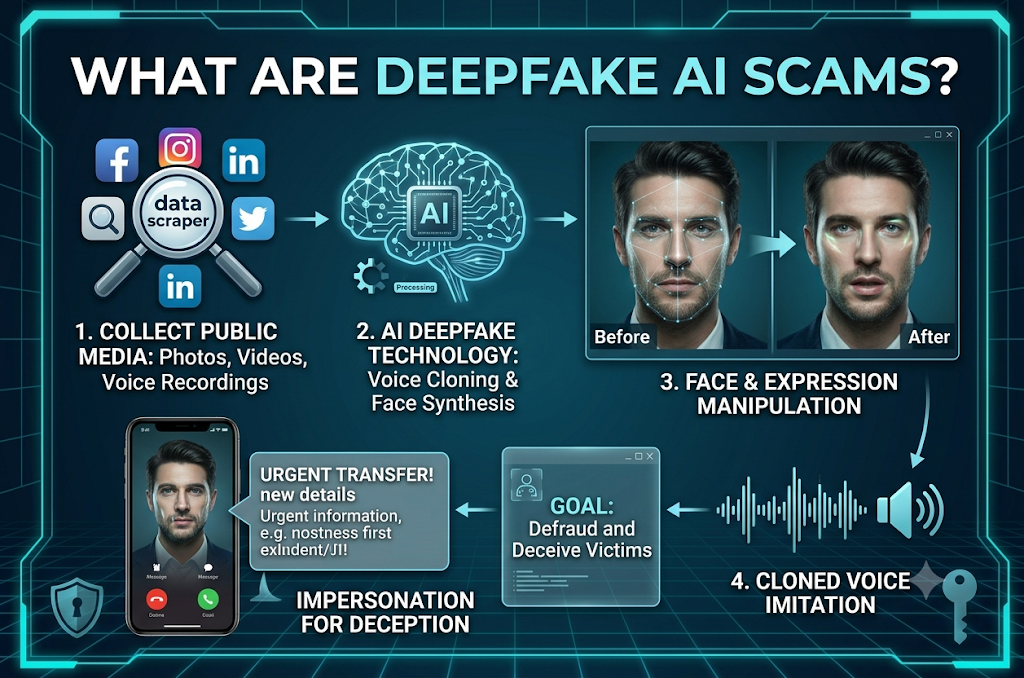
Deepfake AI scams involve the use of artificial intelligence to create or manipulate realistic-looking images, videos, or audio recordings for fraudulent purposes.
Some tools can generate a person’s voice from short audio samples. Others can modify facial expressions, replace faces in videos, or produce convincing recordings of someone saying something they never said.
Scammers may obtain publicly available photographs, videos, and voice recordings from social media, interviews, or other online sources. They can use these materials to imitate a person’s identity after deepfake ai scam.
Common examples of Deepfake AI scams include:
- Voice impersonation: A fake call imitates a relative, friend, or colleague.
- Video impersonation: A manipulated video appears to show a familiar person giving instructions.
- Fake investment promotions: Fraudsters use a public figure’s likeness to promote fraudulent financial opportunities.
- Business payment fraud: A scammer impersonates a manager or executive to request an urgent transfer.
- Romance and identity scams: Fake audio or video calls are used to build trust and manipulate victims.
Not every unusual video or poor-quality call is a deepfake AI. However, people should verify unexpected requests instead of trusting a recording simply because it looks or sounds realistic after deepfake ai scame.
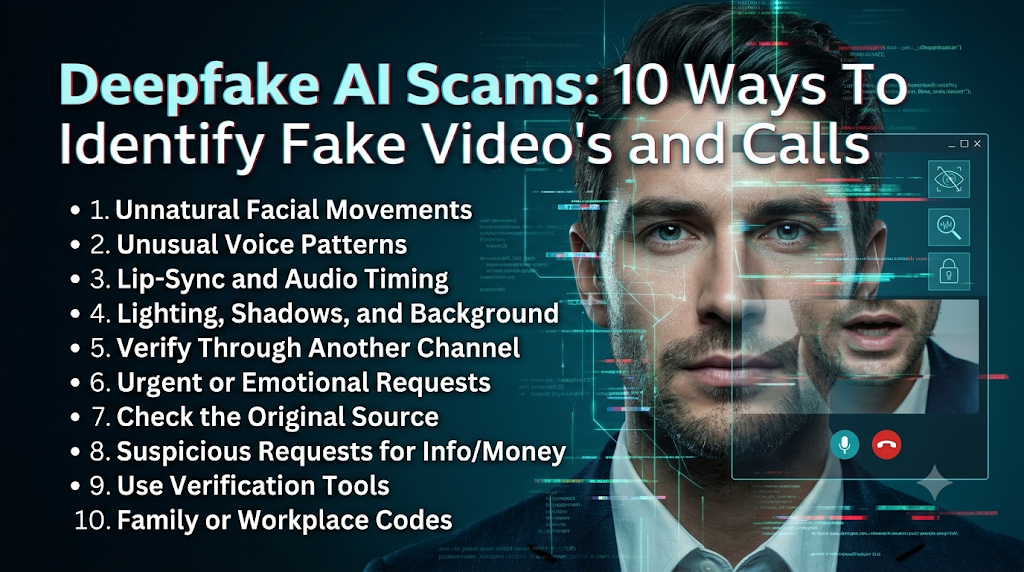
10 Ways to Identify Fake Videos and Calls
1. Look for Unnatural Facial Movements
One possible warning sign is a mismatch between facial movements and the person’s expressions. In some manipulated videos, the mouth may not move naturally while the person speaks. Facial expressions may also appear stiff, delayed, or inconsistent with the conversation.
Pay attention to how the person’s lips move when they pronounce words. Observe whether their facial expressions change naturally throughout the video.
However, modern deepfake AI tools can produce convincing facial movements, and ordinary video compression can also create visual distortions. Therefore, natural-looking expressions do not prove that a video is genuine.
Safety tip: Treat unusual facial movements as a reason to investigate further, not as conclusive proof of a deepfake AI.
2. Listen for Unusual Voice Patterns
AI-generated voices can sometimes sound unnatural. You may notice strange pauses, unusual pronunciation, inconsistent volume, or a robotic tone. The speaker’s emotional expression might also seem disconnected from the words being spoken.
For example, a caller may sound calm while describing an emergency or pronounce familiar names in an unusual way.
Nevertheless, genuine people can sound different because of background noise, poor network connections, illness, or stress. Advanced AI systems can also imitate natural speech convincingly.
Safety tip: Do not rely only on voice quality. Verify the caller’s identity through a separate, trusted communication channel.
3. Check Lip-Sync and Audio Timing
In a manipulated video, the speaker’s mouth movements may not match the words being heard. You might notice a slight delay between speech and lip movement or expressions that change at the wrong time.
Watch the video carefully and compare the mouth movements with the audio. Pay attention to moments when the person turns their head, speaks quickly, or changes expressions.
Keep in mind that internet interruptions, video editing, and poor synchronization can also cause these problems.
Safety tip: If a video contains unusual synchronization errors and makes an unexpected financial request, pause before acting and verify the message independently.
4. Examine the Lighting, Shadows, and Background
Deepfake AI videos can sometimes contain inconsistencies in lighting or image details. For example, the face may appear brighter than the surrounding environment, shadows may look unnatural, or the edges around the face may appear distorted.
Other possible warning signs include unusual reflections in glasses, inconsistent skin texture, or sudden changes in image quality around the person’s head.
These clues are not always reliable. Lighting differences can occur naturally, and modern AI-generated videos may have very few visible defects.
Safety tip: Examine the overall context of the video instead of assuming that one visual flaw proves it is fake.
5. Verify the Person Through Another Communication Channel
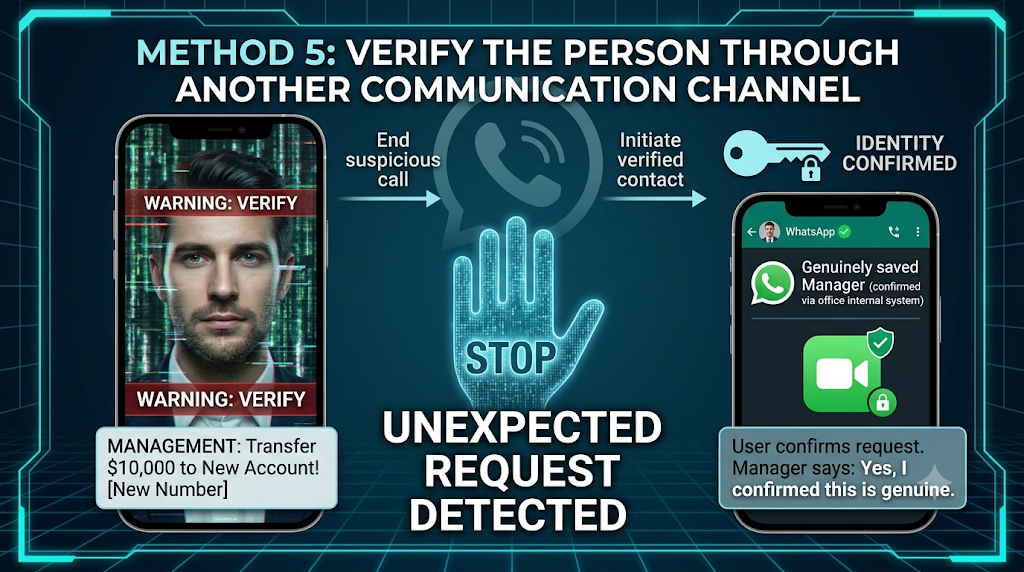
One of the most effective ways to protect yourself is to confirm the person’s identity independently.
Suppose you receive a video call from someone claiming to be your manager. The person asks you to transfer money immediately or share confidential information. Even if the face and voice look familiar, do not automatically trust the request.
End the call and contact your manager using a phone number or communication method you already know is genuine. Do not use a new number or link supplied during the suspicious interaction.
For family emergencies, contact the family member directly or speak with another trusted relative.
Safety tip: Always verify unexpected requests for money, passwords, confidential files, or security codes through an independent channel.
6. Be Careful With Urgent or Emotional Requests
Scammers often use urgency and fear to prevent people from thinking clearly. A deepfake ai caller might claim that a relative has been arrested, injured, or involved in an accident. Another caller might pretend to be an executive who needs an immediate confidential payment.
These messages are designed to make you react before checking the facts.
Be cautious if the caller insists that you must act immediately, keep the conversation secret, or avoid contacting anyone else.
Safety tip: Pause, take a breath, and verify the emergency independently. A genuine emergency should not prevent you from taking reasonable steps to confirm someone’s identity.
7. Check the Original Source of the Video
A video shared on social media or a messaging application may have been edited, taken out of context, or generated using AI.
Before believing or forwarding a suspicious recording, look for the original source. Check whether the person or organization featured in the video has published it through an established official account or website.
You can also search for reliable news reports or official statements that confirm the claim. If the video supposedly announces a major public event, check whether trustworthy sources report the same information.
Be careful with unfamiliar websites that imitate legitimate news outlets or official organizations.
Safety tip: Do not share shocking videos or financial claims until you have checked their source and supporting evidence.
8. Watch for Suspicious Requests for Money or Personal Information
The purpose of a deepfake ai scam is often to obtain money, confidential information, or access to an account.
A fake caller might ask you to transfer funds to a new bank account, disclose a one-time password (OTP), reveal a password, or install remote-access software. A manipulated celebrity video might encourage viewers to invest through an unfamiliar website.
These requests are dangerous regardless of whether the recording is a deepfake ai.
Never disclose passwords, OTPs, PINs, or banking credentials to someone who contacts you unexpectedly. Do not transfer money solely because a familiar face or voice asks you to do so.
Safety tip: Treat unexpected financial requests as suspicious until you have independently verified them.
9. Use Reverse Image Search and Trusted Verification Tools
If a video contains a suspicious person or claim, you may be able to investigate its origin using additional tools.
Take a clear frame from the video and use a reputable reverse image search service to check whether the image appears elsewhere online. This may help you find an older video, an unrelated original photograph, or a different context for the footage.
For important claims, consult official websites and reliable reporting. Some services also offer AI-generated media detection, but their results are not always accurate.
A detection tool may incorrectly label genuine content as artificial or fail to identify sophisticated manipulation. Do not upload private recordings, identity documents, or confidential business material to an unfamiliar verification service.
Safety tip: Combine source verification, independent confirmation, and available detection tools instead of relying on a single result.
10. Establish a Family or Workplace Verification Code
A simple verification procedure can help protect families and organizations against impersonation scams.
Families can agree on a private code word that is not shared publicly or stored in easily accessible social media profiles. If someone calls claiming to be a relative in an emergency, the person receiving the call can ask an appropriate verification question.
Businesses can establish procedures for confirming payment requests, changes to bank details, and access to confidential information. For example, employees can be required to obtain approval through an established internal system before transferring funds.
A code word should be kept private and changed if it becomes exposed. It should supplement, rather than replace, independent identity verification.
Safety tip: Create verification procedures before an emergency occurs, when people have more time to think clearly.
How to Protect Yourself From AI Deepfake Scams
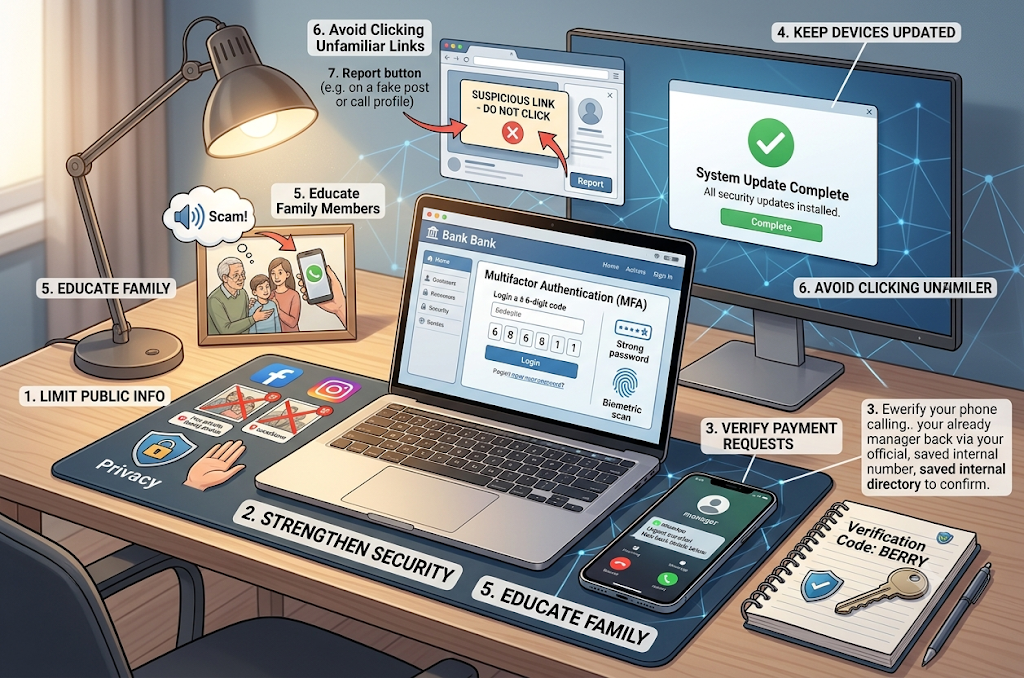
Recognizing suspicious content is important, but prevention is equally valuable. Follow these measures to reduce your risk:
- Limit public personal information: Avoid unnecessarily sharing personal details, private recordings, and sensitive family information online.
- Strengthen account security: Use strong, unique passwords and enable multifactor authentication wherever possible.
- Verify payment requests: Confirm unusual transfers or changes to payment details through a trusted channel.
- Keep devices updated: Install operating system, browser, and security updates regularly.
- Educate family members: Explain how voice-cloning and video-impersonation scams work, especially to people who may be pressured into urgent payments.
- Report suspicious content: Use the reporting features of the relevant platform and preserve useful evidence.
- Avoid clicking unfamiliar links: Never download unknown files or install applications because a suspicious caller instructs you to do so.
Remember that publicly available information can help scammers imitate people, but you do not need to stop using the internet. Sensible privacy settings and careful verification can reduce unnecessary risks.
What Should You Do If You Become a Victim?

If you suspect that you have been targeted by a deepfake ai scam, act quickly.
- Stop communicating with the suspected scammer. Do not send additional money or disclose further information.
- Contact your bank or payment provider immediately if you made a payment or shared financial information. Ask about available options to block or dispute the transaction.
- Change compromised passwords from a trusted device and secure affected accounts. Contact the relevant service provider if you lose access.
- Save evidence. Keep screenshots, call details, transaction records, messages, and relevant links. Avoid sharing sensitive evidence publicly.
- Report the incident. In India, you can report cybercrime through the official National Cyber Crime Reporting Portal at https://cybercrime.gov.in. For suspected financial cyber fraud, call the national helpline at 1930 as soon as possible.
- Warn affected contacts if someone has impersonated you or gained access to your accounts.
Reporting quickly does not guarantee recovery of money, but it may help authorities and financial institutions respond sooner.
Conclusion
Deepfake AI scams demonstrate how convincing digital impersonation can become. Fraudsters may imitate familiar voices, create realistic-looking videos, or invent emergencies to pressure people into making quick decisions.
Although some deepfakes ai contain visible or audible clues, sophisticated examples may be difficult to identify by appearance alone. The most reliable approach is to verify unexpected requests independently, protect sensitive information, and avoid making financial decisions under pressure.
Whether you receive a suspicious family call, a video featuring a public figure, or an urgent business instruction, take time to check the facts. Staying informed and using sensible verification practices can help you protect yourself, your family, and your workplace from digital fraud.
Frequently Asked Questions (FAQs)
1. What is an deepfake ai scam? Deepfake ai scam uses artificially generated or manipulated audio, images, or videos to impersonate someone and deceive people into providing money, information, or access to accounts.
2. Can AI copy someone’s voice from a short recording? AI tools may be able to imitate a person’s voice using relatively short audio samples. The quality of the imitation varies depending on the tool, recording quality, and available material.
3. How can I identify a fake video call? Look for suspicious behaviour, inconsistent visual or audio details, unusual requests, and pressure to act immediately. However, visual clues alone are not reliable. Verify the caller using a separate, trusted communication channel.
4. Are deepfake ai detection tools reliable? They can provide useful clues, but they are not completely reliable. Results should be considered alongside source checks, independent verification, and other evidence.
5. What should I do if someone uses a deepfake ai to scam me? Stop communicating with the suspected scammer, contact your bank if money is involved, secure compromised accounts, preserve evidence, and report the incident through the appropriate official channels.
6. Can deepfake ai scams happen on WhatsApp? Yes. Scammers can distribute manipulated videos, voice messages, and suspicious links through messaging applications, including WhatsApp. Verify unexpected requests before responding or sending money.
7. How can families protect themselves from voice-cloning scams? Discuss common scam tactics, establish a private family verification method, and agree to confirm urgent financial requests through a separate communication channel.
8. Should I trust a video if the person’s face and voice look real? No. Realistic facial movements and voices do not guarantee authenticity. Check the source and independently verify important claims or requests before taking action.
9. Can deepfake ai scammers use celebrities to trick people?
Yes. Scammers may use AI-generated videos or cloned voices of celebrities to promote fake investments, fraudulent products, or suspicious giveaways. Always verify endorsements through the celebrity’s official accounts or trusted sources before clicking links or sending money.
10. How can I report an deepfake ai scam in India?
You can report cybercrime through the official National Cyber Crime Reporting Portal. If you have lost money in an online financial scam, call 1930 as soon as possible. Save screenshots, messages, transaction details, and other relevant evidence to support your complaint in deepfake ai.


