

Apple has officially confirmed its next big event – “Surprise and Shine” — for September 9, 2026, and this year’s keynote is shaping up to be one of the most significant in the company’s recent history. Beyond the usual iPhone refresh, this event marks two firsts: Apple’s entry into the foldable phone market with the rumored iPhone Ultra, and the first keynote led by incoming CEO John Ternus. Here’s everything expected to be announced.
Table of Contents
- When and Where: Apple’s September 9 Event Details
- A New Era: John Ternus’s First Keynote as CEO
- iPhone Ultra: Apple’s First Foldable Phone
- iPhone Ultra Design and Display
- iPhone Ultra Specs and Performance
- iPhone Ultra Price and Release Date
- iPhone Ultra vs. Samsung’s Galaxy Z Fold8
- iPhone 18 Pro and Pro Max: What Else to Expect
- What Won’t Be Announced
- Why This Event Matters
- Conclusion
- FAQs
When and Where: Apple’s September 9 Event Details
Apple confirmed the date of its September event on August 26, roughly two weeks ahead of schedule. The keynote, titled “Surprise and Shine,” will take place at Apple Park in Cupertino, California, starting at 10:00 AM Pacific Time (1:00 PM Eastern). As with recent years, Apple is expected to stream a polished, prerecorded keynote video rather than a live presentation, broadcast on Apple’s website, the Apple TV app, and its YouTube channel. Select media will be invited to a small hands-on area at Apple Park following the video to try out the new devices in person.
Following the keynote, pre-orders for most new devices are typically expected around September 12, with the new iPhones becoming available for purchase around September 18 — though the iPhone Ultra specifically may see a delayed rollout due to manufacturing complexity, something we’ll cover in more detail below.
A New Era: John Ternus’s First Keynote as CEO
This year’s event carries extra significance because it marks a leadership transition at the very top of Apple. John Ternus officially takes over as CEO from Tim Cook on September 1, just over a week before the keynote — meaning September 9 will be his very first product event leading the company. Ternus previously served as Apple’s Senior Vice President of Hardware Engineering, and has been closely involved in the development of Apple’s product lines for years, giving him a strong technical background heading into his new leadership role.

While Apple’s keynote format is unlikely to change dramatically overnight, Ternus stepping into the spotlight for a launch this significant — headlined by Apple’s first foldable device — adds a layer of symbolic weight to the event that goes beyond the hardware itself.
iPhone Ultra: Apple’s First Foldable Phone
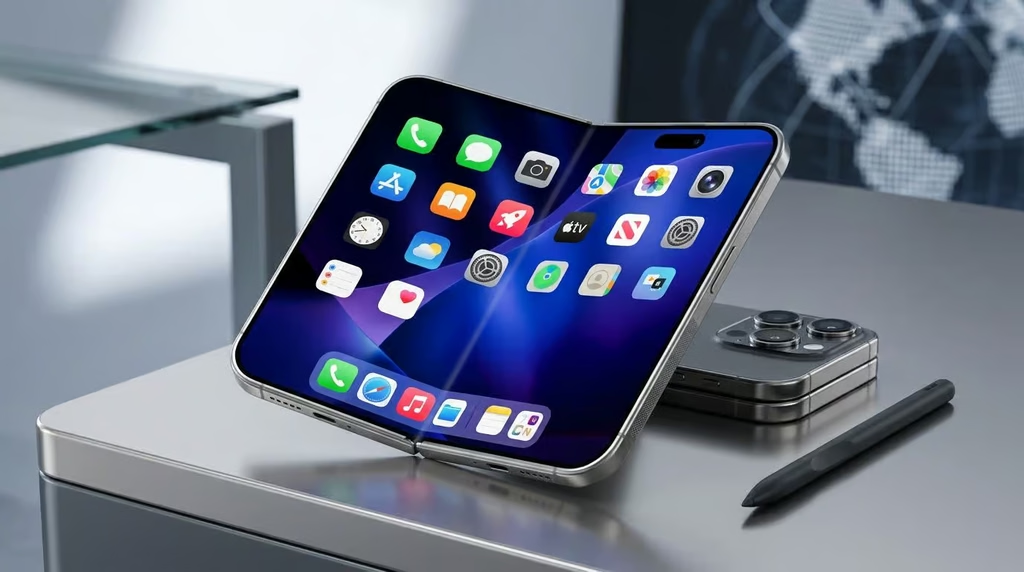
The headline story of this year’s event is almost certainly Apple’s rumored foldable iPhone, widely expected to be named the iPhone Ultra. After years of speculation and multiple design iterations reportedly tested internally — including a horizontally-opening iPad-style fold and a vertical clamshell design similar to competitors’ flip phones — Apple has reportedly settled on a book-style foldable that opens like a small tablet.
What makes the iPhone Ultra particularly notable is its form factor choice. Unlike most foldables on the market, which tend to be tall and narrow when unfolded, the iPhone Ultra is expected to be wider than it is tall, giving it a distinctly different profile from Samsung’s long-running Galaxy Z Fold lineup.
iPhone Ultra Design and Display
Display leaks suggest the iPhone Ultra will feature a large inner screen measuring approximately 7.7 to 7.8 inches, roughly comparable in size to an iPad mini, with a resolution around 2,713 x 1,920 pixels. The outer cover display, usable when the phone is folded shut, is rumored to come in around 5.49 inches with a 4:3 aspect ratio — noticeably squatter and wider than a standard iPhone screen.
One of the most closely watched aspects of the design is Apple’s approach to the crease problem that has affected virtually every foldable phone on the market to date. Multiple reports indicate Apple has developed a “new material property,” paired with metal support plates beneath the display, specifically to eliminate or dramatically minimize the visible crease when the phone is unfolded — something competitors have struggled to fully solve even several generations into their own foldable lineups. The device is also expected to be remarkably thin, with rumors pointing to roughly 4.5mm when unfolded and around 9.5mm when folded shut, aided by a new liquid hinge design built from aluminum and titanium.
iPhone Ultra Specs and Performance
Under the hood, the iPhone Ultra is expected to run on Apple’s latest A20 or A20 Pro chip, built on a 2-nanometer manufacturing process for improved efficiency. Camera-wise, leaks point to dual 48-megapixel rear cameras (a wide and ultrawide combination), though notably, some reports suggest the device may skip a telephoto lens entirely — a trade-off likely made to keep the folded profile as slim as possible. Up front, dual 18-megapixel selfie cameras are rumored, one on the cover display and one inside, allowing users to take photos or make video calls whether the phone is open or closed.
Perhaps the most talked-about hardware decision is Apple’s choice to bring back Touch ID, built into the device’s side button, rather than relying on Face ID. This would mark the first time in years that a flagship iPhone has shipped without Face ID as its primary authentication method — likely a practical necessity given how a front-facing Face ID sensor array would be difficult to implement across both a cover screen and a foldable inner display.
On the software side, references buried in the iOS 27 beta to a “foldstate” and “angledegrees” system property all but confirm that iOS 27 has been specifically built to detect and respond to the iPhone Ultra’s hinge angle — suggesting deeper software integration for the foldable form factor than a simple screen resize.
iPhone Ultra Price and Release Date
Pricing estimates for the iPhone Ultra have shifted somewhat as the launch date has approached. Early rumors from earlier in the year pointed to a starting price around $1,999, but more recent reports — citing supply chain pressures and rising component costs, especially around memory pricing — suggest the final starting price could land anywhere between $2,000 and $2,500. Regardless of where it lands within that range, it’s expected to be the most expensive iPhone Apple has ever released.
Timing is also somewhat uncertain. While the iPhone Ultra is expected to be unveiled alongside the iPhone 18 Pro and Pro Max on September 9, some reports suggest it may not ship at the same time as the other models. Manufacturing challenges tied to the display and hinge assembly have led to speculation that the iPhone Ultra could see a delayed release into October, or possibly later, even if it’s formally announced in September. Suppliers are reportedly working against an initial production target of around 10 million units, a scale that could take three to five months to fully deliver.
iPhone Ultra vs. Samsung’s Galaxy Z Fold8
Apple isn’t entering the foldable market unchallenged. Samsung, which has spent multiple generations refining its own foldable lineup, launched the Galaxy Z Fold8 series — including the Galaxy Z Fold8, Z Fold8 Ultra, and Z Flip8 — on August 7, 2026, just weeks before Apple’s own event. Notably, Samsung’s top-tier Z Fold8 Ultra measures just 4.1mm when unfolded, making it slightly thinner than the iPhone Ultra’s rumored 4.5mm, and it’s priced at $2,099.99 — positioning it as a direct, and already-available, rival to Apple’s yet-to-launch device.
Industry analysts see Apple’s entry as a potential turning point for the foldable category as a whole. Global foldable smartphone shipments are projected to grow by around 20% in 2026 compared to the previous year, with Apple’s arrival cited as one of the key factors driving that growth. After nearly a decade of foldables remaining a relatively niche category dominated by Samsung, Apple’s version — even arriving late — could be the push that finally moves foldables into the mainstream smartphone conversation.
iPhone 18 Pro and Pro Max: What Else to Expect
While the iPhone Ultra is the headline act, Apple’s September event will also introduce the iPhone 18 Pro and iPhone 18 Pro Max, continuing the company’s now-standard approach of splitting its lineup across two release windows. Notably, there will be no standard iPhone 18 this year — that model, along with an iPhone 18e and iPhone Air 2, has reportedly been pushed to a spring 2027 launch instead, meaning September’s event is focused entirely on Apple’s most premium offerings.
The iPhone 18 Pro models are expected to be a comparatively modest, spec-focused update rather than a dramatic redesign. Rumored upgrades include a slightly smaller Dynamic Island, an improved OLED display, and the same A20 Pro chip and C2 modem expected in the iPhone Ultra. One notable camera change under discussion is a variable aperture main lens, which would let the camera adjust its aperture more like a traditional DSLR, potentially improving low-light and depth-of-field performance. A new “Dark Cherry” colorway has also been rumored as this year’s signature shade. Given ongoing memory shortages across the industry, some price increases across the Pro lineup are also considered likely.
What Won’t Be Announced
Not everything Apple has in development is expected to make an appearance on September 9. A refreshed 14-inch MacBook Pro, an updated iMac, a new high-end OLED MacBook Pro with a touchscreen, an OLED iPad mini, and updated Mac mini and Mac Studio models are all reportedly in the pipeline, but unlikely to debut at an iPhone-focused event. Apple is also said to be developing a smart home hub with a 7-inch display and full Siri integration, along with its own smart home security camera — but these are widely expected to be saved for a separate event later in the year, possibly in October or November, rather than sharing the spotlight with the iPhone Ultra reveal.
Why This Event Matters
It’s rare for an Apple keynote to combine a genuine hardware-category first with a CEO transition in the same event, and that combination is exactly what makes September 9 worth paying attention to, even for people who aren’t in the market for a $2,000+ phone. The iPhone Ultra represents Apple’s first major new form factor since the iPhone X in 2017, and its success or failure will likely shape how seriously the broader smartphone industry treats foldables going forward. At the same time, John Ternus stepping into his first keynote as CEO gives the public its first real look at how Apple’s leadership — and by extension, its product direction — might evolve in the years ahead.
Conclusion
Apple’s “Surprise and Shine” event on September 9 is shaping up to be one of the most consequential in years, not just for what’s launching, but for who’s leading the announcement. Between the long-rumored iPhone Ultra finally breaking cover, a fresh CEO taking the stage for the first time, and a direct challenge to Samsung’s foldable dominance, this is one Apple event that’s genuinely difficult to predict down to the last detail — which, fittingly, is exactly what “Surprise and Shine” seems to be promising.
FAQs
Q: What is the iPhone Ultra? The iPhone Ultra is Apple’s rumored first foldable iPhone, expected to be unveiled at Apple’s September 9, 2026 event alongside the iPhone 18 Pro and Pro Max, featuring a book-style fold and a large internal display similar in size to an iPad mini.
Q: How much will the iPhone Ultra cost? Estimates vary, but most recent reports suggest a starting price between $2,000 and $2,500, making it the most expensive iPhone Apple has ever released.
Q: When will the iPhone Ultra be released? It’s expected to be announced on September 9, 2026, though its actual release could be delayed into October or later due to manufacturing challenges with its display and hinge.
Q: Does the iPhone Ultra have Face ID? No. Rumors indicate the iPhone Ultra will use Touch ID built into the side button instead of Face ID, likely due to the challenges of implementing Face ID across a foldable design.
Q: Who is John Ternus? John Ternus is Apple’s incoming CEO, taking over from Tim Cook on September 1, 2026. He previously served as Apple’s Senior Vice President of Hardware Engineering, and the September 9 event will be his first keynote as CEO.
Q: Is the iPhone Ultra better than Samsung’s foldables? It’s too early to say definitively, but early comparisons show Samsung’s Galaxy Z Fold8 Ultra is slightly thinner (4.1mm vs. the iPhone Ultra’s rumored 4.5mm) and already available at $2,099.99, giving Samsung a head start while Apple’s device remains unreleased.


[…] of the biggest expected upgrades is a new-generation Apple silicon chip. Apps may open faster, demanding games could run more smoothly, and AI-powered […]