

Few animals fascinate people the way the elephant does. In India, the elephant is a symbol of strength and wisdom, and it appears in temples, festivals, folk stories, and even on the national heritage animal list. Yet most people know only a handful of basic details about this giant.
The truth is far more amazing than the stories. These giants can recognise themselves in a mirror, call each other by name-like sounds, and feel the footsteps of a distant herd through the ground. They also face real danger, because habitat loss and poaching are shrinking their numbers every year.
In this guide, you will learn 10 surprising truths about these giants, from their size and species to their memory, family life, and survival challenges. You will also see how ordinary people can help protect them. Whether you are a student, a wildlife lover, or just curious, these facts will change how you see the world’s largest land animal.
Table of Contents
Fact 1: The Largest Land Animal on Earth
The first thing that surprises people about the elephant is its sheer size. An adult African bush elephant can stand about 3 to 4 metres tall at the shoulder and weigh around 5,000 to 6,000 kilograms, and some large males are even heavier. That is roughly the weight of four or five small cars. Asian ones are somewhat smaller, but they are still giants, with adults commonly weighing between 3,000 and 5,000 kilograms.
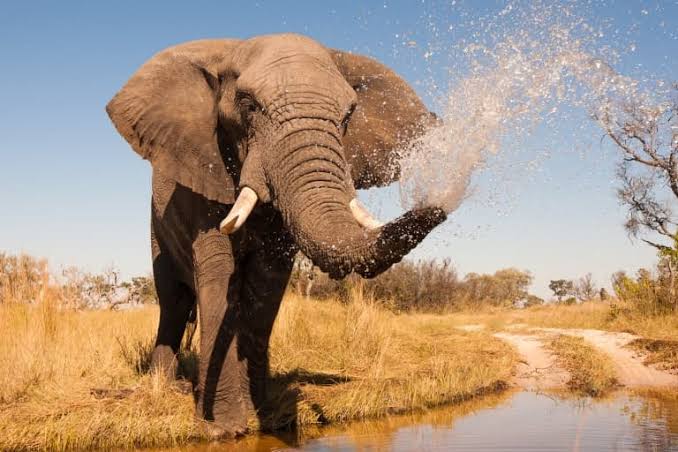
Size gives these animals big advantages. Adults have very few natural predators, because a healthy adult is simply too large and too well protected by its herd for a lion or tiger to attack safely. Calves and sick animals are the exceptions, which is why the whole herd guards the young.
Despite its bulk, an elephant walks surprisingly quietly. Thick, spongy pads of fat and tissue under their feet act like cushions, spreading the weight and softening each step. A creature the size of a small truck can approach without making much sound.
Fact 2: Three Living Species, Not One
In fact, scientists recognize three living species:
- African bush elephant (savanna type): the largest of all, found in open grasslands and woodlands across sub-Saharan Africa.
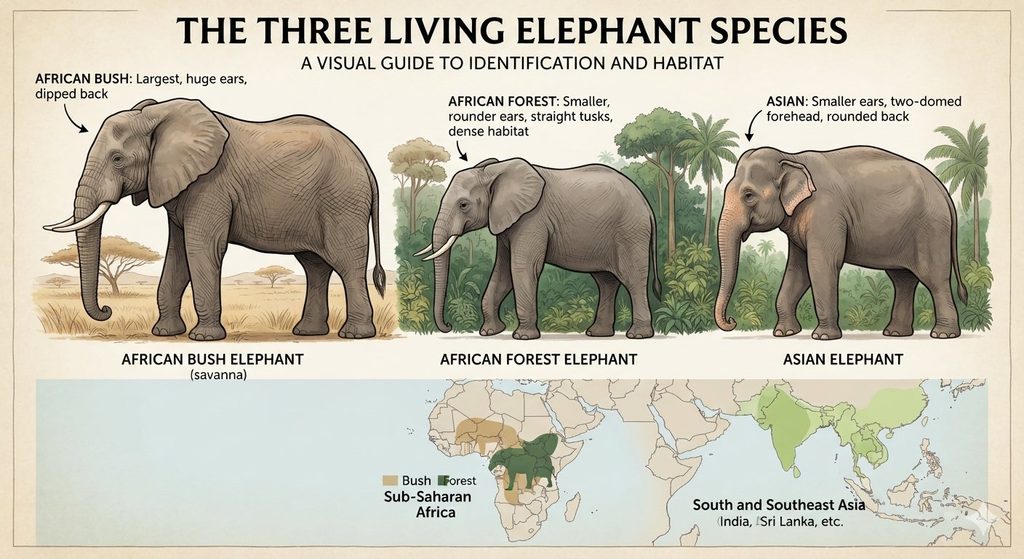
- African forest elephant: comparatively small, with tusks in straight position and ears rounded, lives in the heavy rainforests area of Central and West Africa.
- Asian elephant: found in India, Sri Lanka, Thailand, and other parts of South and Southeast Asia, with smaller ears and a distinctive two-domed forehead.
African animals have large, fan-shaped ears, while Asian ones have smaller, rounder ears. Another easy clue is the back: African animals tend to have a dipped back, while Asian ones have a rounded or flat one.
In India, the Asian elephant is found mainly in the south, the north-east, and parts of the Himalayan foothills. The country holds the largest share of the world’s wild Asian population, which makes its conservation a national responsibility.
Fact 3: The Trunk Is an Incredible Multi-Purpose Tool
If you had to pick the most amazing part of this animal, it would probably be the trunk. It is a fusion of the nose and the upper lip, and it contains tens of thousands of muscle bundles with no bones at all. This gives it astonishing strength and precision.
Uses of Trunk are:
- Breathing and smelling: the trunk is the main nose, and they have an excellent sense of smell.
- Drinking: the trunk sucks up water, usually several litres at a time, and then squirts it into the mouth.
- Eating: it grabs grass, leaves, and branches and carries them to the mouth.
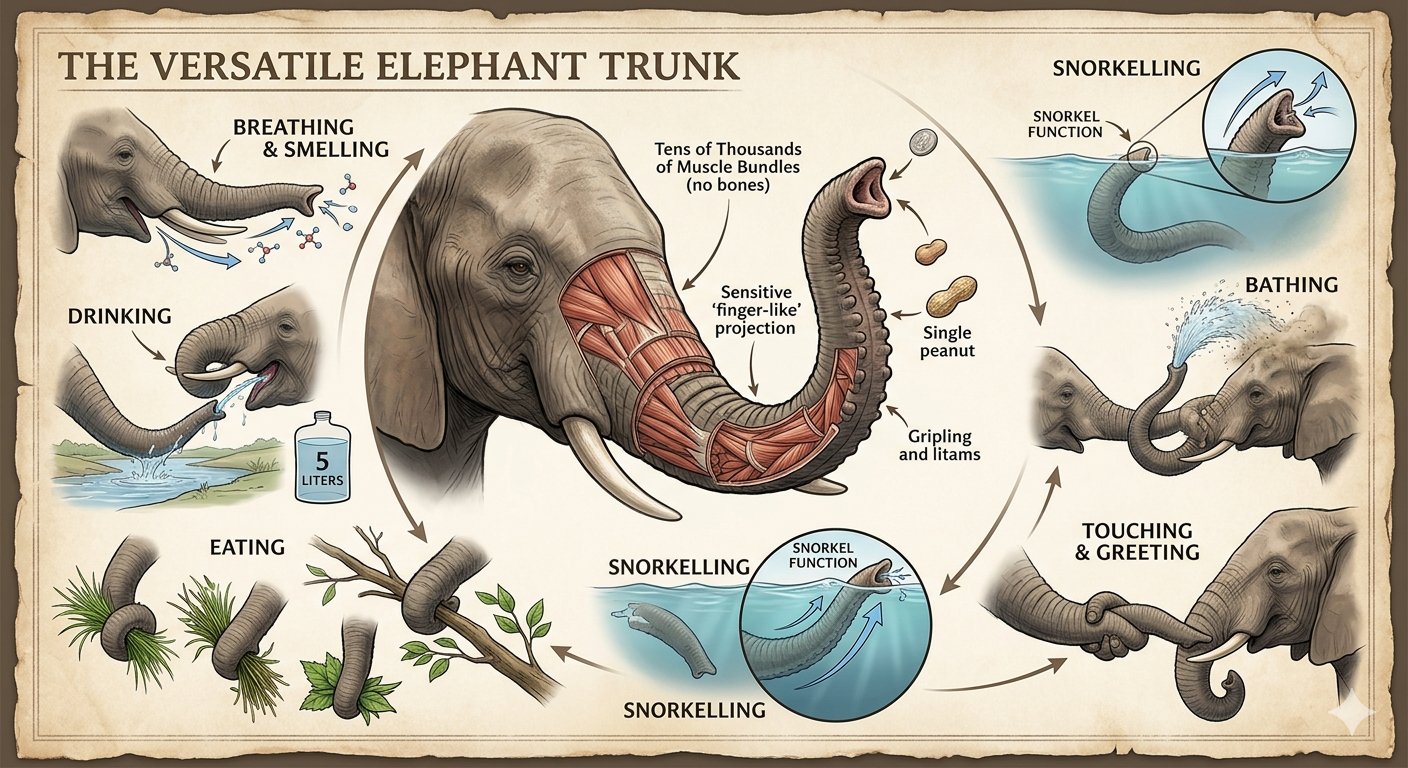
- Bathing: the animal sprays water or dust over its back to cool down and protect its skin.
- Touching and greeting: members of a herd often entwine trunks, much like people hold hands.
- Snorkelling: when crossing deep rivers, the animal can lift its trunk above the surface like a snorkel.
The trunk tip is so sensitive, can pick minor things from ground. Yet the same organ can lift heavy logs. Few tools in the animal kingdom combine such delicacy with such power.
Fact 4: A Remarkably Intelligent Brain
The brain of an elephant weighs about five kilograms, the largest of any land animal. Size alone does not prove intelligence, but the behaviour of these animals shows that they are exceptionally clever.
Here are some well-known examples:
- Self-recognition: in a famous experiment at a New York zoo, an Asian elephant named Happy touched a mark on her own head while looking in a mirror. Passing this test suggests self-awareness, which very few animals show.
- Problem solving: these animals have worked together to pull a rope at the same time to reach food, showing cooperation.
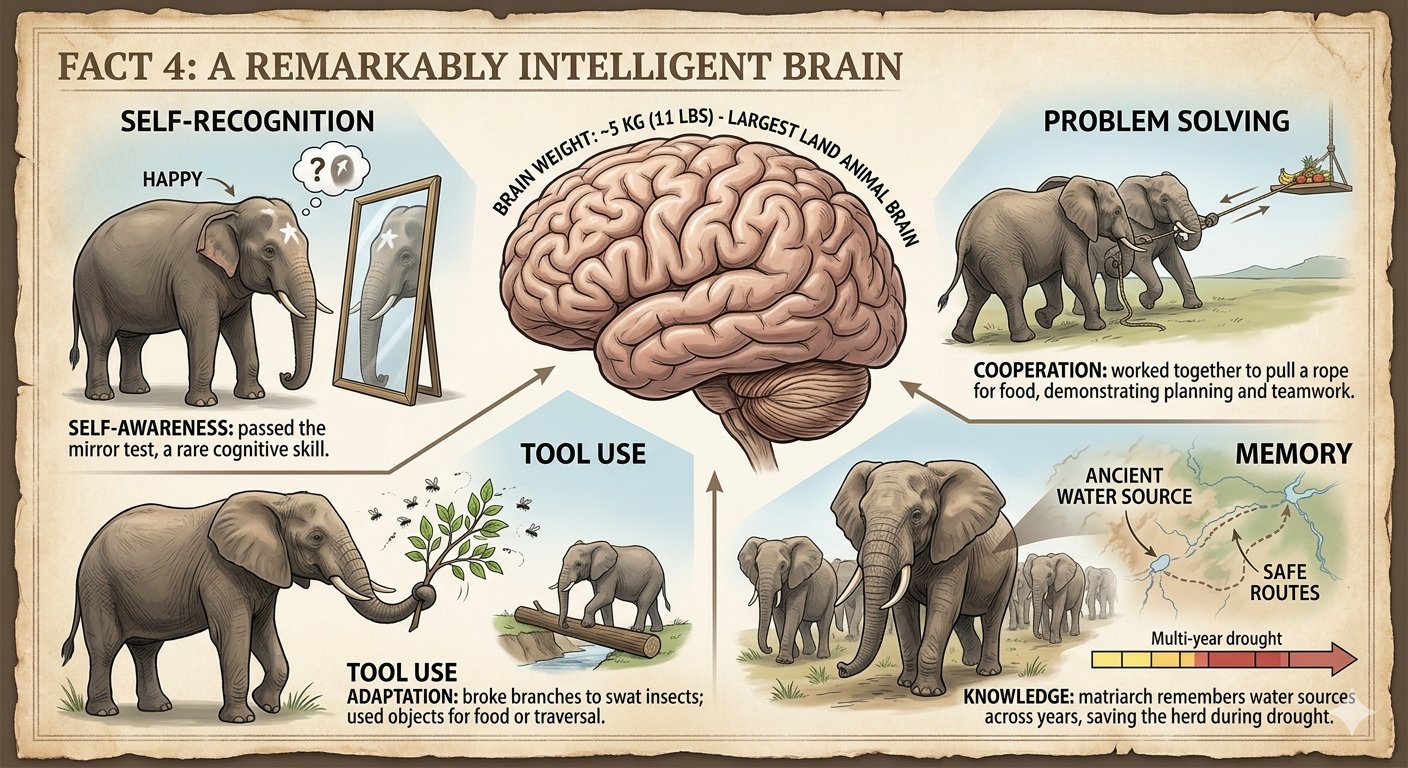
- Memory: older females, called matriarchs, seem to remember water sources and safe routes across many years, which can save the herd during droughts.
The common saying that an elephant never forgets is an exaggeration, but it points to something real. Long memory helps herds survive in harsh seasons, and it is one reason older animals are so valuable to the group.
Fact 5: Secret Communication Over Long Distances
These animals talk in ways that humans cannot easily hear. Alongside trumpets, rumbles, and snorts, they produce very low-frequency sounds called infrasound. These deep rumbles can travel several kilometres through the air and the ground, which lets family members stay in touch even when they are far apart.
The animals also listen with their feet. Sensitive cells in the feet and trunk can pick up vibrations in the ground, so a herd may sense a distant storm or a faraway family call without hearing it in the usual way.
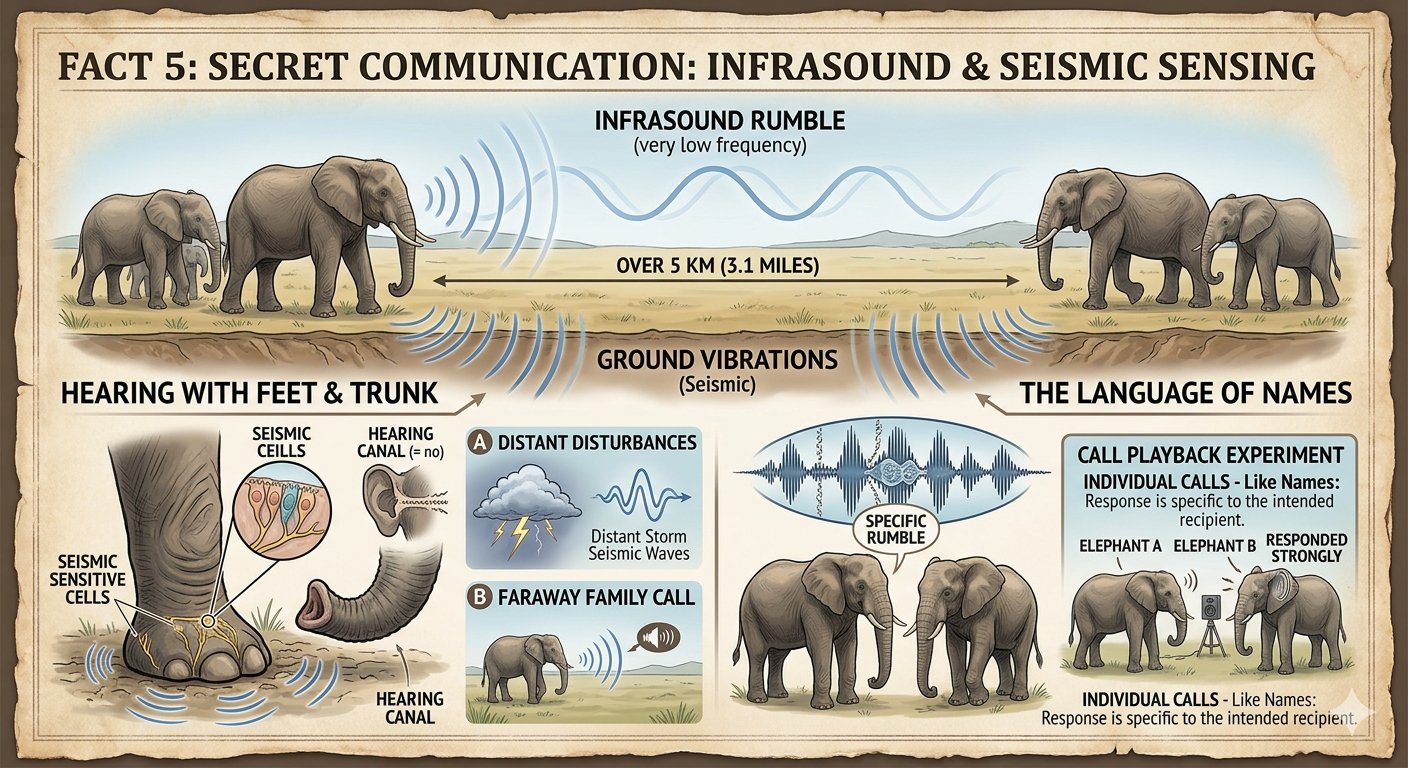
In recent years, researchers studying African elephants in Kenya reported that the animals seem to use specific calls to address individual herd members, similar to names. When a recorded call was played back, the animal it was meant for responded more strongly than the others. This research is still developing, but it suggests that they have a more advanced social language than previously believed.
Body language matters too. Spread ears, raised trunks, and slow head shakes all send clear messages about mood, warning, and play.
Fact 6: Life Inside a Close-Knit Family Herd
An elephant herd is a family, and it is led by the oldest and most experienced female, the matriarch. The group usually includes her sisters, daughters, and their calves. Females stay in the herd for life, while young males leave in their early teens to live alone or in small bachelor groups.
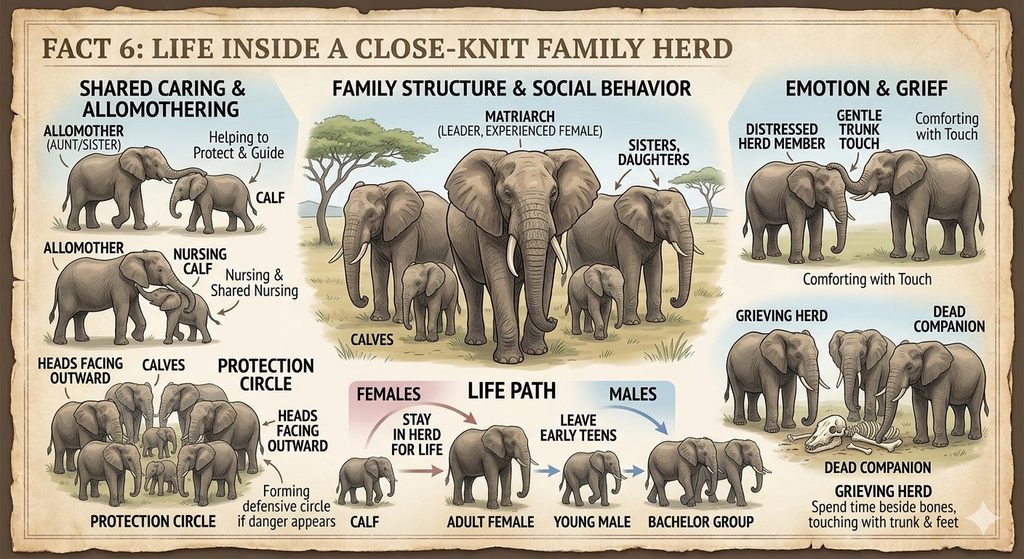
Caring for the young is a shared job. Aunts and older sisters, sometimes called allomothers, help to protect, guide, and even nurse calves. If danger appears, the adults form a circle around the babies with their heads facing outward.
They also appear to show deep emotion. They have been seen comforting distressed herd members with gentle trunk touches, and some groups spend time quietly beside the bones of a dead companion, touching them with their feet and trunks. Scientists are careful about calling this grief, but the behaviour clearly shows strong social bonds.
Fact 7: The Longest Pregnancy of Any Mammal
A baby elephant takes about 22 months to develop before birth, which is nearly two years and the longest pregnancy of any mammal. The long wait is needed because the calf must be well developed to walk with the herd within hours of being born.
At birth, a calf weighs around 100 kilograms and stands about a metre tall. Within a day, it can stand and follow its mother, and for the first few years it depends on her milk. A calf may continue to nurse for two years or longer, and it stays close to the family for much of its youth.
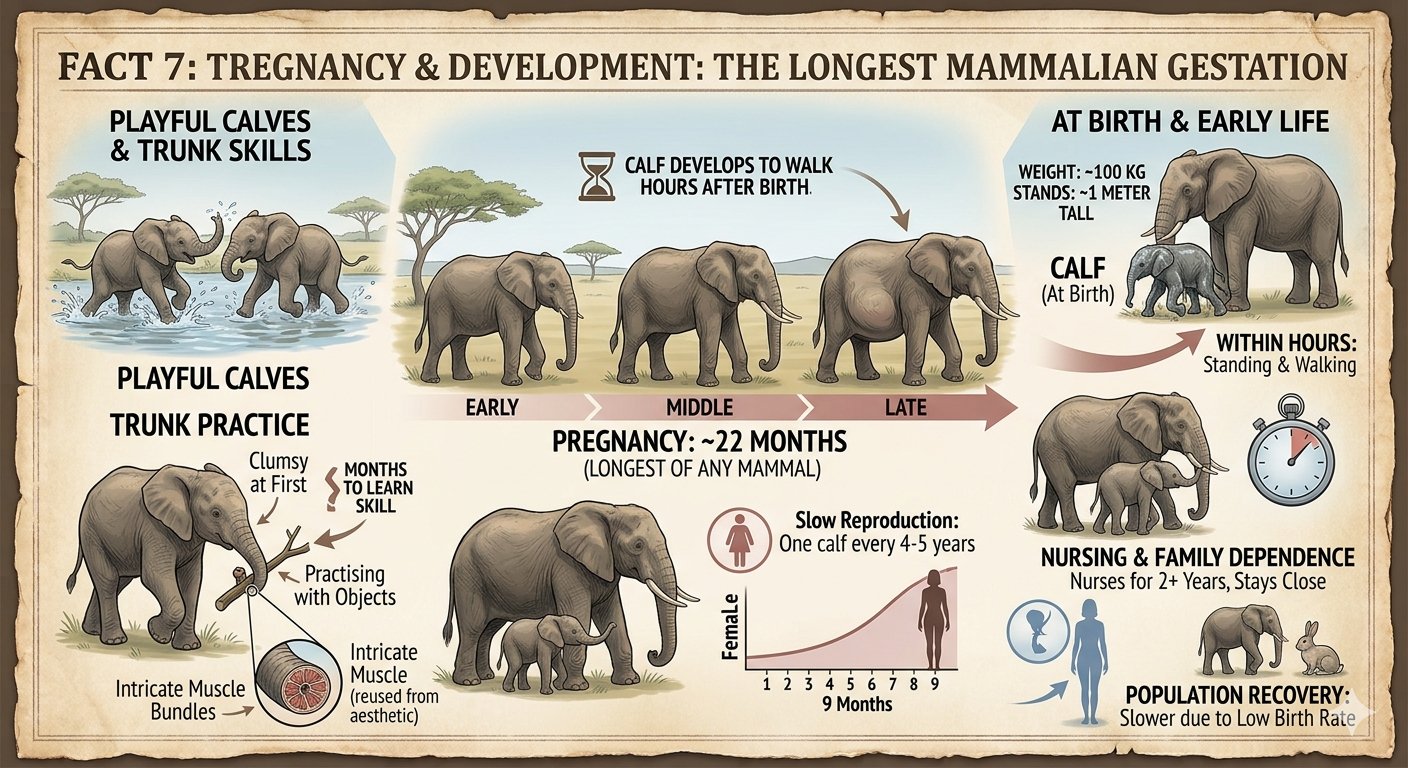
Because of this slow reproduction, they have a low birth rate. A female may have a calf only once every four to five years. This is a key reason why population recovery takes so long when numbers fall, and why every single animal matters for the species.
Calves are playful as well. They splash in water, chase each other, and practise using their trunks, which at first seem clumsy and hard to control. Learning to use the trunk skilfully can take months.
Fact 8: Huge Appetites and Clever Daily Habits
Feeding such a large body is a full-time job. An adult elephant can eat roughly 100 to 150 kilograms of grass, leaves, bark, roots, and fruit in a single day, and it spends up to 16 hours a day searching for and chewing food. It also drinks large amounts of water, often 100 litres or more.
Only around 40 to 50 percent of that food is fully digested, so elephant dung is full of seeds. As the herd travels, it spreads these seeds across the landscape, which helps new trees and plants grow. For this reason, they are often called “gardeners of the forest.”
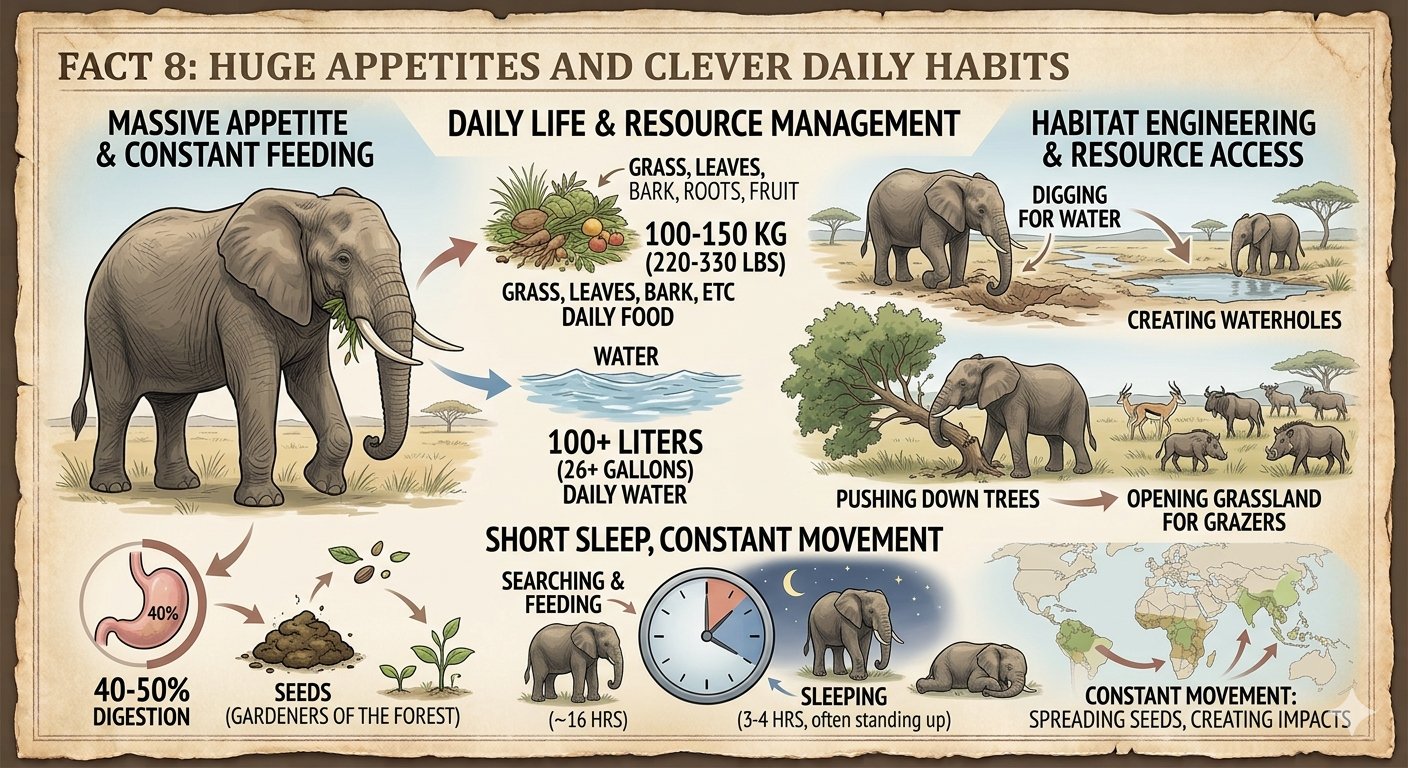
They also shape their habitat in other ways. By digging for water in dry riverbeds, they create small waterholes that other animals use. By pushing down trees, they open up grassland for smaller grazers.
Interestingly, the elephant sleeps very little, usually only three to four hours a night, and often standing up. Their busy days and short nights fit a life of constant movement and feeding.
Fact 9: Ears, Skin and Tusks Built for Survival
Every part of this animal’s body is designed to cope with heat, insects, and a heavy diet.
Ears as air conditioners. The large ears are filled with blood vessels. When the animal flaps them, the blood cools in the breeze and carries that coolness back through the body. This is especially important for African animals living in hot savannas.
Skin that protects. The skin looks thick, but it is also very sensitive and can be bitten by insects. They therefore throw mud and dust over their backs to form a natural sunscreen and insect shield. The deep wrinkles also trap moisture and help the skin stay cool.
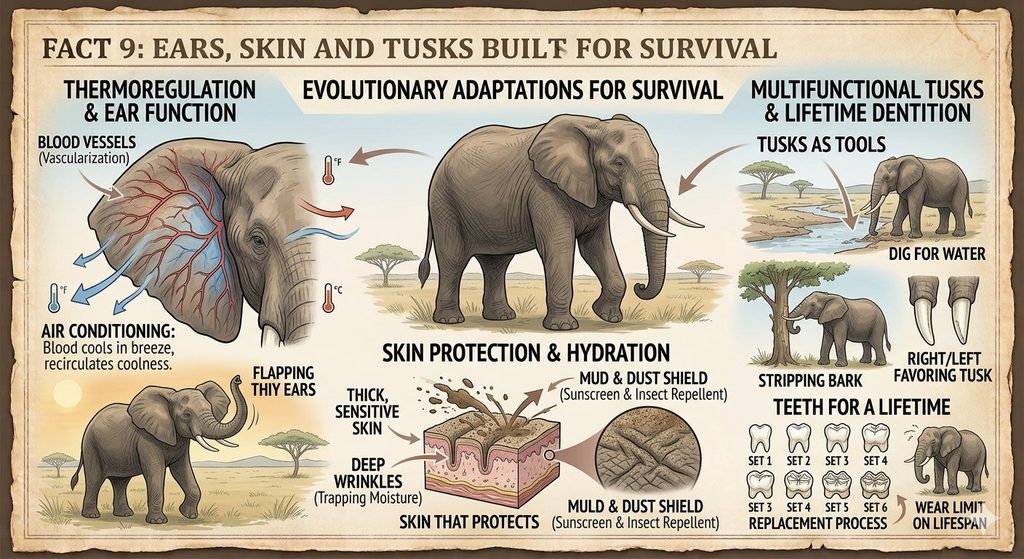
Tusks as tools. Tusks are actually very long upper front teeth, or incisors. They use them to dig for water and roots, strip bark from trees, lift objects, and defend themselves. Most animals favour one tusk over the other, just as people are right-handed or left-handed. In Asian elephants, usually only males have large tusks.
Teeth for a lifetime. An elephant grows six sets of molars during its life, and each set replaces the last. Once the final set wears down, the animal struggles to eat, which is one of the main limits on its lifespan of around 60 to 70 years in the wild.
Fact 10: A Species Under Serious Threat
Despite its strength, the elephant is in danger. All three species are listed as threatened by the International Union for Conservation of Nature, with the African forest elephant considered critically endangered and the African bush and Asian species considered endangered.
The main threats include:
- Habitat loss: forests and grasslands are cleared for farms, roads, mines, and towns, which breaks up the routes that herds follow.
- Poaching: elephants are killed illegally for their ivory, even though trade in new ivory is widely banned.
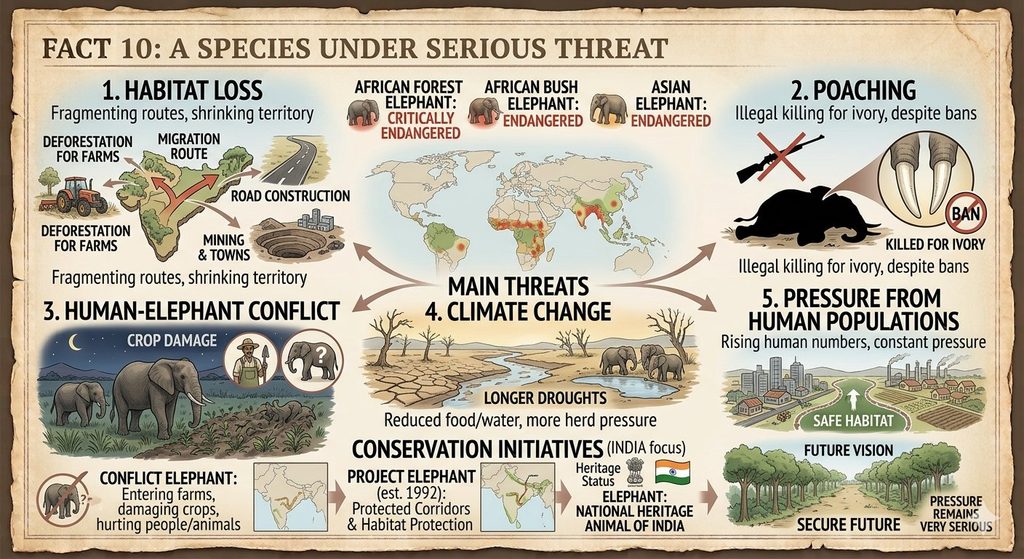
- Human-elephant conflict: when herds enter farms looking for food, crops are damaged and sometimes people and animals are hurt or killed.
- Climate change: longer droughts reduce water and food, putting extra pressure on herds.
In India, the government launched Project Elephant in 1992 to protect the animals and their habitats and to create protected corridors. The country has also declared the elephant its national heritage animal. Even so, the pressure from growing human populations remains very serious.
Elephants in Indian Culture and Tradition
For thousands of years, the elephant has held a special place in Indian life. Ganesha, the elephant-headed god, is worshipped as the remover of obstacles, and his image appears in homes, shops, and temples across the country. Ancient texts describe these animals as symbols of royalty, power, and good fortune, and kings once used them in processions and in battle.
Even today, decorated animals take part in temple festivals in states such as Kerala, where they are admired by thousands of spectators. At the same time, wildlife experts and animal welfare groups point out that captive animals can suffer from long hours of standing, heavy chains, noise, and stress. For this reason, many courts and conservation groups have called for stricter rules and better care.
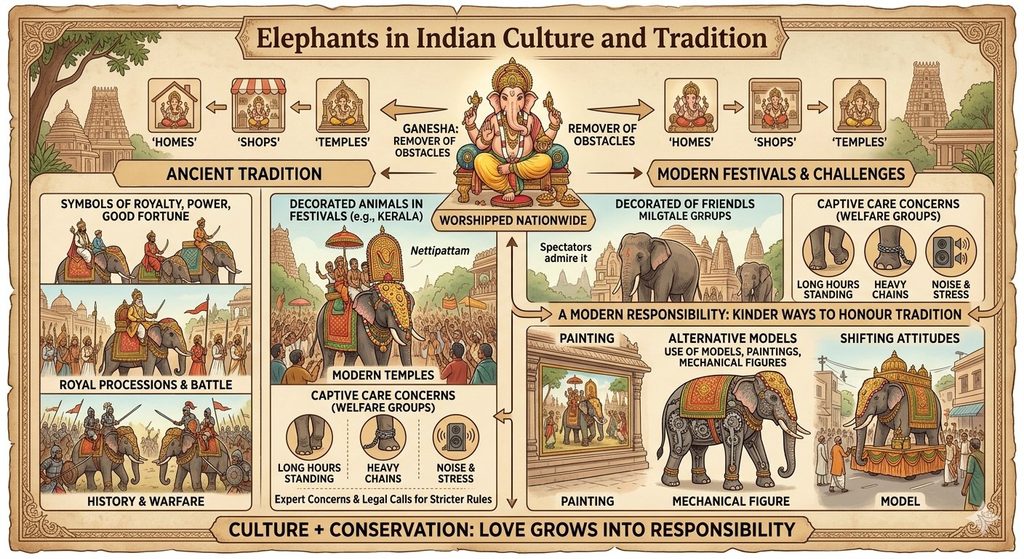
Respecting culture and protecting animals do not have to be opposites. Many communities are now looking for kinder ways to honour tradition, such as using models, paintings, or mechanical figures in festivals. This shift shows that love for these animals can grow into responsibility, which is exactly the attitude that conservation needs.
How You Can Help Protect These Giants
You do not need to be a scientist to make a difference. Here are practical steps:
- Never buy ivory or ivory-like souvenirs. Reducing demand reduces poaching.
- Choose ethical wildlife tourism. Visit sanctuaries and national parks that watch animals in the wild or rescue them, and avoid places that offer rides or tricks, which often involve cruelty.
- Support conservation groups. Organisations that protect habitats and run anti-poaching and community programmes rely on public support.
- Spread awareness. Sharing accurate information, especially on World Elephant Day on 12 August, helps people understand why these animals matter.
- Respect wildlife rules. If you live or travel near wildlife areas, follow local safety guidance and never disturb herds.
Small actions add up when many people take them together.
Conclusion
The elephant is far more than a big animal. It is an intelligent, social, and emotional creature that shapes its environment and holds ecosystems together. From its powerful trunk and secret low-frequency calls to its two-year pregnancy and strong family ties, every fact shows how special these giants are.
Their future, however, depends on us. Habitat loss, ivory poaching, and conflict with people continue to push these giants towards danger. By learning about them, choosing ethical tourism, and supporting conservation, we can help make sure that future generations will still see elephants walking free.
Frequently Asked Questions (FAQs)
1. How much does an elephant weigh?
An adult African bush elephant usually weighs around 5,000 to 6,000 kilograms, while an Asian adult weighs roughly 3,000 to 5,000 kilograms. Newborn calves weigh about 100 kilograms.
2. How long do elephants live?
In the wild, they typically live for about 60 to 70 years. Their lifespan is closely linked to their teeth, because once the last set of molars wears out, eating becomes very difficult.
3. How many species of elephant are there?
There are three living species: the African bush, the African forest, and the Asian elephant. Each lives in a different habitat and has its own physical features.
4. What do elephants eat?
They are herbivores. They eat grass, leaves, bark, roots, and fruit, and an adult can consume about 100 to 150 kilograms of food in a day.
5. How long is an elephant’s pregnancy?
The pregnancy lasts around 22 months, which is the longest of any mammal. A female usually gives birth to a single calf.
6. Why do elephants have such big ears?
The ears help the animal stay cool. Blood vessels in the ears release heat into the air as the animal flaps them. African animals have the largest ears because they live in the hottest regions.
7. Are elephants really intelligent?
Yes. These giants can recognise themselves in a mirror, solve problems, use simple tools, and cooperate with each other. They also have excellent memories and strong emotional bonds.
8. How do elephants communicate?
They use trumpets, rumbles, and snorts, as well as very low-frequency infrasound that travels long distances. They also use touch and body language, and they can sense vibrations through their feet.
9. Why are elephants endangered?
The main reasons are habitat loss, illegal ivory poaching, conflict with humans over farmland, and climate change. Their slow breeding rate makes it very hard for populations to recover.
10. How can I help protect elephants?
You can avoid buying ivory, choose ethical wildlife tourism, support trustworthy conservation groups, and spread accurate awareness. Respecting wildlife rules near wildlife habitats also helps keep both people and animals safe.


