


Introduction
Agentic AI has been in the news lately. It has deleted production databases of various companies. And then lied about it. This has sparked fear among the people regarding its use and what it can or cannot do. But fear is the mind-killer. It never leads to anything useful. Instead, let us understand what Agentic AI is, how it works, and what makes it powerful yet dangerous, because understanding removes fear and brings clarity.
Table of Contents
What is Agentic AI?
Agentic AI is a system that is built to think, plan, execute, and achieve goals without much human intervention. It uses the tools at its disposal to complete tasks autonomously. It can take multiple approaches to solve the problem given to it, telling us that it is flexible and adaptable to the constraints of the system it is put in. Agentic AI can also review its past actions and decide whether they took it closer to the defined goals or not. It can re-align itself so that the set objectives are met as quickly as possible. In simple language, it is very similar to how humans achieve tasks. But these systems don’t get tired, and they don’t need sick leaves.
What is Generative AI?
Generative AI is an AI system that can generate text, pictures, videos, and code using simple text prompts. This is the part that made AI famous among the masses. It has replaced major search engines such as Google and Bing, as people now use ChatGPT and Claude to search for answers. Generative AI cannot act autonomously. It needs human intervention at all times. It is more conversational in nature. A user can engage with generative AI in multiple ways. Some of the popular use cases are generating code, writing tasks, brainstorming, and much more.

What are AI Agents?

AI Agents are the building blocks that together form Agentic AI. Think of them as various organs. As each organ in the human body has a crucial job, all the organs work in tandem to ensure that the human body works perfectly. Similarly, in the agentic AI system, AI agents have their own roles and responsibilities, and they must act and fulfill those roles to ensure the system continues to work seamlessly.
Understanding the Difference
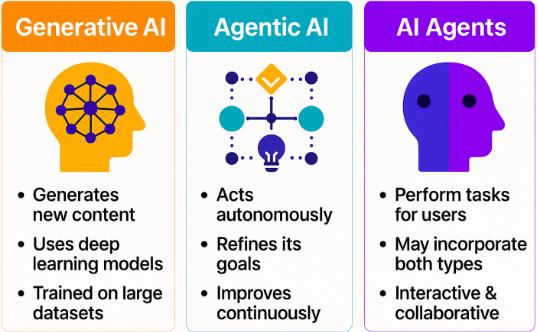
The best way to understand the difference between Generative AI, AI agents, and Agentic AI is to first see how they are linked to each other.
Generative AI was the first AI system produced for the masses. It was trained on massive amounts of data. It has billions of parameters and uses a large number of GPUs. Almost all major companies of the world are using generative AI in some way or the other. Some of its applications include customer support and code generation. When generative AI matured, it lead to more specialized forms that focused on one task only such as image and video generation, coding, and designing. These specializations led to capitalization of the AI race wherer everyone raced to build AI models that solve a particular usecase.
These specialized AI models are now used as AI agents. They can perform one task with super-high accuracy. These agents are then integrated with each other to form an autonomous system. This system is known as Agentic AI and acts as the centerpiece by managing all agents and making sure that it is moving towards its goal rather than away from it.
In essence, generative AI responds to user queries. It is an answering machine. AI agents act. It is an execution machine. Agentic AI manages. It is a management machine.
Now, let’s see their differences.
| Parameter | Generative AI | AI Agents | Agentic AI |
| Core Function | Creates content (text, images, code) in response to a prompt | Executes a specific, defined task autonomously | Manages multiple agents to achieve a complex, multi-step goal |
| Behavior Type | Reactive: responds only when prompted | Proactive: acts within a defined scope | Fully autonomous: plans, acts, and adapts without constant input |
| Decision Making | None: generates output based on patterns | Limited: makes decisions within a narrow task boundary | Advanced: makes layered decisions across an entire workflow |
| Memory | No persistent memory across sessions | Short-term, task-scoped memory | Long-term memory across tasks and sessions |
| Tool Usage | Rarely uses external tools | Uses one or a few tools to complete its task | Uses multiple tools dynamically, such as search, APIs, code execution, and more |
| Human Involvement | Required at every step | Required to define the task upfront | Minimal: humans set the goal, AI handles the rest |
| Scope of Work | Single output per prompt | Single task per session | End-to-end workflows spanning multiple tasks |
| Adaptability | Low: cannot course-correct | Moderate: adjusts within its task | High: re-plans when it hits obstacles |
| Real-World Example | ChatGPT writing a blog post | An agent that searches the web and summarises results | An AI that researches, writes, edits, and publishes a blog post on its own |
| Analogy | A talented freelancer who works only when you call | A specialist employee with one clear job | A project manager who leads a team to deliver results |
What is in the limelight right now?
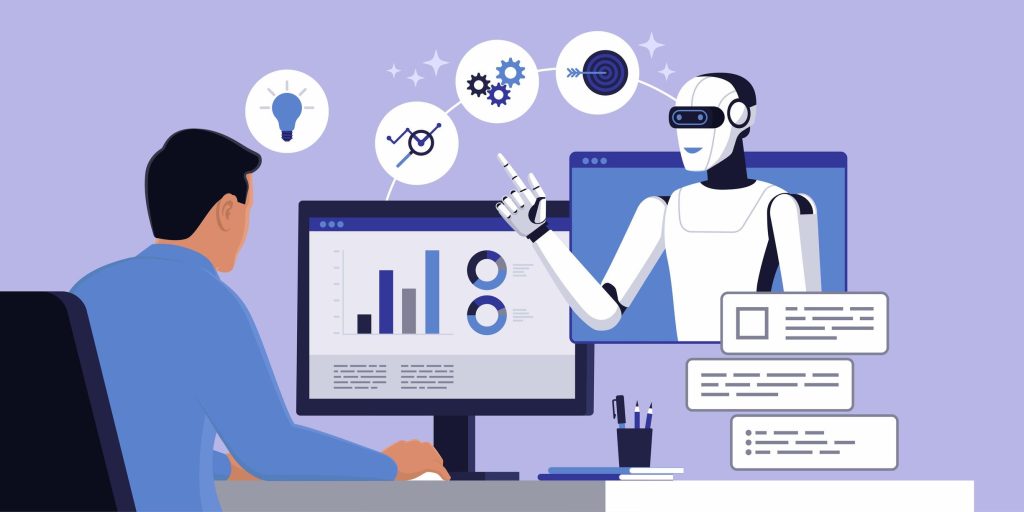
Currently, Agentic AI is dominating research and news circles. The shift has been gradual. We started from generative AI, which required extensive human input. Then came AI agents, which could do specific types of tasks without human-in-the-loop. Now, the goal is to automate the entire process of thinking, planning, and execution for a particular task. This is where Agentic AI is emerging as a key player. It acts as a strict manager, coordinating with multiple AI agents to get the job done.
The numbers back this up. According to McKinsey’s 2024 State of AI report, organizations are actively investing in systems that can take action, not just generate output. Venture capital funding for agentic AI startups surged significantly in 2024, with companies like Cognition AI, Cohere, and various agent-framework startups attracting hundreds of millions in investment. The message from the market is clear: agentic AI is the new gold.
Big tech has taken notice, too. Microsoft embedded agentic capabilities directly into its Copilot suite, allowing it to perform multi-step tasks across Word, Excel, and Outlook without user intervention at each stage. Google introduced Project Astra and agent-based features within Gemini. Anthropic’s Claude has demonstrated computer use with the ability to navigate a screen, click buttons, and complete tasks like a human operator would. These are not demos. These are shipped products, which signal that the agentic era is already underway.
What is driving this shift is a fundamental change in what businesses expect from AI. The early promise of generative AI was about saving time on content creation. The promise of Agentic AI is different. It is about delegating entire workflows. A marketing team does not just want AI to write a campaign brief; they want AI to research the audience, draft the brief, schedule the posts, monitor performance, and flag what is underperforming. That end-to-end pipeline is exactly what Agentic AI is being built to deliver.
7 Powerful Examples to Help You Understand Agentic AI

Agentic AI can sound very technical. But once you see it in action, it starts to make complete sense. Here are 7 real-world examples that show exactly what Agentic AI does and why it matters.
1. Customer Support That Actually Solves Problems
We have all been there: you raise a support ticket, and days later, someone sends a copy-paste reply that does not even address your issue. Agentic AI changes this completely. When you raise a complaint, it reads your issue, checks your order history, looks up the company’s refund policy, decides the best resolution, and either solves it instantly or escalates it to the right human, all without anyone telling it what to do next. It does not just respond. It resolves.
2. Software Development on Autopilot
When a developer needs to build a new feature, they usually spend hours reading documentation, writing code, testing it, fixing errors, and repeating the cycle. Agentic AI compresses all of this. A developer describes what they want in plain English. The AI plans the approach, writes the code, runs it, catches the errors, fixes them, and hands back a working solution. Tools like Devin and GitHub Copilot Workspace are already doing this today. The developer becomes the decision-maker, not the doer.
3. Research Reports Written While You Sleep
Imagine asking someone to research the electric vehicle market, compare the top five players, analyse recent news, and put it all into a structured report. That would take a human analyst a full day. Agentic AI does it in minutes. It searches the web, reads articles, pulls relevant data, filters out noise, and writes a clean, structured report, all on its own. You wake up to a finished document ready for review.
4. E-Commerce Running Itself
Running an online store involves dozens of small decisions every day such as updating product listings, adjusting prices based on competition, restocking inventory, and responding to customer queries. Agentic AI can handle all of this in the background. It monitors stock levels, detects when a product is running low, places a reorder with the supplier, adjusts the price if a competitor drops theirs, and updates the website, without anyone touching a dashboard. The store keeps running even when the owner is not watching.
5. Healthcare Scheduling and Patient Follow-Up
Hospitals and clinics deal with a massive coordination problem every day. Patients miss appointments, doctors have shifting availability, and follow-ups often fall through the cracks. Agentic AI steps in as a silent coordinator. It schedules appointments based on doctor availability, sends reminders to patients, reschedules automatically when there is a cancellation, and flags patients who have not followed up after a procedure. It keeps the entire pipeline moving without a single phone call from the admin team.
6. Personal Finance on Autopilot
Most people know they should track their spending, invest regularly, and plan for taxes but life gets in the way. Agentic AI acts like a personal finance manager working quietly in the background. It monitors your bank account, spots unusual spending, suggests where to cut back, moves money into savings when your balance crosses a threshold, and sends you a weekly summary in plain English. It does not just give you advice. It takes action, within the boundaries you set.
7. Your Personal Productivity Assistant
Think about everything that clutters your workday, such as emails piling up, meetings with no agenda, follow-ups you forgot to send, and documents scattered across three platforms. Agentic AI handles all of it. It reads your emails and drafts replies for your approval, prepares a meeting agenda based on previous conversations, reminds you of pending follow-ups, and organises your files automatically. It is not a chatbot you talk to. It is a behind-the-scenes operator that keeps your work life from falling apart.
What is the Future?
Agentic AI is now in its application stages. And the research community has moved on to what comes next.
The next evolutionary layers are expected to unfold along three disciplines which are multi-agent management, physical AI, and autonomous goal-setting: ultimately converging toward artificial general intelligence.
AI, which has spent decades confined to screens, is now beginning to move, manipulate, and interact with the real world through robotics. And beyond that, the goal is AI that does not just execute goals but sets them on its own.
Whatever the future brings, agentic AI seems to be both a boon and a bane for the world. It seems to be setting up a dangerous precedent and we need to be very careful about what we share with AI.
Conclusion
AI has come a long way from answering simple questions. Generative AI gave machines a voice. AI Agents gave them a job. Agentic AI gave them a workflow. Each step has moved AI closer to something that does not just assist but acts. We are still in the early days, but the direction is clear. The future belongs to AI that thinks, plans, and delivers with humans steering the wheel.
Frequently Asked Questions
Q. Is Agentic AI the same as Generative AI?
A. No. Generative AI creates content when prompted. Agentic AI takes that a step further. It plans, makes decisions, and completes multi-step tasks on its own.
Q. Is Agentic AI safe?
A. It can be, when designed with human oversight built in. Most systems today include checkpoints where humans can review or intervene before critical actions are taken.
Q. Do I need to be technical to use Agentic AI?
A. Not anymore. Many Agentic AI tools today are built for everyday users. No coding required.
Q. Is Agentic AI already being used in real products?
A. Yes. Tools like Microsoft Copilot, Google’s Gemini, and Anthropic’s Claude already have agentic capabilities shipped in their products.
Q. Will Agentic AI replace human jobs?
A. It will replace tasks, not people. The more likely outcome is that it handles repetitive workflows, freeing humans to focus on judgment, creativity, and strategy.


