

Ethereum Staking: Energy Shift, Governance, and Liquid Staking Explained
Ethereum staking feels like a quiet revolution. It changes the energy story, shifts incentives, and subtly redistributes power across the network. At first, it looked like just an energy-saving upgrade, but staking is also about capital efficiency, user experience, and the social layer forming around validators.
Staking is not magic. It is incentive design. Users lock ETH to secure the chain and earn rewards, while validators run nodes and attest to blocks. Retail users want easy staking, and medium players worry about running infrastructure. Custody and control remain big concerns.

Ethereum Staking and Decentralization vs Convenience
Initially, it seemed like staking would decentralize Ethereum instantly. But convenience and market forces can lead to centralization. Large staking pools offer low friction and liquid tokens, but they also concentrate voting power. This creates a tradeoff between usability and decentralization.
Smart Contracts and Systemic Risks
Smart contracts automate stake aggregation, liquid token issuance, and safety checks. However, they introduce attack surfaces. A single bug in a staking contract can lead to massive losses. Audits help, but they are not a guarantee.
Liquid Staking and Why Lido Matters
Liquid staking allows users to keep capital working while securing the network. Users receive derivatives like stETH that represent their staked ETH. This model improved accessibility and capital efficiency.
Lido scaled this model and made staking easy for users. However, pooled validators also increase governance influence for platform administrators, which raises centralization concerns.
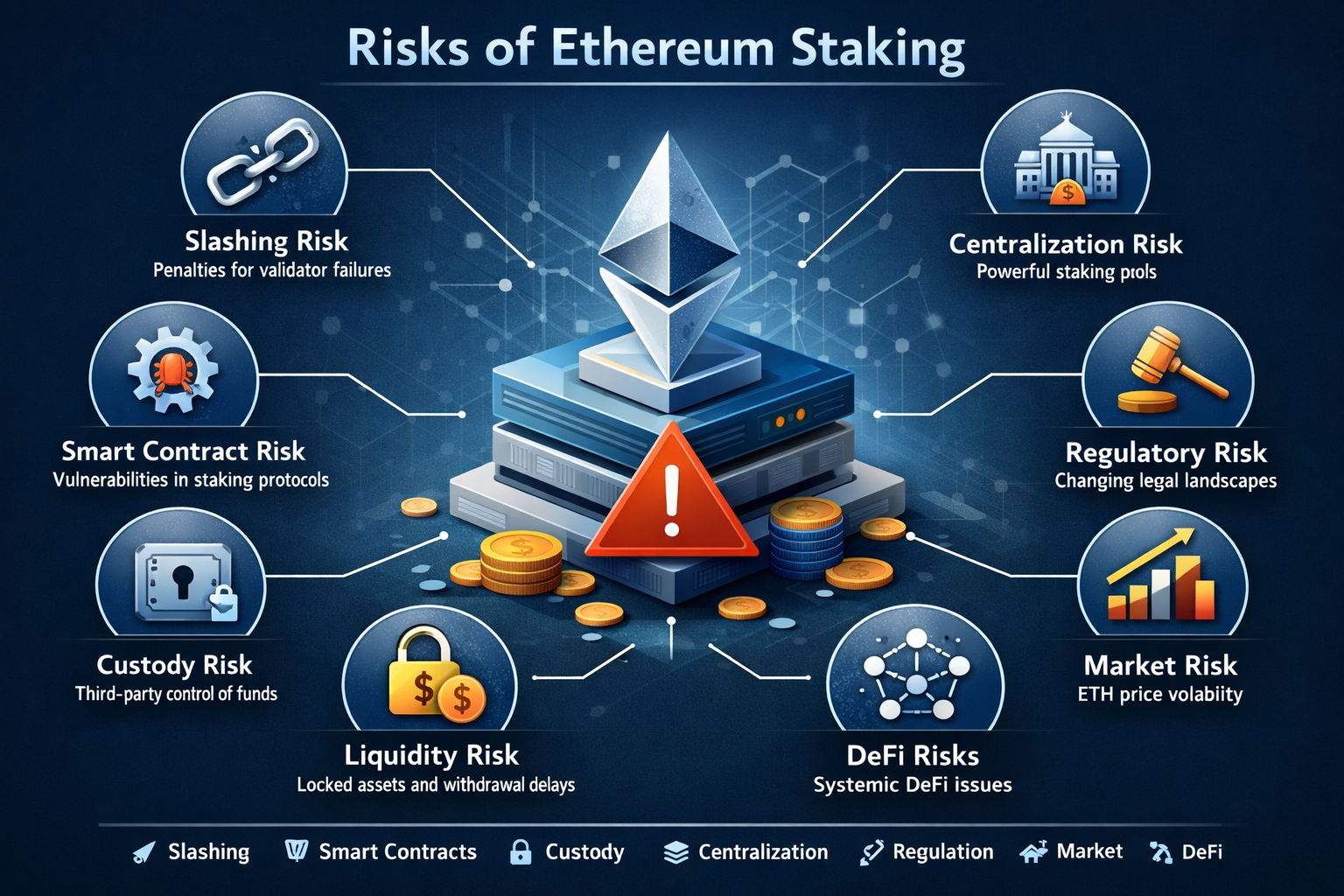
Risks of Ethereum Staking
Ethereum staking often looks like an easy way to earn passive income, but it carries several technical, financial, and governance risks that many users overlook. Understanding these risks is essential before locking funds into the protocol.
Slashing Risk
Slashing is one of the biggest risks in Ethereum staking. If a validator behaves maliciously, double-signs blocks, or stays offline during critical moments, a portion of their staked ETH can be permanently lost. Slashing penalties are designed to discourage bad behavior, but even accidental downtime due to hardware failures, internet issues, or misconfigurations can lead to losses. Recovery from slashing is not immediate and can be financially painful, especially for solo validators.
Smart Contract Risk
Liquid staking platforms rely heavily on smart contracts to manage deposits, rewards, and token issuance. A single vulnerability or bug in a staking contract can result in massive losses. Even audited contracts are not completely safe, as audits cannot guarantee the absence of hidden exploits. Smart contract exploits in DeFi have historically caused billions of dollars in losses, and staking protocols are not immune to this systemic risk.
Centralization Risk
Large staking pools and platforms can accumulate a significant share of staked ETH, leading to validator concentration. When a few platforms control a large portion of validators, they gain disproportionate influence over Ethereum governance and protocol upgrades. This centralization undermines the core principle of decentralization and can create coordination risks if major staking providers act together.
Custody and Counterparty Risk
When users stake through centralized exchanges or staking services, they often do not control their private keys. This introduces counterparty risk, where the platform could freeze withdrawals, face hacks, or become insolvent. Custodial staking means trusting a third party with your funds, which goes against the self-sovereign nature of blockchain.
Liquidity Risk
Staked ETH is typically locked for a certain period, and withdrawals may be delayed depending on network conditions. Although liquid staking tokens like stETH improve liquidity, they can trade at a discount during market stress. This can lead to losses if users need to exit positions quickly. Liquidity can dry up during crashes, making it difficult to sell staked assets without significant slippage.
Operational Risk for Validators
Running a validator requires technical expertise, secure key management, constant uptime, and monitoring systems. Hardware failures, power outages, software bugs, or human errors can cause downtime and penalties. Many users underestimate the operational complexity of maintaining a validator, which can turn staking into a high-maintenance task rather than passive income.
Governance Risk
Staking is directly tied to governance power in Ethereum. Validators influence protocol upgrades and parameter changes. When staking is concentrated in a few pools, governance decisions may reflect the interests of large institutions rather than the broader community. This creates a risk of protocol capture and reduces the democratic nature of decentralized governance.
Insurance and Risk Mitigation Limitations
Some staking platforms offer insurance products to protect against slashing or smart contract failures, but these protections are often limited and undercapitalized. In extreme market events, insurance funds may not be sufficient to cover losses. Users should not assume insurance eliminates risk entirely.
Regulatory and Legal Risk
Staking regulations are still evolving worldwide. Governments may classify staking rewards as taxable income or impose restrictions on staking services. Regulatory uncertainty can affect staking platforms, exchanges, and even validators, potentially impacting user funds and staking operations.
Market and Price Risk
Staking rewards are paid in ETH, so users are exposed to price volatility. If the price of ETH drops significantly, staking rewards may not offset capital losses. Market downturns can also trigger liquidity issues in liquid staking tokens, amplifying losses.
Systemic DeFi Risk
Liquid staking tokens are widely used in DeFi protocols for lending, trading, and collateral. If a major staking protocol fails or depegs, it can trigger cascading liquidations across DeFi platforms. This interconnected risk makes staking part of a broader financial system with systemic vulnerabilities.
Running Your Own Validator vs Staking Pools
Running your own validator gives you full control but requires technical knowledge and infrastructure. Joining a staking pool offers convenience but reduces control and protocol influence.
Governance and Validator Concentration
Aggregated staking pools can influence upgrades and protocol decisions. Validator concentration amplifies governance risk, even when token holdings are fragmented. This makes staking pools powerful coordination points.
Practical Advice for Ethereum Staking
- Diversify across staking providers
- Run your own validator if possible
- Understand smart contract and slashing risks
- Avoid chasing high APY blindly
Engineering Levers and Risk Mitigation
Smart contract architecture, off-chain governance, and economic design can reduce failure risks. Permissioned withdrawals, staggered onboarding, and slashing buffers help, but edge cases always exist.
Future of Ethereum Staking
Ethereum staking brings lower energy use, better capital efficiency, and DeFi composability. But governance, centralization, and smart contract risks remain. This tension drives innovation and highlights the need for better user education.
Frequently Asked Questions
What is the main benefit of Ethereum staking?
Ethereum staking secures the network and provides rewards, replacing energy-intensive mining with economic security.
Should I use a liquid staking provider or run my own validator?
Run your own validator for control. Use liquid staking for simplicity and liquidity.
What is slashing in Ethereum staking?
Slashing is a penalty where validators lose part of their staked ETH for misbehavior or downtime.


Awesome post.
Nous avons les nouveaux maillot manchester united bleu, nous avons plus d’offres spéciales, nous avons aussi le meilleur service clientèle, nous sommes madridshop.
Post writing is also a fun, if you be familiar with afterward you can write if not it is difficult to
write.