


Introduction
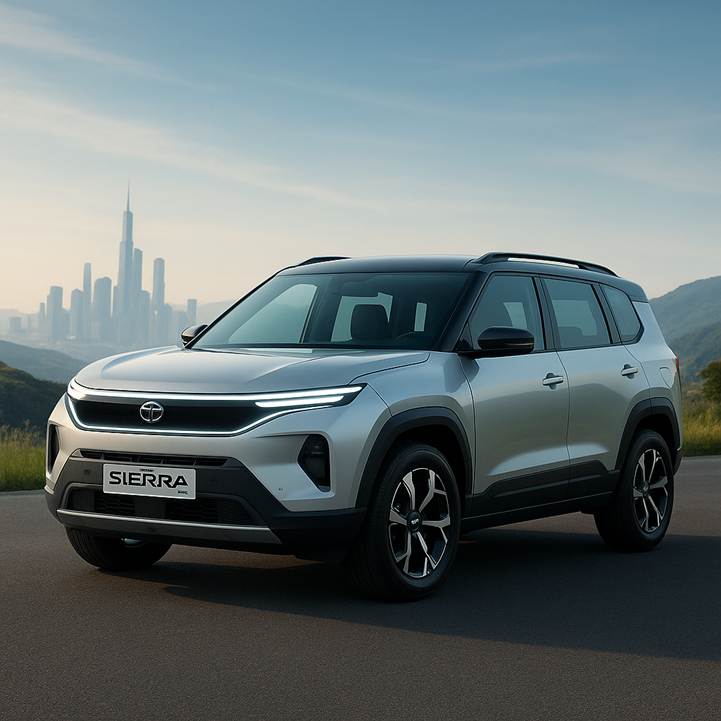
The Tata Sierra is coming back—modern, safer, and packed with tech, but still carrying the nostalgic Sierra vibe. Tata first showed the near-production Sierra EV at Auto Expo 2023 and then a more production-ready version at the Bharat Mobility Global Expo 2025. Since then, multiple test mules of the ICE (petrol/diesel) Sierra have been spotted, confirming that Tata will offer both EV and ICE powertrains. The interior now features a triple-screen dashboard, ADAS, and premium cabin materials—clearly aiming higher than Tata’s current midsize SUVs. (Autocar India [1])
Important timing note (as of October 6, 2025): Most reliable outlets indicate the Sierra EV first (late-2025 to early-2026), followed by the ICE versions. Some reports say “late 2025,” others say “Jan 2026”—so treat timelines as “expected” until Tata announces prices. (Autocar India [1])
- Quick Summary (What you should know in 30 seconds)
- Powertrains: EV (first), then petrol and diesel ICE.
- Interior: New 3-screen layout (driver + center + passenger), panoramic sunroof, ADAS L2 suite expected. (NDTV [3])
- EV platform & range (expected): Based on Tata’s Acti.ev/Gen-2 architecture with ~65–75 kWh battery options, targeted up to ~500 km claimed range in higher variants. (Numbers are early expectations, not final.) (CarLelo [4])
- ICE engines (expected): New 1.5-litre TGDi petrol and a 2.0-litre turbo-diesel (similar family as Harrier/Safari).
- Launch window: EV late-2025 to early-2026; ICE to follow. (Autocar India [1])
- Positioning: Premium, above Curvv / near Harrier—focus on design, tech, and comfort. (Inference based on features & reporting.)
Variants & Launch Plan
Expected Variants
- Sierra EV: Core product to launch first, multiple battery/motor options likely. (Autocar India [1])
- Sierra ICE (Petrol/Diesel): To follow the EV; several trims expected (entry variant spied with steel wheels/halogen, top trims with full LED + tech pack).
Launch Window (Reality Check)
- Autocar India lists late 2025 for Sierra EV.
- CarWale lists Jan 2026 (tentative).
Takeaway: Final dates depend on Tata’s pricing/production readiness; EV first, ICE after. (Autocar India [1])
Design & Dimensions (Exterior)
Modern-Classic Sierra Look
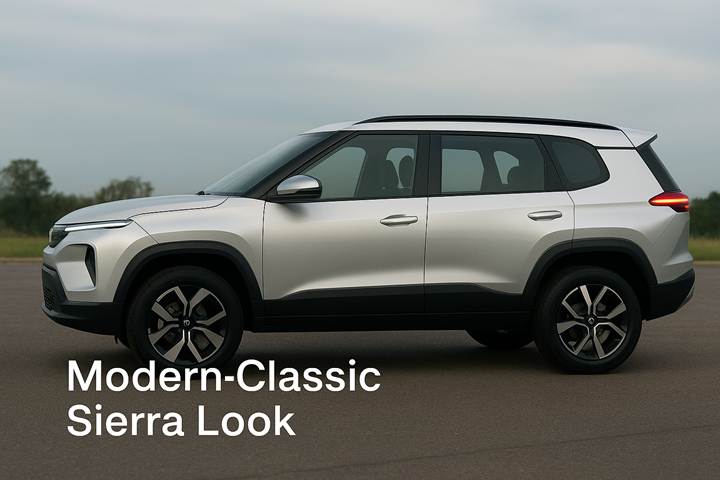
- Signature Sierra silhouette with a clean glasshouse and connected light bars front and rear.
- Flush door handles, upright fascia, bold cladding; show cars wore striking yellow/dual-tone finishes at Bharat Mobility 2025.
Lighting & Wheels
- Full-width LED DRLs/taillamps, projector/LED headlamps, and new alloy designs seen on test cars and expo models. (Base trims spied with halogens/steel wheels.) (NDTV [3])
Dimensions aren’t officially published yet; expect a footprint in the midsize-to-upper-midsize SUV band (inference vs. Harrier/Curvv packaging). We’ll update when Tata releases exact figures.
Interior & Comfort
Triple-Screen Dash (First for Tata)
- Driver display + central infotainment + passenger screen, reportedly ~12.3-inch each on higher trims. This brings co-passenger media/assist features and lets the driver keep key data split logically.
Features You Can Expect
- Panoramic sunroof, ventilated seats, touch HVAC panel, 360° camera, wireless charging, Type-C ports, ambient lighting, and connected-car tech with OTA updates.
Seating & Practicality
- 5-seater layout with supportive front seats, wide rear bench, flat floor area in EV (expected), and flexible boot area. (Layout inferred from spy shots/expo cars; final trim mapping pending.)
Safety & ADAS
- Multiple airbags, ABS + EBD + ESC, hill-assist/traction, 360° camera.
- ADAS Level 2 suite expected (lane keep/warn, AEB, blind-spot, adaptive cruise in higher trims).
- Targeting strong crash performance (Tata’s recent record + positioning), though no official rating yet for Sierra.
Powertrains — EV, Petrol & Diesel (Deep Dive)
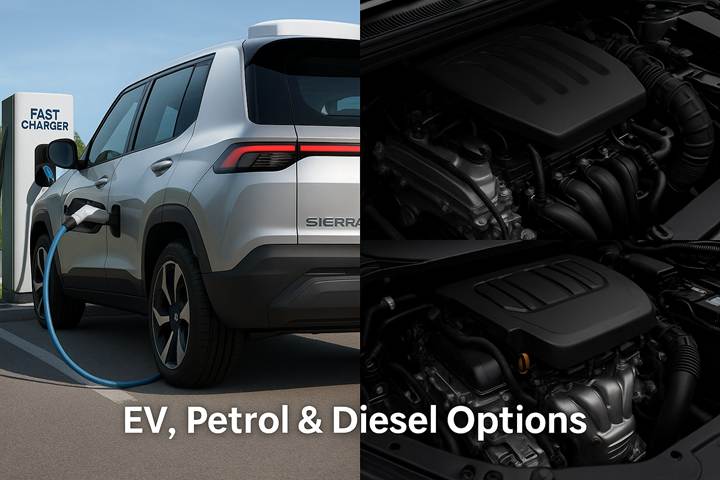
Sierra EV (What we know & what’s expected)
- Architecture: Tata’s Acti.ev / Gen-2 EV platform family.
- Battery options (expected): ~65 kWh and ~75 kWh packs.
- Range target: Up to ~500 km claimed in higher variants (real-world will be lower).
- Drivetrains: Primarily FWD single-motor; dual-motor AWD/QWD rumored for top trims.
- Charging: DC fast charging support expected; exact kW not confirmed. Note: Capacities and range are indicative based on credible reporting; Tata has not officially published final numbers yet. (Motoroids [7])
Sierra Petrol (Expected)
- New 1.5-litre TGDi turbo-petrol; power/torque figures reported in the ~170 PS / 280 Nm ballpark in media.
- 6-speed manual and torque-converter automatic likely.
Sierra Diesel (Expected)
- 2.0-litre turbo-diesel (family seen in Harrier/Safari) with strong mid-range torque, paired with manual/AT. Exact outputs for Sierra not announced yet.
Technology & Connectivity
- Connected car suite with remote lock/unlock, vehicle health, live location, geo-fencing, and OTA updates.
- Voice assistant (on-board + smartphone/Watch integration expected).
- App-based charging/route planning on EV variants. (Feature set extrapolated from Tata’s latest products and Sierra spy/preview coverage.)
Ride, Handling & NVH (What to expect)
- EV: Quieter cabin, instant torque, regenerative braking with adjustable levels; heavier battery may be balanced with a stiffer suspension tune.
- Petrol: Quicker responses, refined city drivability; turbo lag should be minimal with the TGDi unit.
- Diesel: Relaxed highway cruising, strong roll-on power; best if you tour often or tow.
(Driving feel summarized from powertrain characteristics and segment norms; proper verdict only after media drives.)
Charging, Range & Running Costs (EV)
Daily use
- Most city users charge at home (AC). Overnight top-ups cover weekly commutes for many.
- Public DC fast charging is expanding fast in metros and highways, but availability varies by city.
Cost lens (simple view)
- Home AC charging typically costs a fraction of petrol/diesel per km.
- Battery warranty and thermal management matter; expect Tata to match Harrier EV-class coverage. (Exact figures TBD at launch.)
Price & Positioning (Expected, not final)
- Media estimates for Sierra EV hover around ₹20–25 lakh ex-showroom for initial trims; ICE pricing to undercut/overlap depending on variant & taxes. Final pricing is TBA. (Autocar India [1])
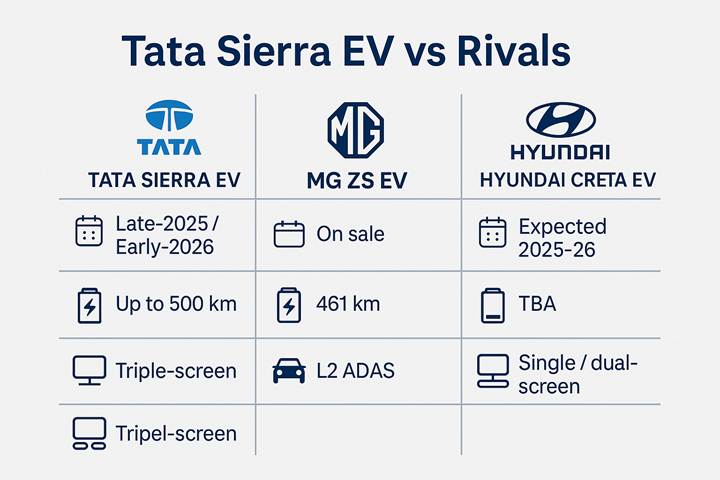
Tata Sierra vs Rivals (EV & ICE)
These are like-for-like, indicative comparisons to help you position Sierra in your head.
| Item | Tata Sierra EV (exp.) | MG ZS EV | Hyundai Creta EV (upcoming) | Tata Harrier EV |
| Launch window | Late-2025 / Early-2026 (EV first) | On sale | Expected 2025–26 | On sale (2025) |
| Range (claimed) | Up to ~500 km (exp.) | 461 km (ARAI, latest gen) | TBA | TBA |
| Screens | Triple-screen (exp.) | Dual | Single/dual (exp.) | Dual |
| ADAS | L2 expected | L2 (select trims) | Expected | L2 |
| Est. price | ₹20–25L (exp.) | ~₹22–28L | TBA | ~₹25L+ |
(Competitor details are summarized from current/announced products; Sierra specifics are “expected” until official spec sheets are out.) (Autocar India [1])
Pros & Cons (Honest view)
Pros
- Iconic design, modern execution—fresh yet familiar.
- Tech-rich cabin: triple-screen, connected features, ADAS (expected). (NDTV [3])
- Powertrain choice: EV for city + clean mobility; diesel for highway; turbo-petrol for balance.
Cons (to keep in mind)
- Timelines not crystal-clear (reports vary late-2025 vs Jan-2026). (Autocar India [1])
- EV fast-charging infra still uneven beyond metros. (General market reality)
- Pricing risk: Tech and brand positioning may push upper variants into Harrier/Compass territory.
Who should consider the Sierra?
- You want an EV with character and a premium cabin, but don’t want a huge SUV.
- You tour a lot? Pick the diesel (torque + range).
- You want quick city performance and don’t clock crazy highway miles? Turbo-petrol makes sense.
- You value screens/ADAS/connectivity and like the Sierra legacy story.
What makes it special?
- It’s not just “another SUV.” It’s Tata’s design flagship for the mass-premium space, mixing heritage with modern UI/UX (three screens, ADAS, connected tech). That blend—plus EV-first strategy—makes Sierra feel future-ready without losing its identity. (Autocar India [1])
FAQs
Q1. Is the Tata Sierra confirmed as an EV and ICE?
Yes—EV first, ICE later has been consistently reported by multiple outlets and backed by Tata’s EV-first showcase strategy.
Q2. When exactly is the launch?
Expect late-2025 to early-2026 for the EV; ICE to follow. Final dates and prices will be announced by Tata. (Autocar India [1])
Q3. What are the engine options for the ICE Sierra?
Expected 1.5-litre TGDi turbo-petrol and a 2.0-litre turbo-diesel with manual and automatic gearboxes.
Q4. What’s the EV’s battery size and range?
Reports suggest ~65–75 kWh packs with up to ~500 km claimed range, depending on variant. Exact specs are pending.
Q5. Does it really have three screens?
Yes—driver cluster + center infotainment + passenger display have been spied and reported by reputable outlets. (Autocar India [6])
Q6. Will it get ADAS?
Level-2 ADAS is expected on higher variants (final feature list at launch).
Conclusion
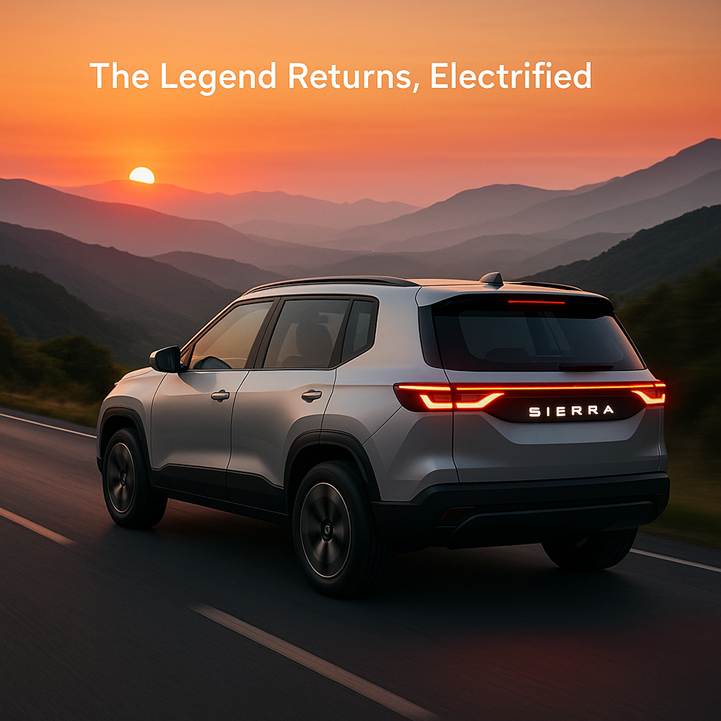
The Sierra’s comeback isn’t just nostalgia—it’s Tata showing maturity in design, tech, and powertrain choice. If Tata nails quality, pricing, and charging support, the Sierra EV can be the “want” car in its class, and the ICE versions will attract buyers who still prefer fuel pumps over plugs. Watch for the official price and exact specs; those two will decide how far the Sierra goes.


